James Spooner grew up as a punk rocker with a mohawk. But as a mixed-race kid, he didn’t always feel like he belonged. Then, he found Afro-punk — and pushed it into the spotlight.
Guest
James Spooner, author and illustrator. His latest book is It Starts with Anger: A Punk Beginning. An AFROPUNK Ending. Founder of the AFROPUNK festival. Filmmaker behind the 2003 documentary “Afro-Punk.”
The version of our broadcast available at the top of this page and via podcast apps is a condensed version of the full show. You can listen to the full, unedited broadcast here:
Transcript
Part I
AMORY SIVERTSON: On October 6, 1990, a punk band called Futile Effort played an all-ages show in Victorville, California. It was at a converted pool hall perfectly named the Rack’N’Roll.
(SOUND OF GUITAR FEEDBACK)
In a grainy videotape of the show uploaded to YouTube, dozens of teenagers mill around the room. Some are wearing plaid or ripped jeans. A few have leather jackets. Up top? Mohawks. A sign duct-taped to a metal pole in the middle of the room reads, “Slam at own risk!!,” with two exclamation points. A handful of kids periodically try to get a mosh pit going.
One of the kids there was 14-year-old James Spooner, a biracial kid from a very white desert town. And this was James’ first real punk show.
(SOUND FROM VIDEO)
JAMES SPOONER: B.S. Spooner, bass player from Filth and Fury.
UNIDENTIFIED KID: Yeah, we’re the band Filth and Fury. We’ll be playing songs later.
CAMERA PERSON: Who are you guys’ influences?
UNIDENTIFIED KID: Huh?
CAMERA PERSON: Who are you influenced by?
UNIDENTIFIED KID: By the Sex Pistols, (BLEEP) Misfits.
SIVERTSON: B.S. Spooner, James introduces himself as there, trying on a new punk identity. And James writes about this show and many other formative musical experiences in his new graphic memoir, It Starts With Anger: A Punk Beginning, An Afro-Punk Ending.
James Spooner is an author and illustrator. He’s also the filmmaker behind the 2003 documentary Afro-Punk, and co-founder of the festival of the same name.
James Spooner, welcome to On Point.
JAMES SPOONER: Thank you so much for having me.
SIVERTSON: So you admit at the very beginning of this book that you had a Futile Effort poster in your bedroom before you had even really heard Futile Effort’s music. Uh, James, I think in punk terminology, that’s called being a poser. (LAUGHS)
SPOONER: (LAUGHS) Thank you for calling me out on —
SIVERTSON: You called yourself out! (LAUGHS)
SPOONER: I do. Yeah. Yeah, I mean, I think it’s important for, you know, whenever we’re talking about punk rock to define what punk is so that we’re all kind of on the same page.
And, you know, what I was trying to do with that passage in the book was just make it kinda clear that, yes, a kid who is sticking — is wearing a shirt of a band that they don’t know, you know, it’s cute, and we understand in retrospect that everyone is searching for identity, but there is something about authenticity that’s important in punk rock.
There is something about authenticity that’s important in punk rock.
SIVERTSON: Mm-hmm.
SPOONER: And, you know, at 14 years old, sticking this flyer on my wall when I hadn’t heard the band, that was not authentic. You know?
SIVERTSON: (LAUGHS) So what is the understanding of punk that you want us all to start from here?
SPOONER: You know, I’ve thought long and hard about how to define punk and what all punk essentially has in common. And it’s really this desire to, you know, quote-unquote, “Keep it real,” to be authentic, and to not sell out.
And the conversation about what selling out is a deeper one, it’s a nuanced one, and it’s one that is explored in my book because there were all of these moments where I was posed with the possibility of selling out, and at times, you know, jumped on that opportunity. And the book explores what the ramifications of that were.
SIVERTSON: Mm. Yeah, so there’s a lot there, and we will get to all of it. But I want to stick with your beginnings here. Because you came to punk rock honestly. You know, as we said, you found punk as a biracial kid living in a very white desert town in California. So if “it starts with anger,” as your book title suggests, what were you angry about then?
SPOONER: Yeah, that’s a great question. You know, I was 13. I lived in a very small town called Apple Valley that is two hours from L.A., two hours from Vegas, and really just in the middle of nowhere. And there was, you know, a lack of culture, nothing really to do. There weren’t a lot of Black folks there. I’m, you know, being raised by my single white mom. I’m a new kid in town. Puberty. I mean, the list goes on, you know? So it’s like —
SIVERTSON: What were you not angry about? (LAUGHS)
SPOONER: Yeah. I mean, it’s definitely one of those scenarios where it’s like a perfect storm for punk to take hold.
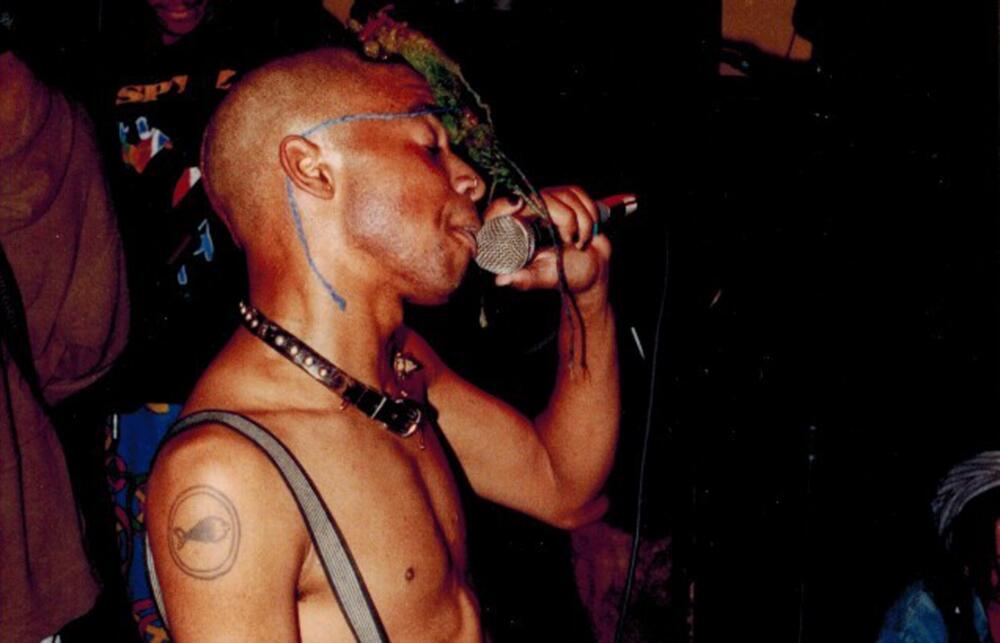
James Spooner is seen in his younger punk days. (Dan Soupene)
SIVERTSON: Mm. So what did this music offer you at that time? How did it help you deal with that sort of teenage anger and angst?
SPOONER: Well, if you go back to 1989 and you see what is, you know, pop music or, you know, just what was on MTV, we’re dealing with, you know, Paula Abdul. We’re dealing with New Kids on the Block, we’re dealing with MC Hammer. And that stuff really didn’t appeal to me. It didn’t speak to me. But when I heard Keith Morris from Black Flag sing the words, or scream the words, “I don’t care,” yeah, like, that’s how I felt. You know?
SIVERTSON: Mm. Okay, well, this wouldn’t be a punk show if we didn’t listen to some music. So let’s hear the song Attitude by Bad Brains, who’s widely known as the first all-Black punk band.
(“ATTITUDE” BY BAD BRAINS PLAYS)
SIVERTSON: So you write about the ways that this song in particular helped you as a sort of misfit teenager who was, you know, wearing plaid and had a mohawk. What did having that attitude mean to you?
SPOONER: Well, you know, I think that’s an apt song to start with because the lyrics, you can hear, despite the screaming, you can clearly hear him saying, “Don’t care what you may say, I got that attitude,” and it’s — that is exactly what an angry 13-year-old needs as a soundtrack.
SIVERTSON: Mm. Yeah, and it would be easy, or you can imagine that it would be easy given the fact that you’re a Black kid in a very white town, you’re leaning into the punk aesthetic, which kind of, you know, it can put a target on your back to people who think that that is a strange way to dress or move through the world. And yet you have this song that is helping you maybe lean into that, rather than be dragged down by the attitudes of your peers.
Lead Singer H.R. (Human Rights) of the seminal Punk band Bad Brains performs live at the Roseland Ballroom on June 213, 1993 in New York City, New York. (David Corio/Getty Images)
SPOONER: Yeah, I mean, one of the memorable cels in my previous book, The High Desert, and, you know, a moment from my life, was that on a regular basis, people would be — I’d be walking down the street, and they would drive by, roll down the window, and scream the N-word at me.
SIVERTSON: Mm.
SPOONER: You know, this was just, like, par for the course. And when I put on that punk gear, half the time they wouldn’t say that. They would say, “Freak.” They would say, you know, the other F slur. Like, they would — you know, I felt like, at least subconsciously, I felt like I had some control over what they were going to target me for. Does that make sense?
SIVERTSON: It does, yeah. And, you know, another thing that you started to hint at is that punk is — some people, the uninitiated might say, like, “Oh, it’s just a genre of music,” or, “It’s an aesthetic: plaid, leather, mohawks,” but really, it’s a whole ethos. So tell us about the punk ethos as you see it and really when it started to become an essential part of what being punk meant to you.
SPOONER: Yeah, I appreciate that question because I do think that the mainstream sees punk as kind of silly. It’s just like the Sex Pistols and like, you know, moshing or whatever. It’s all the aesthetic that is easily boiled down and made into something that is commercial and commodifiable. But in reality, there are like strong politics. These kids who are young and angsty or whatever usually come out of that, you know, again, it’s like it starts with anger, but it goes in other places.
And when I think about my friends who grew up in that scene, who are all now in their — adults in their 40s and 50s, these people are talented artists who are, you know, working in prisons, who are writing books, who are — I mean, Mo Mitchell, who is a protagonist in my film, Afro-Punk, is the national director of the Working Families Party. Like that — those politics that he holds came directly out of his experiences in the punk scene.
So there is an actual, viable threat that punk can create. And all of the silliness that, you know, it’s packaged in, that’s the thing that I want to talk about. That’s the thing that feels like — I don’t know. The commercial aspects or the things — that’s the stuff that people wanna sell, but that’s not the stuff that actually real punk rockers and hardcore kids take with them into adulthood.
SIVERTSON: Mm. We’re listening to another song right now that speaks to some of the political themes that you were talking about. This is “Red, White and You” by the band Struggle from their 1992 EP. We’ll let that take us into the break.
(“RED, WHITE AND YOU” BY STRUGGLE PLAYS)
Part II
SIVERTSON: James, we have mentioned a couple times a documentary that you made back in 2003 about the Black punk scene and the Black punk experience called Afro-Punk, and I wanna play a clip from that documentary. This is a montage of people talking about something I know you can also relate to. Let’s listen.
(CLIP FROM “AFRO-PUNK” DOCUMENTARY)
INTERVIEWEE 1: When I first started going to shows and, like, I was the only African American kid there, it was kinda weird. Like, I felt out of place and, like, I didn’t really know, like, who to talk to and where to stand and, like, if I should be here.
INTERVIEWEE 2: I would feel like everyone turns around, “Look at the Black girl coming in.”
INTERVIEWEE 3: Usually I’m the only Black person.
INTERVIEWEE 4: Yeah, I was, like, the only Black person there.
INTERVIEWEE 5: I think I’m the only one that I know of.
INTERVIEWEE 6: There’s 300 white kids and two Black kids. You’re just like, “Damn.” (LAUGHS)
SIVERTSON: So James, what was it like going to shows as a young Black teen, particularly your earliest shows when you’re still living in a mostly white small town in California?
SPOONER: Being, you know, the only one is something that I thought was very unique to this punk experience, something that while making the film I focused, you know, a significant amount of attention on. And it was difficult to fully express myself when an essential part of my being, my Blackness, was like I felt like I needed to minimize it in order to make my white friends feel comfortable.
SIVERTSON: Mm.
SPOONER: But something that was really telling to me after I started showing the documentary around was how many Black folks who weren’t in the punk scene related to that. I had people standing in line to talk to me after the screening and would say like, “Oh, you know, I’m the only Black person at my climbing gym. I went to school on a lacrosse scholarship, and people make fun of me for that. Like, I’m the only Black person who works at my bank.” You know? And that experience of being the only one is something that is pervasive within all of American culture.
And then on the flip side, I’ve heard people say, in the same way that people would say like, “Punk is some white people stuff,” like, “That’s not what Black people do.” I’ve heard people say, you know, that about gardening. You know?
SIVERTSON: (LAUGHS)
I’ve heard people say … “Punk is some white people stuff. That’s not what Black people do.”
SPOONER: I’ve heard people say that about, like, ridiculous things. I’ve heard people say that about like, you know, reading. And it’s just like, you know, I have a friend who, he’s a botanist in D.C. who’s Black, and I just think like, man, what a sad world we would live in if Black people weren’t allowed to garden, you know? But that is a unfortunate part of a lot of our experience, you know?
SIVERTSON: Yeah. And it’s, you know, it seems to me that part of the punk experience is community, and at its best, the experience of going to a show for a band that you and everyone else in the room loves is this feeling of, “These are my people.”
But you write about moments at shows where it was very clear that these were not in fact your people in many ways. There are people wearing swastikas at the shows. There are displays of misogyny and homophobia. So how were you able to carve out any sort of safe space or forge a sense of belonging and community for yourself?
SPOONER: Yeah. I don’t wanna paint the picture for the audience that the average punk show you’re gonna see a kid wearing a swastika. Like, that is not true.
SIVERTSON: Mm-hmm.
SPOONER: Especially when you live in a big city like New York or Los Angeles or whatever. Like, in the ’90s I did, in New York City, I did hear homophobia, I did hear sexism. There were instances where, in retrospect, I was like, “Oh, that was not a cool place for my white friends to put me in.” You know?
One of the examples I give in the book was hanging out with a bunch of SHARP skinheads, Skinheads Against Racial Prejudice, and their whole agenda was to beat up white supremacists, you know? So that sounds like, all right, you’re on the right side, you know? But then I realized that there were times where they were using me as bait to lure the white supremacists so then they can go and beat them up, you know?
SIVERTSON: Mm.
SPOONER: And that’s not a cool place for a supposed anti-racist to put their Black friend in, you know?
SIVERTSON: Yeah.
SPOONER: So that makes sense why I didn’t wanna stick around that part of the scene. And the first half of the book I’m kind of, like, Goldilocks-ing my way through the punk scene looking for a space that feels safe and feels right for me. And there were moments where I found feminist scenes or scenes where, you know, everyone is vegan, and we had radical politics and whatnot, but the conversation around race wasn’t very nuanced.
SIVERTSON: Hmm.
SPOONER: And that’s when I kind of realized that ultimately I’m gonna need to have to make my own scene.
SIVERTSON: You mentioned New York, and you moved to New York with your mom when you were 15, and it was very different from small-town California. You went to a performing arts high school. And you include this anecdote about a Black classmate in your sculpture class named Suzanne who sort of helps herself to your headphones, we’ll say, one day when you’re listening to this particular song by the band Minor Threat, who I should say is all white. So let’s listen to that.
(“GUILTY OF BEING WHITE” BY MINOR THREAT PLAYS)
SIVERTSON: So the lyrics are a little hard to understand there, but he’s saying, “You blame me for slavery 100 years before I was born. Guilty of being white.” He says, “I’m sorry for something that I didn’t do.”
And Suzanne, your classmate, was taken aback by these lyrics, as were you when you heard them for the first time. So can you tell that story of trying to explain this song to Suzanne and also how you think about these lyrics today?
SPOONER: Yeah, this song and this band and the singer, Ian MacKaye, really are foundational to the kind of punk that I’m talking about. He’s the architect of the do-it-yourself movement in punk and is categorically not racist. But this song was written in 1981, and he was 19 and, you know, didn’t have a very nuanced view of how this song would land on Black listeners.
You know, years later, when I’m listening to this song and confronted by my Black classmate about what the lyrics mean, I didn’t exactly know how to answer. I, you know, I was, again, I was 15 years old, and when she asked me, “Who is ‘you’?” You know, “‘You’ blame me for slavery,” like who is ‘you?’ I didn’t know, actually. I was like, “Who is ‘you?'” You know? And she made it clear that her interpretation was that “you” was all Black people. And in retrospect, I can absolutely see how she saw it that way.
And I mean, I’ve had conversations with Ian MacKaye about this, and I know that wasn’t his intention, but this song is forever in the archive in an otherwise perfect catalog. This is a song that every Minor Threat fan has to contend with.
SIVERTSON: Mm. So when was the first time that you saw a Black punk band play, or a punk band fronted by a Black singer? And how is that different than going to a show for an all-white punk band?
SPOONER: Yeah, when I moved to New York, my first kind of local show was at, it was this place called Pool Bar, and I have a, a chapter that is kind of centered around this moment. There was a band called Bushmon fronted by my friend Ryan Bland, who is Black. The band was all Black. They had a lot of Black friends, so the audience was very Black, and it was the first time that I got to experience punk, you know, essentially in a Black space. And it was just a breath of fresh air, you know?
For the first time, it felt like being Black in the punk scene was an asset. Everyone on stage was definitely cooler than everyone in the crowd, and me and the Black people in the crowd definitely felt like we were more like them than the white people in the crowd. Just being a 15-year-old, seeing somebody that I could look up to who was speaking about things that were closer to my own experience, I mean, ultimately we all want representation, and to experience that was, you know, it was huge.
For the first time, it felt like being Black in the punk scene was an asset.
SIVERTSON: Hmm. So let’s talk more about Black punk bands and Black-fronted punk bands, and specifically your documentary Afro-Punk. You were in your twenties when you made this, which is kind of incredible. And is it fair to say that you were having a bit of an identity crisis leading up to making this documentary?
SPOONER: Absolutely. I mean, the title of the book, It Starts With Anger, connects with so many moments because there was a lot of anger and there were a lot of projects, a lot of ideas, things that came out of that anger.
In my early twenties, when I was like, 23-ish, this was around the year 2000, I started reflecting on my experience as a Black punk, and I was angry. You know, in, in so many ways the punk rock scene raised me. And just like anybody who raises a punk, eventually they’re going to react. They’re going to want to, like, rebel or defy them, you know?
And for me, just in that moment, I really wanted to show the, the punk scene what they’ve done, you know? The punk scene really sees itself as being very political, being just really on point in so many ways, and that was obviously not the complete story. And I wanted to show them the complete story by just interviewing other Black punks and us all just talking about the experience of being a Black person in the scene, you know?
And it wasn’t just an attack on punks or punk rock. It was, I feel like, a pretty well-rounded conversation. But specifically when it comes to punk, I felt like — This is my community. I feel like I can change it. I feel like punks can take it, you know? So I wanted to start that conversation.
SIVERTSON: Yeah. I mean, you interview, what is it, like, 80 people in the documentary to hear their experiences? And a point in the book that was really powerful for me is hearing your father’s reaction to the documentary.
And, you know, I know that this is a big topic in the sense that a theme in the book is your own sense of what it means to be Black and what the quote-unquote, “right and wrong way to be Black,” and the messages that you’re receiving from other Black people about your own Blackness and messages that you got from your father sort of about that, who is from Saint Lucia. And can you just tell the story of his reaction to seeing this documentary?
SPOONER: I did a screening just for a bunch of people who were in the movie. It was kind of just, you know, one of my first screenings to just see how it played in front of an audience, you know? And my dad was there.
And afterwards I was taking questions and he stood up and, you know, told some funny stories from my childhood that were kind of embarrassing or whatever, and then just said, like, “I wish I would’ve seen this movie when you were a kid,” you know? Like, “I’m realizing for the first time that you weren’t trying to be white and that you’re actually, you were having a Black experience. It’s just not one I was familiar with.”
SIVERTSON: Mm. Well, there’s so many great things about the documentary. And we’re getting to another break here, but I do want to mention one of the women featured in the documentary, and that’s Tamar-kali Brown, and I wanna hear a little bit of her song “Boot.” Let’s listen.
(“BOOT” BY TAMAR-KALI PLAYS)
SIVERTSON: Okay, so I had to hear a little bit of Tamar-kali because she is incredible, number one. But also you write about the importance of feminism on your own politics and the influence of, you know, Riot Grrrl, the feminist punk movement, and bands like Bikini Kill, the influence that had on you, and specifically Kathleen Hanna of Bikini Kill’s mantra of “girls to the front.” You know, basically men get out of the way, girls to the front.
What impact did this mentality have on you and how you thought about your own place in the punk community?
SPOONER: Yeah, when I first heard Riot Grrrl and I first encountered Bikini Kill or Heavens to Betsy and these kinds of bands, it was kind of the first time that I saw a group of marginalized people centering themselves. And it wasn’t hard for me to do the translation for my own experience.
So when it came time to make the Afro-Punk film, to start showing it, to start having shows around the Afro-Punk experience, I pulled directly from Riot Grrrl in that concept of centering Black punks, you know? And I went out of my way to build a space where Black people would feel comfortable listening to rock and roll, you know? I can credit a lot to the example of the Riot Grrrls from a decade before I started doing this Black punk thing.
I went out of my way to build a space where Black people would feel comfortable listening to rock and roll.
SIVERTSON: Mm-hmm. And so you’re trying to say, like, “Black people to the front now.” You know, “Women to the front, Black people to the front.”
SPOONER: Yeah. I mean, you know, we didn’t really have to say those words because the thing that I was trying to do when I first built — when I first started doing Afro-punk shows was I went out of my way to invite Black people to the shows. So those early Afro-punk shows were largely Black, you know? So I think there wasn’t a need to say, you know, “Black people to the front,” because there were already Black people in the front, you know?
SIVERTSON: Mm-hmm.
SPOONER: But it was an amazing experience, something I can imagine that many of those Riot Grrrls felt, where it was like, “Oh, we have, you know, an all-Black mosh pit,” you know? That probably felt for people the same as the first time they were in a all-girl mosh pit, you know?
SIVERTSON: Mm. We have to take another quick break. And let’s go into the break with another band fronted by a woman. This is “Straight Jackers” from the band Stiffed.
(“STRAIGHT JACKERS” BY STIFFED PLAYS)
Part III
SIVERTSON: James, we’ve talked about the documentary Afro-Punk. You’ve started to mention these sort of Afro-Punk shows that you were putting together, which, which ultimately turns into the Afro-Punk Festival that you co-founded. This got going just a year basically after the documentary was released. How did it take shape?
SPOONER: Yeah. So I met this guy named Matthew Morgan, and he was more of a music manager guy and he had a lot of good ideas. And the two of us together started doing small events at this bar in New York called The Delancey. And basically, we would show the film — at that time, people were coming in droves, so there was always a good 100 people right off the top — and then we’d have three bands play, all Black-fronted. And it started to, you know, like a scene started to build up.
I was posting these photos from the shows on my website. I had a pretty active message board. And the kids on the message board, who are from all over the country, wanted to meet each other. So, you know, all the stars aligned, and we decided to basically do a Fourth of July weekend meetup. I had connected with the Brooklyn Academy of Music, who had a really successful Afro-Punk screening, and they suggested that we do like a Afro-Punk weekend where we show Black liberation films and anchor the whole thing with my documentary.
So we ultimately had the four days of screenings. We had three nights of concerts and a picnic. And that was basically what Afro-Punk Fest, how it started, and that’s what it was for a good three years.
SIVERTON: Mm. Did you have visions, though, of this becoming a big event? Or were you imagining a smaller, more underground existence for the festival?
SPOONER: Well, I mean, it’s — capitalism is interesting because it makes it so that you’re never quite happy, you know?
SIVERTSON: (LAUGHS)
SPOONER: There’s always something bigger. There’s always something better, right? You know, there’s more that you want, right? I knew we had something special. I also knew that there were hundreds and thousands of kids who hadn’t heard about it yet, hadn’t come yet. You know, like, we had a, a community that finally felt seen and held and, you know, we wanted more people, right?
Around the fourth festival, that’s when we started getting interest from corporate sponsors. And what that felt like to me was, you know, “Hey, we’re Mountain Dew. We’ll give you free soda and $80,000, and then you can do the festival for free, and it can be all ages, and it can be outdoors, and we can build a skate park,” you know?
SIVERTSON: Mm.
SPOONER: And that all sounded like upsides to me. Like, I could care less about Mountain Dew in particular, but if the only compromise is that they have free soda available for whoever comes, it’s like, what’s the downside here, you know?
SIVERTSON: Yeah.
SPOONER: And it was only through doing — like, when you have a sponsor, all of a sudden the 150 to 300 people who are coming to your show isn’t enough. You need more eyeballs to make your sponsors happy.
SIVERTSON: Huh.
SPOONER: So then it was like, “Okay, now we have to get 1,000 people. Well, how do we do that?” And that’s where the compromises start happening.
SIVERTSON: Okay. So the compromises, including compromises around the music that is at the festival. And as the festival expands, so did the genre of musical acts that started appearing at them, and there’s more hip hop and R&B. What were you feeling at the time as this became, musically speaking, less and less punk?
SPOONER: Yeah, I mean, it was — it’s interesting. You know, the thing about selling out is that it doesn’t usually happen overnight, you know? There are little choices that are made throughout, you know?
And we had — there was a band called Game Rebellion that was a — they were, like, a live hip-hop group that leaned into rock and roll more. They were a little kind of metal with a rapper. And they were very popular in New York, and they played Afro-Punk shows quite a bit, you know? So when this festival where we were, like, trying to get, uh, thousands of people to come came up, my partner was like, “Well, let’s just do a day of live hip-hop,” you know? Which ended up, like, somehow turning into multiple days of live hip-hop.
And these bands, like, didn’t make any sense. They weren’t necessarily part of the scene, and they definitely didn’t hold any of the values that I was trying to promote within Afro-Punk.
A view of the general atmopshere during the 12th Annual Afropunk Brooklyn Festival at Commodore Barry Park on August 27, 2016 in New York. (Mireya Acierto/WireImage)
SIVERTSON: Yeah. And when you say the values, I mean, there’s a story in the book of you getting up on stage at one point after a song is performed. Why is that? What were you, what were you hearing and seeing that made you go, “This is not what I had in mind?”
SPOONER: Yeah, this is a wild story. So there was a band that, at the end of their set, they did, like, a medley of dancehall hits, and one of those songs was “Boom Bye Bye” by this artist, Buju Banton. That song is about violently killing gay people.
And I’m sitting there in the crowd — well, first of all, like Buju Banton got so much backlash for this song that he actually stopped playing it in 2007. So now we’re in 2008, and somebody’s playing it on the Afro-Punk stage. Like, it was mind-blowing to me. So I’m sitting there, I’m standing with, like, my two lesbian friends, looking at, you know, all the s- the volunteers who, you know, have their badges swinging around their neck, and most of them are queer.
And I’m like, “What is this? Like, how is this happening?” You know? So it was one of those kind of, like, seeing red moments where I just, like, acted. And I just went on stage and I told the band and the audience that this is not what Afro-Punk is supposed to be about. You know? This is not what punk rock is about. And if it wasn’t for the queer members of our community, we wouldn’t even have a community, you know?
SIVERTSON: Mm.
I just went on stage and I told the band and the audience that this is not what Afro-Punk is supposed to be about. This is not what punk rock is about.
SPOONER: So it wasn’t really a brave moment because I knew who my audience was, you know? But it definitely was a turning point for me, where I realized, I didn’t book this band. I don’t even know who this band is, and this has fully gotten out of control.
SIVERTSON: Mm.
SPOONER: You know?
SIVERTSON: Yeah. And so this festival in 2008, which, you know, you refer to it in the book as Mountain Dew Fest because you have Mountain Dew as a sponsor. You have Toyota as a sponsor that has a car there with a picture of your face on it. This was your last Afropunk Festival, your last one being affiliated with the fest.
SPOONER: Mm-hmm.
SIVERTSON: And, you know, you ask the question in the book of whether you had created a safe space for Black people as you were intending to do, or whether you just created a brand. How do you answer that for yourself?
SPOONER: I mean, ultimately, it’s both, you know? In the moment, we were abandoning our community for our sponsorship opportunities, and that was crystal clear to me. It didn’t necessarily have to feel that way to everyone who was in the space. We don’t always know when we’re being sold something.
But seeing how, you know, the biscuits are made or whatever, I was definitely like, “Oh, we’re making choices here, and each one of these choices is compromising our community in order to sell them things.” You know?
SIVERTSON: Hmm.
SPOONER: So, you know, but when I look at the long arc of history, Afro-Punk became this global brand. It became — it’s undeniable that culture shifted because of the Afro-Punk Fest and the Afro-Punk brand.
You know, Black Panther looks the way it does because of the inspiration that they got from the people who go to Afro-Punk. You know, we have Spider-Punk, who is a Black — you know, he probably wouldn’t have been Black if Afropunk didn’t exist, you know? Like, these things, there is more representation, but again, it’s like at what cost, you know?
SIVERTSON: Mm-hmm.
SPOONER: And the cost was that the kids who this festival and this brand were built on were slowly pushed out, you know? By 2010, many of the kids who were the original people going to these concerts felt like they weren’t cool enough to be there.
SIVERTSON: Hm.
SPOONER: And, you know, the fest went on for a couple decades.
And over the years, people, kids were growing up with this idea of Afropunk. You know, they could live wherever they lived, and, you know, there was this fantasy of this space where, like, you know, 70,000 Black weirdos get together and listen to rock and roll and whatever. And then they would get there and be like, “Oh, this is like an R&B fest with, like, costumes,” you know? A lot of people, you know, kind of disparagingly call it, like, “Afrochella” or something like that.
And it’s like Afro-Punk has value, but it doesn’t have punk values, you know? It’s really important to know the difference, and the punks who were going could see the difference. And so they would go back home and start their own thing. And that’s where the community comes back in, you know?
So, you know, to get back to your question of like, is it a brand or a safe space or community, it’s like, yeah, well, Afro-Punk is a brand, but like the mainstream is one thing and the underground is another thing. And the underground is often reacting to what’s happening in the mainstream.
So when I see all of the POC punk festivals that are happening all over the country and parts of Europe, I’ve talked to these organizers and many of them — all of them, actually — credit their inspiration for them, it started with anger at Afro-Punk, you know?
SIVERTSON: (LAUGHS)
SPOONER: (LAUGHS) And then they created their own thing, which is so beautiful to me. It’s — like they’re doing stuff that’s way cooler than what we were doing.
SIVERTSON: Yeah, it’s — I mean, I love this idea that you create Afro-Punk. Afro-Punk becomes this whole other, you know, beast of a thing that is — it’s a multimillion-dollar event in six different countries. It is not punk by your standards anymore. And yet because it’s not punk, the quote-unquote “real punks” then create something that is maybe even more punk than you would have foreseen.
SPOONER: Yeah, it’s — you know, there’s this idea of do it yourself, and the thing that it takes a while to learn is that like do it yourself doesn’t mean doing it by yourself.
And all of these Black and brown fests that are happening around the country, you know, there’s Break Free Fest in Philly, there’s Xingonas in the Pit in San Antonio, there’s Decolonise Fest in London. Like, all of these fests happened autonomously, you know? But they started to catch wind of each other, and they’re, you know, supporting each other in whatever ways they can. And this is the stuff that I needed. And if it existed, I wouldn’t have needed to make Afro-Punk in the first place, you know?
So it’s a beautiful thing to stand back and be like, “Oh, I set this thing into motion that was so mainstream that it caused the underground to say like, ‘F that,’ and like do their own thing.”
SIVERTSON: Mm. You are 50 years old now. Is that right?
SPOONER: I am.
SIVERTSON: And you have two daughters, one of whom I hear is into punk?
SPOONER: Yeah, I mean, my older daughter is 17. She definitely goes to shows. She’s definitely into a lot of the same stuff I’m into. She turns me on to bands that are happening now and keeps me kind of current.
My younger daughter is 12, and she’s just kind of dipping her toes in, you know? And it was very cute. She doesn’t live with me, and she came to visit, and she’s like, you know, “Dad, like I’m kind of getting into alternative. Like, I like the Yeah Yeah Yeahs,” whatever, you know? And then I took her to the mall, and we went to Hot Topic, and she was just like, “Oh my God, like this is so cool,” you know? She was like nervous to go in there, you know? (LAUGHS)
SIVERTSON: (LAUGHS)
SPOONER: And it’s just funny because I think of myself at that age, and like, you know, Hot Topic had just opened. And it’s like there’s so much that we can like kind of — it’s very easy to clown, like that’s clearly like poser stuff or whatever. But like that’s how it starts, you know? You have to find it somewhere.
And hopefully it doesn’t just stay in that silly space that I was talking about at the top of the hour, and it’s more — it’s the gateway into something real, something political, something that can actually change the world.
It’s the gateway into something real, something political, something that can actually change the world.
SIVERTSON: Well, that is a great place to end. James Spooner, his new book is It Starts With Anger: A Punk Beginning. An Afro-Punk Ending. James, congrats on the book, and thank you so much for joining us.
SPOONER: Right on. Thank you.
SIVERTSON: And in honor of your daughter and of women and girls in punk, we’re gonna go out on the song “Plastic” by the band Upchuck.
(“PLASTIC” BY UPCHUCK PLAYS)
The first draft of this transcript was created by Descript, an AI transcription tool. An On Point producer then thoroughly reviewed, corrected, and reformatted the transcript before publication. The use of this AI tool creates the capacity to provide these transcripts.