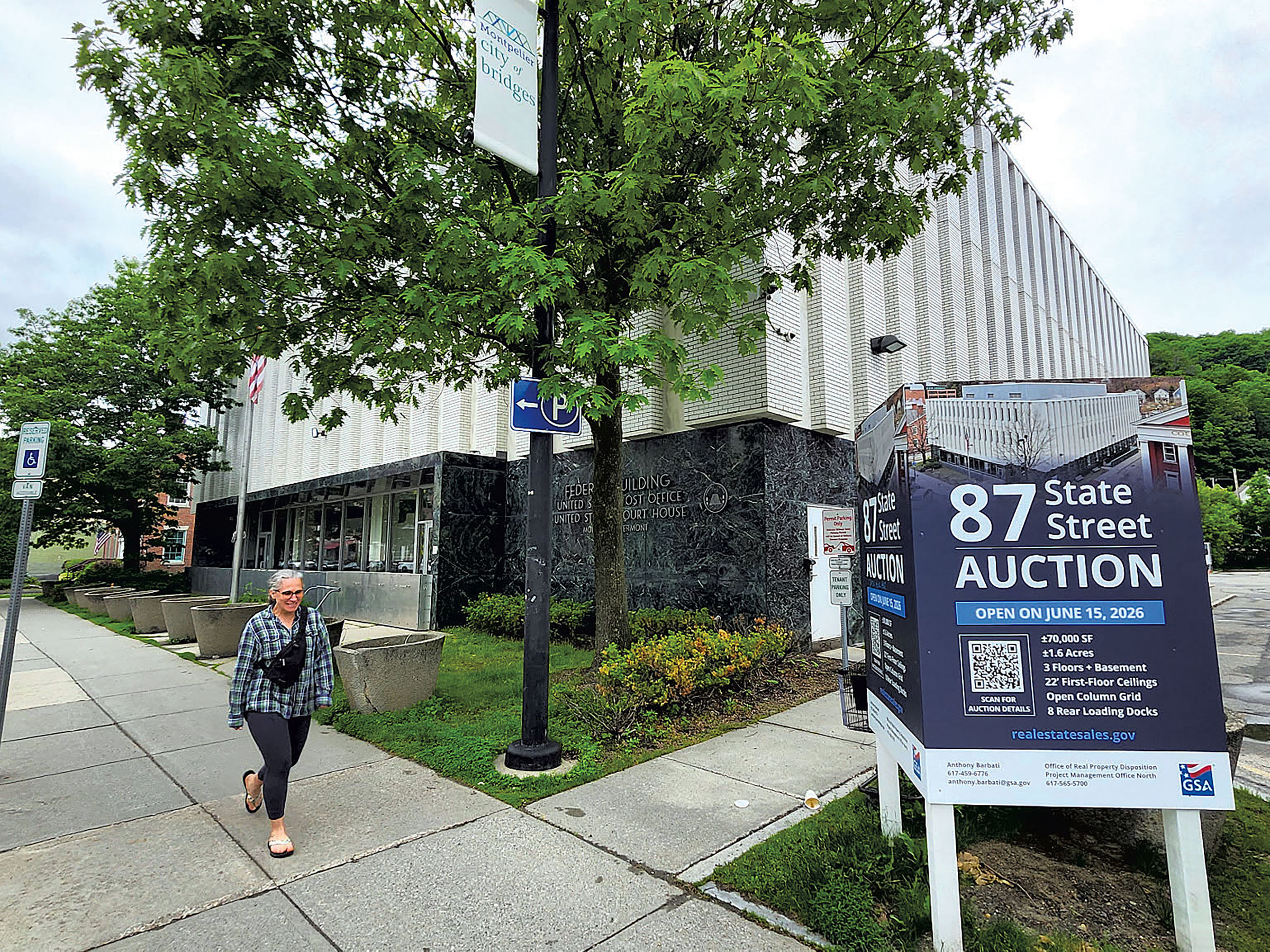
For more than half a century, the federal building at 87 State Street in Montpelier has occupied one of the most prominent perches in Vermont’s Capital City.
The hulking, three-story granite structure sits just blocks from both the Statehouse and Main Street, anchoring downtown Montpelier with roughly 70,000 square feet of office space and a sprawling rear parking lot. Generations of Vermonters passed through the post office that occupied the first floor. The building once embodied the federal government’s presence in and connection to the Green Mountain State.
Today, the historic, 62-year-old structure is vacant.
Nearly three years after catastrophic flooding inundated downtown Montpelier, the U.S. General Services Administration is preparing to auction off the property as part of a broader effort to reduce its real estate holdings. Bidding will open at $500,000 on Monday, June 15. The auction will run through August 5.
For some, however, the sale is about far more than unloading an aging federal asset. The property represents one of the largest redevelopment opportunities in downtown Montpelier — a chance to restore a landmark building, add desperately needed housing and redefine a flood-susceptible district.
But as the auction approaches, local officials, advocates and environmental consultants say prospective buyers are being asked to make multimillion-dollar decisions without enough information about the extent of environmental risks from polychlorinated biphenyls, or PCBs, asbestos, mold and floodwaters. Absent a fuller understanding of those risks, they say, it’s impossible to estimate what redevelopment might ultimately cost.
“It’s an incredible opportunity to build new flood-resilient housing that could be the economic engine of the downtown,” said Ben Doyle, a Montpelier city councilor and president of Preservation Trust of Vermont. “Or, conversely, we could have an undercapitalized speculative investor buy this thing at auction and then sit on it for the next 20 years because they have no capacity to actually see it through.”
That uncertainty has prompted a coalition of institutions, businesses and nonprofit organizations to create a local development corporation — a nonprofit entity used in Vermont for coordinating and financing economic development projects — to help shape the property’s future.
The group has not committed to bidding on the building, but it wants to be involved in the process, potentially by bringing in public funding to aid a private developer. Nearly every option is on the table. Those behind the effort know what they don’t want: a costly white elephant that stays vacant in the heart of the Capital City.
When floodwaters swept through downtown Montpelier in July 2023, the federal building was one of many that got inundated. Water filled the basement and rose three and a half feet on the first floor, where the post office was located.
Tenants relocated. The post office closed. For more than 400 days, Vermont’s capital had no post office until a new location opened on Main Street in October 2024. Most federal agencies eventually left town.
And in late 2024, the feds announced plans to let go of the property. State and local groups were given a chance to purchase it before auction. Among those exploring the possibility was Jon Copans, executive director of the Foundation for a Resilient Montpelier, which was created to support community-led initiatives in the Capital City.
The discussions went nowhere.
Rear view of the federal building Credit: Kevin McCallum
According to Copans and Doyle, the federal government wouldn’t budge on its asking price of roughly $2.4 million and would not facilitate the type of environmental assessment they believed was necessary because the property was being sold “as is, where is, with all faults.”
“We felt like we were being asked to make a decision without enough information,” Doyle said.
In September 2025, the local partners arranged a walk-through of the building with a team of consultants, Vermont Commerce Secretary Lindsay Kurrle and groups who might be interested in leasing the space. The feds wouldn’t allow additional testing, but potential buyers brought along an environmental consultant to get an expert look at the building’s condition and materials.
The tour raised some immediate concerns. Doyle learned the building contained asbestos. And the elevator, damaged by the floods, remained broken; a negative air-pressure containment method had been set up to pull air toward the elevator to prevent mold spores from spreading further.
Then the consultant mentioned something unexpected: He’d already been inside the structure years earlier to test the building materials for PCBs. The feds should have a report with the results, he said. When asked, the General Services Administration eventually provided the document.
The 2023 report documented widespread PCB contamination throughout the property, including in the paint, floors and exterior.
“PCBs in building materials are pervasive — in some cases in significant quantities,” the report says. “Future renovation activities will need to plan for presence of PCBs in building materials that will be disturbed.”
The situation still upsets Doyle. He feels like the feds withheld key information that his group only obtained by pure luck.
Despite the contamination, the feds refused to remediate the chemicals or budge on the asking price.
In the months since the first offer fell through, the General Services Administration has listed the building for public auction and gradually posted documents detailing its condition, including reports on asbestos, mold and PCB contamination. The report on PCBs in the building materials, which Copans and Doyle learned about through the consultant, was posted last Friday.
Copans and Doyle have continued working with environmental consultants to review the public information and determine the ultimate cleanup cost.
One expert, Dan Voisin of Stone Environmental, said it’s nearly impossible to determine the actual condition of the building given the limited information that has been made available.
What troubles Voisin most is the unknown extent of the environmental problems. The limited testing data established that contamination exists but not how much or what might be needed to remediate it — particularly the PCBs in the building materials. Although auction documents urge bidders to inspect the property prior to submitting an offer, prospective buyers are not permitted to conduct additional tests.
Meanwhile, marketing materials describe the building to prospective buyers as “de-risked” and “positioned for unlocked value.” The brochure also says, “Environmental documentation is comprehensive and available for buyer review, converting what many buyers assume to be unknowns into underwritten, quantified conditions.”
Copans disagrees.
“There is inherent risk in this purchase, because we cannot understand the full scope of the contamination and the cost of cleanup,” he said.
A GSA spokesperson said the agency determined the property’s value through an appraisal process. The GSA is responsible for protecting taxpayer interests by seeking the building’s fair market value, the spokesperson said.
“We need to understand what’s actually going on in there,” Voisin said. “It’s time to turn on the lights.”
Doyle and Copans have shifted their focus from challenging the federal process to formalizing a local response ahead of the auction.
“Clearly the federal government has demonstrated no one is coming to save us,” Doyle said. “So the best defense is an offense.”
That “offense” took shape officially on June 2, when representatives from 10 major Montpelier institutions formally established a local development corporation focused on the property’s future.
Its board includes representatives from Vermont Mutual Insurance Group, National Life Group, Union Mutual, Central Vermont Medical Center, Downstreet Housing & Community Development, the City of Montpelier, Central Vermont Economic Development Corporation, Central Vermont Regional Planning Commission, Foundation for a Resilient Montpelier and Preservation Trust of Vermont.
The group could serve as a vehicle to help manage liability, secure environmental grants, coordinate redevelopment efforts and obtain financing from the Vermont Economic Development Authority.
Copans said he understands that highlighting the building’s conditions could be viewed as an attempt to scare off other bidders. But he said he’s simply trying to prevent the next owner from ending up surprised — and spare Montpelier the fallout of a failed redevelopment.
Our interests are in putting that property back to work for Montpelier.
Jon Copans
“Our interests are in putting that property back to work for Montpelier,” Copans said. “Whatever pennies they’re going to make on the sale of this property is meaningless when you look at the holistic picture of the federal budget, yet it has a tremendous impact on the future of the city.”
Beth Damon, a Montpelier architect and inn owner, hopes the auction could bring a new look to the block. The current cube-shaped federal building with its narrow upper story windows is “not a very welcoming” structure, she said.
If there were a way to open up the building’s interior, it could make a nice theater space, Damon said, though she acknowledged that the massive concrete support columns and need for flood-proofing could make that a challenge.
“It needs a big renovation to make it purposeful,” she said.
The outcome that worries Copans most is that the building is sold to the wrong buyer: an out-of-state investor who sees an attractive historic property near the Statehouse, wins the auction, and later discovers redevelopment costs are far higher than they care to see through.
Doyle has seen efforts stall in other Vermont towns, such as Newport, where redevelopment efforts froze after buildings were razed. An area known as the “pit” has sat empty for more than a decade under the control of a federal receiver after authorities discovered the property developers were using a Ponzi-like scheme involving the federal EB-5 visa program.
That area, along with the Montpelier building, could benefit from a state program, newly expanded with up to $2 million, intended to help buyers acquire and plan cleanup for federal properties.
“Vermonters deserve — Americans deserve — federal government, state government and municipal governments that are working together in the interests of communities,” Copans said.
But once the auction opens on June 15, the federal government will step back and leave it up to the bidders. ➆
The original print version of this article was headlined “Bid Trouble | The flood-prone federal building in Montpelier is being auctioned off. Some worry potential buyers aren’t getting the full story about its flaws.”
This article appears in June 10 • 2026.