PLAINFIELD — The Zoning Board is asking a company proposing to build a controversial cell tower in town to consider alternative sites in neighboring Lebanon.
Atlantic Tower has applied for permission to construct a 130-foot cell tower on a property off Old Stagecoach Road to address a gap in coverage on Route 120.
The tower would provide increased coverage from near Methodist Hill Road to just South of Croydon Turnpike Road on the Plainfield end, with minimal increased coverage beyond that point.
But the Rural Conservation II zoning district in which the site sits doesn’t allow for cell towers, even with special exceptions.
At a Monday meeting, the Zoning Board discussed concerns that the tower’s coverage won’t provide much service into Plainfield past Croydon Turnpike Road, posing a question of who they’re building it for.
“I haven’t seen even an effort to convince us that there is a public benefit that is greater than violating our ordinance,” said Board member Brad Atwater.
Manchester-based attorney Christopher Swiniarski, who represents Atlantic Tower, has repeated throughout the past few meetings that federal law– specifically the Telecommunications Act of 1996– supersedes local zoning ordinances in favor of cell towers when those ordinances prohibit access to cell service.
The town currently has three other towers, two on Freeman Road, a Rural Conservation I zone, plus one on Beauty Hill Road and one on Colby Hill, both Rural Residential zones. These districts allow for cell towers by special exception.
Members of the Zoning Board asked Monday that the applicant consider two alternative properties, one owned by Cole Partners LLC and the other by Patch Orchards Inc. Both sit off Route 120 in Lebanon, but close enough to the Plainfield town line to address the same coverage gap.
These properties fall in Rural Lands districts that allow for cell towers by special exception in Lebanon.
Eric Cole, a Lebanon city councilor and one of the Cole family property owners, did not respond by deadline to a Wednesday phone message.
“We haven’t heard anything about it,” Barbara Patch, a Patch Farms owner, said Wednesday by phone.
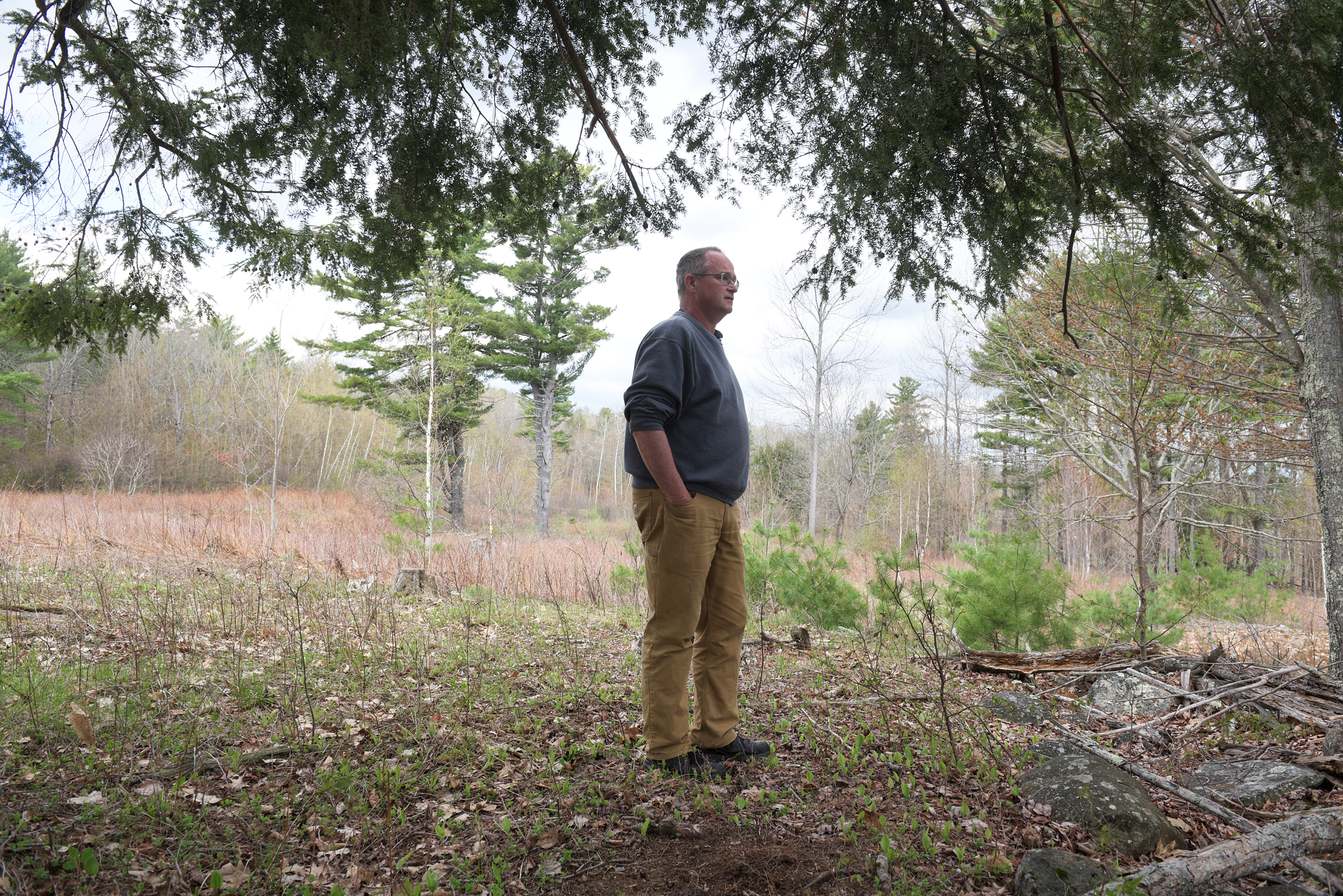
While the Plainfield property owner, Robert Greene, is willing to lease a plot of land to the company, neighbors have pushed back, citing a negative impact on Plainfield’s visual character and natural resources.
In April, the company conducted a balloon test to see where in Plainfield the tower would be visible from and provided photos, which are available on the town website.
“If you’re looking for it, you will spot it, but it’s not really in your face,” said Swiniarski.
Town officials who took their own photos argued that the images provided by the applicant may not reflect the true impact of the tower.
“If the person who took the picture had moved three or four feet to the right, the tower wouldn’t be obscured,” said Zoning Board member Peter Martin.
Throughout the meeting, board members went back and forth with Swiniarski over whether or not the company has a right to put a tower in that spot if the Zoning Board declines it.
Board member Matt Decker said that the applicant only has that right when there are “no other reasonable alternatives to the carrier’s proposed solution to that gap,” referencing the case Omnipoint Holdings v. City of Cranston R.I., a 2009 case in which the court ruled in favor of the city’s zoning board of review.
The case set a precedent that the burden is on a carrier to investigate viable alternatives, said Decker.
“I think the words were probably poorly chosen because they were based on the case at hand,” Swiniarski said, adding that the board can’t deny the property just because there’s another.
Atwater, however, said that a site in a zoning district that allows for cell towers is better than one that isn’t.
In a 2026 federal court case, Vertex Towers, LLC v. the town of Hampton N.H., the court specified that “If the municipal defendant can point to one or more feasible alternatives to the plaintiff’s proposal, there is no effective prohibition.”
Swiniarski said that it’s not about who specifically gains coverage on a town level, but rather about making carriers compete with each other to make their service better.
“The service is basically missing in Lebanon, and they haven’t even looked in Lebanon to see if there’s a place to put that tower,” said resident Brian Hampton.
Swiniarski expressed a willingness to look further into the suggested sites just outside of town.
“Unlike a lot of people that would come in, I have no vested interest in this particular site,” he said.
The Plainfield Zoning Board will reconvene to continue the hearing at 7 p.m. on July 13 in Meriden Town Hall.