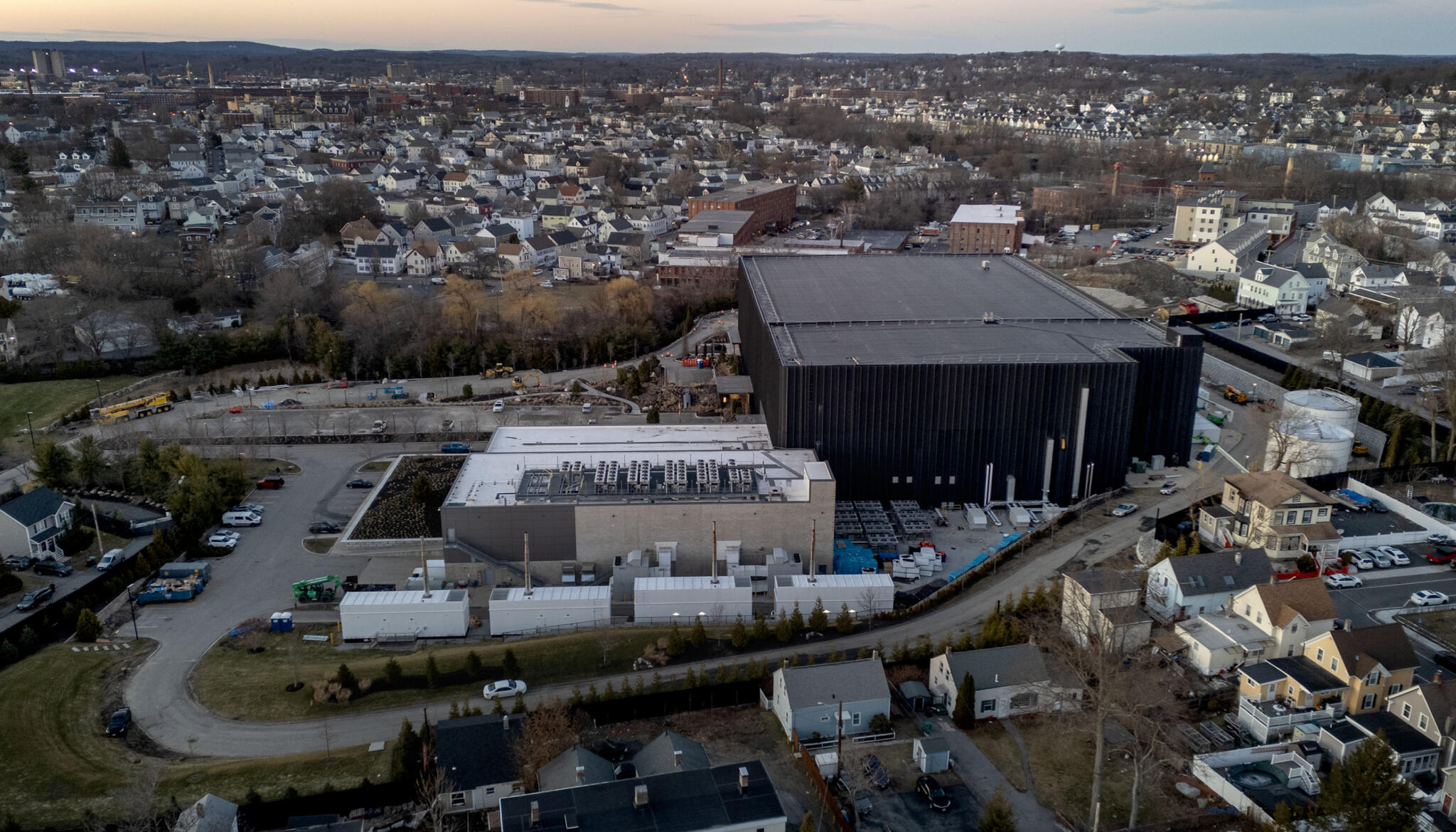
A group of Lowell residents went to court Wednesday to try and stop the expansion of a 352,000 square-foot data center in their backyards.
Attorneys for the residents — some of whom literally live in the shadow of the hulking black building and regularly smell the exhaust of the facility’s diesel generators — told a Middlesex Superior Court judge that the Massachusetts Department of Environmental Protection violated their rights when it it signed off on an air quality permit needed for the center’s expansion last year without considering the community’s objections.
“ The problem here is that our clients never got the hearing that the law entitles them to,” said Stephanie Safdi, who represents Lowell residents, in court today.
She asked the judge to order a return to status quo, “ so the plaintiffs can be heard on their claims before [Facility developer The Markley Group] installs and operates more diesel generators and cooling towers next to their homes.”
The court filings claim the department exceeded its statutory authority by entering into an agreement with Markley to allow more diesel generators on the site. That agreement was done out of the public eye, the neighbors’ lawsuit alleges, and came as community members were still appealing the original air quality permit.
“ I’ve never seen anything like this where [state regulators] enter into a secret agreement that sort of strips the petitioners of any ability to participate or give feedback,” said Alexandra St. Pierre, vice president of the Conservation Law Foundation’s Environmental Justice program and one of the lawyers representing the plaintiffs. “This whole process has been really unfair to the residents.”
The Lowell residents’ day in court comes as communities around the country push back against efforts to build and expand the resource-thirsty, and often polluting, facilities.
Earlier this year, Lowell passed a yearlong moratorium on new data centers, though it doesn’t affect the existing Markley facility in the Sacred Heart and Back Central neighborhoods of the city.
Opposition to data centers is mounting across the country. The facilities house the computers that enable AI services like ChatGPT, but abutters and opponents say the facilities bring noise, pollution, and skyrocketing energy bills.
Markley attorney Michelle O’Brien wanted to focus instead on what the data center does support. She said the facility processes information for entities like UMass Lowell and the local hospital.
“ Unfortunately for Markley, it seems caught in the wave of anti-data center sentiment around the country,” said O’Brien. “ The facility needs backup generators in case national grid has an outage, which happens.”
Several other cities and towns have passed, or are considering passing, similar moratoriums, and last month the Healey administration paused a plan to give data center developers tax breaks for building in Massachusetts.
While the specifics of the lawsuit are about a single data center in Lowell, the case also brings up larger issues about environment justice, said St. Pierre.
In recent years, the legislature has passed laws mandating that state agencies and developers give community members a meaningful chance to participate in a permitting process. The laws also call for environmental impact analyses that look beyond whether pollution from a specific project exceeds air quality standards. Instead, the study must take into account how any new emissions would add to existing air pollution and environmental burdens.
According to the plaintiffs, the state ignored these laws when granting approvals to the Markley Group in 2025.
“If a diesel-generating entity in the middle of an urban neighborhood cannot trigger these cumulative impact regulations, then what was the use of having our new protections for environmental justice communities?” asked Mary Wambui, a Lowell resident and one of the plaintiffs in the case.
During Wednesday’s hearing, the counsel for the Department of Environmental Protection, Seth Jaffe, said “ the department followed the rules.”
In an emailed statement, the CEO of the company that owns the Lowell data center, Jeff Markley, wrote that the company “conducted all the analyses required by the Massachusetts Department of Environmental Protection as part of the permit process.”
He added that “MassDEP properly evaluated and approved the permit” to install more generators on site, and that he’s confident the superior court will “uphold the previous dismissal of the appeal, and affirm the permit.”
According to Markley, about a decade ago, city officials in Lowell approved the company’s plans for 31 generators and fuel tanks large enough to store 250,000 gallons of diesel fuel on the site.
“Currently there are only 23 generators on site, two of which are not yet wired or operational,” he said.
Diesel generators next to the Markley data center in Lowell, Mass. (Robin Lubbock/WBUR)
At the center of the lawsuit is a series of expansion plans Markley filed with the state between 2023 and 2025. Taken together, those proposals would have, among other things, increased the number of operational backup diesel generators on site to 27.
Even before the first expansion plan in 2023, the facility was “disrupting daily life for residents with air pollution, industrial noise, dust, odor, traffic, and other impacts,” the lawsuit states. And in an area that’s already “disproportionately burdened by air pollution and other environmental stressors,” adding more diesel generators and cooling equipment to the mix will only exacerbate these problems.
These aren’t your standard backyard generators, said St. Pierre. They’re large, loud and hold thousands of gallons of diesel fuel.
She said she understands why residents were upset about plans to install more of them, and that they took all the right steps to voice those concerns. They attended public meetings, they filed comments with the Department of Environmental Protection. And when the department approved the air quality permit for the expansion last July, they banded together and filed a timely appeal three weeks later with the department’s Office of Appeals and Dispute Resolution.
As explained in the plaintiff’s lawsuit, a hearing officer decided that the group didn’t have standing to appeal the case, and in December 2025, the officer recommended that department commissioner Bonnie Heiple uphold the permit.
Heiple did that a few months later, but in the interim, Lowell residents noticed construction work and more diesel generators at the data center site. As far as they knew, Markley couldn’t start this work until it received the final air quality permit, so they asked the company what was going on.
This, according to the lawsuit, is how they learned about the consent order.
Residents have spent years raising concerns about the facility and going through the regulatory process to register those concerns, Wambui, the Lowell resident said: “And so when we heard that they had entered into an agreement that allowed the data center to continue doing some work in the site, we were shocked.”
Eileen Castle, 82, is another plaintiff in the case. Part of the Markley property is just feet from her backyard.
She sat in the front row of the courtroom. She said the hearing made her feel “positive.”
“We can’t do anything about having a data center at this point in time,” she said, “but we do have to understand that we need support and we need help to make sure that [Markley] doesn’t do things wrong.”