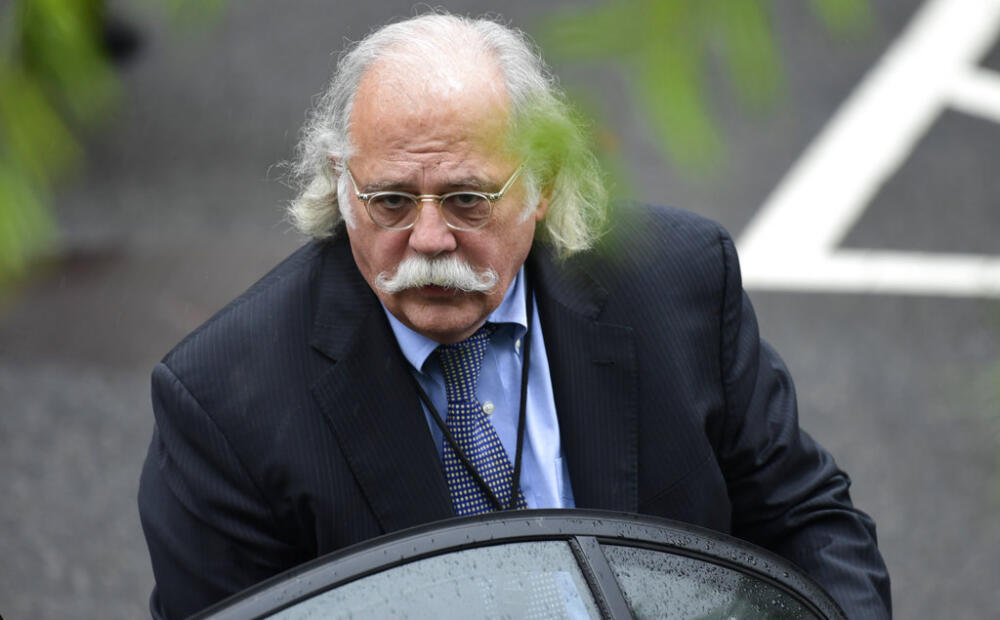
Ty Cobb served as special White House counsel in the first Trump administration. Now, he’s one of the president’s loudest critics. Ty Cobb talks about why he thinks the president is no longer fit for office.
Guests
Ty Cobb, former White House attorney who served under Donald Trump in 2017 and 2018.
The version of our broadcast available at the top of this page and via podcast apps is a condensed version of the full show. You can listen to the full, unedited broadcast here:
Part I
MEGHNA CHAKRABARTI: Ty Cobb served as White House Special Counsel in the first administration of President Donald Trump. In 2017 and 2018, he represented the White House’s response to Robert Mueller’s investigation into Russian interference in the 2016 presidential election, an investigation that Trump referred to endlessly as a, quote, “witch hunt.”
Cobb had frequent and close contact with Trump during that time. He saw the inner workings not only of Trump’s White House, but of Trump’s thinking and approach to the world. And since then, Ty Cobb has been speaking forcefully about his belief that Donald Trump is dangerous for America. He reserves special criticism for the Republican Party and its role controlling both houses of Congress.
He told PBS’s Frontline that Congress has neutered itself through its own cowardice. So the question now, more than a year and a half into Trump’s second term, isn’t just what more will Donald Trump do, but can the country recover from a president and a party that have taken full advantage of the basic truth that rules only matter if people care about them?
And Ty Cobb joins us now to tell us more. Ty Cobb, welcome to On Point.
TY COBB: Thank you so much, Meghna. Nice to be with you.
CHAKRABARTI: So I know that given that you were serving as White House Counsel, there are ethical strictures around what you can and can’t tell us regarding specifics of experiences that you had while in the White House, and I want to honor that.
But at the same time, I’m going to probe to see what you can tell us. Is there a time when you were meeting with President Trump in that 2017 to 2018 period where you had a moment where you thought, “Aha, now I understand better what makes this man tick”?
COBB: That’s an excellent question.
Yes, I think there were several moments where I got insights into the way that the president assesses things and responds to stressors and other matters. So I guess my short answer is of course, yes. Highlighting those in a meaningful way it’s difficult because of the privilege issues that you mentioned.
On the other hand, what I can say with great confidence is who he was then and who he is now is a very different picture. He certainly no longer has anybody around him who restrains his malignant narcissistic impulses. And he’s allowed basically to do things that are just unthinkable in the history of the presidency.
Who [Trump] was then and who he is now is a very different picture. He certainly no longer has anybody around him who restrains his malignant narcissistic impulses.
Such as these constant memes that we see between, 2:00 a.m. and 4:00 a.m. And the Truth Social posts that he makes. Yesterday’s of course with him, dressed up as a warrior à la Patton and MacArthur. It’s just amazing the way that he has demeaned the presidency and the dignity of the office.
CHAKRABARTI: Yeah. So I think we can fairly describe the office of the presidency as a major pressure cooker, no matter who’s occupying the office.
It’s just amazing the way that [Trump] has demeaned the presidency and the dignity of the office.
COBB: Absolutely.
CHAKRABARTI: But so again even though I’m desperate to try and get you to give us some specifics, I understand if you can’t.
But so can you tell us, under moments of particular duress, how did the President as you saw him, respond back in 2017, 2018?
What was his demeanor? What were some of his initial sort of responses to any one of the number of pressures that he experienced as a first-term president?
COBB: Sure. I have to say, the president doesn’t have a very long attention span. He didn’t have one then.
He has almost none now. So the conversations are never long or philosophical. It’s really, he typically responds with what he wants done and is adamant about it until you can talk him out of it. I’m not sure people actually talk him out of it at this stage of the game.
But he has an outcome that he desires, and he doesn’t really understand why that’s not achievable. So anything that is an obstacle to his will frustrates him greatly, can provoke an angry response or a intemperate response. But none of these discussions take very long because he just does not stay engaged.
CHAKRABARTI: So you felt like you had a short window to sort of —
COBB: Always.
CHAKRABARTI: Always. Okay. And how did you best use that window of time, do you think?
COBB: I tried to be professional in every circumstance. I always referred to him as Mr. President. I think that was helpful. I think that he understood that I had a lot of respect for the office and as a result, I think he considered what I had to say.
And I tried to present things, I learned to try to present things when they were fully baked in the sense of not half-baked. But where you had an actually discernible recommendation. And reasons why it was in his interest.
CHAKRABARTI: Let me ask you. You said that he learned that you had a tremendous amount of respect for the office of the presidency. Did he demand that you show respect for him, though, personally? Or loyalty even.
COBB: So not in my circumstance. But keep in mind that I had an unusual role which was he knew that he didn’t know what he had asked me to deal with.
He knew that the legal demands of the special counsel and of Congress were something that he was finding his way on. And I was more like a guide. And so he didn’t really have the experience to divine himself how to respond, so he had to rely on me or trust me to get it right.
And there were many times that he didn’t trust me. He would have advisors constantly telling him that he needed to be more aggressive on Mueller, he needed to attack Mueller. Part of my arrangement was that he would not attack Mueller. And ultimately, when Rudy came in 11 months after I had started, and we were essentially done with the production and the interviews, the two of them began to attack Mueller aggressively, and that’s when I departed.
CHAKRABARTI: Is that why you departed?
COBB: That’s one of the reasons, one of the reasons, yes.
CHAKRABARTI: And other reasons?
COBB: I think the other reasons were basically we were largely completed, I had largely completed my task, and I had the benefit of unlike many people there who were younger and had aspirations for higher office or greater authority, I didn’t have any of that.
I wasn’t there auditioning for anything and no desire to be appointed to anything. So I was free to do whatever I thought the right thing was, and it was the right thing for me to depart when I did.
CHAKRABARTI: Okay. So a couple more questions in terms of comparing the president’s state of mind or demeanor in the first administration versus this one.
Because a lot of what you’re saying we’ve heard others say before in terms of the president doesn’t have a long attention span, he really only processes things that are put immediately in front of him. That seems to be getting much worse in this administration. I was just thinking about Jonathan Swan and Maggie Haberman’s new book.
COBB: Excellent book. Excellent book.
CHAKRABARTI: And they talk about how really the president will only take a minute to look at recent printouts that a particular, specific White House aide has been charged in putting right in front of him, and that’s virtually the extent of his information processing, which we could talk about for a lot.
But in terms of sort of what his default state is, his default approach to life, let alone occupying the office of the presidency, I’m wondering, did you encounter, was vengeance a default state for him, is what I’m trying to ask?
COBB: So that’s a difficult question to answer, because those around whom he was comfortable being vengeful, I was not really in that group.
I think people who had known him longer and could endure that. But he doesn’t, anything that is an obstacle for him and anybody involved in creating that obstacle or persisting with perpetuating that obstacle is an enemy to him. The lens of narcissism is really the only lens that truly puts him in focus.
And narcissists are driven by their desires and solely focused on what it is that they want and can accept. And any insult, any resistance turns whoever provided those stimuli into an enemy for him.
CHAKRABARTI: We have about a minute before our first break, Mr. Cobb.
I’m curious, if the Ty Cobb of 2017 and 2018 could have given advance warning to the Ty Cobb of 2026, what would yourself from a decade ago have said?
COBB: I think what I’d say is really what I’ve been saying for years, which is, the Constitution, when crafted, was not designed to restrain someone as evil as President Trump.
The Constitution, when crafted, was not designed to restrain someone as evil as President Trump.
What we see in terms of the level of corruption, the lack of any restraints at all in terms of integrity or dignity, those were at a formative stage. But largely restrained by people surrounding him, particularly General Kelly, whose service to the country cannot be overstated.
He endured, more than any person should ever have to endure to try to restrain President Trump. Keep in mind, he was at Arlington Cemetery when the president was referring to the dead soldiers as people he just didn’t understand, and why’d they do it, and what good were they?
One of those soldiers was General Kelly’s son.
Part II
CHAKRABARTI: Ty Cobb, you used the word just before the break, you used the word evil, that President Trump is evil. You’ve said that before in other interviews. But it is a highly specific word.
Why do you choose to use that word?
COBB: I choose that word because, A, it’s appropriate. B, it defines the stakes. I don’t think Americans can address where we are without accepting that fact and respond to it in a way that will be remotely of assistance in terms of the restructuring and reforms that are going to be necessary to recover from the damage that has been done in the last 18 months.
The level of corruption is just extraordinary. Now we know in an unprecedented arrangement that the president is selling access to his thoughts and intentions seconds before they become public to Wall Street firms for $100,000 or more.
CHAKRABARTI: Let me provide a little bit of detail on that for people who don’t know. So the president is now selling, as you said, early access to his Truth Social posts for $100,000 a month to anyone, basically anyone who’s willing to pay. Because those posts can be market movers essentially. And so he’s literally, the president of the United States is selling early access to that information.
I think it’s completely unprecedented. And there have been people in recent days who have said, people who are still ostensibly Republicans, not in office, who have said, “If anything has ever been impeachable beyond January 6th, 2021, this is it,” and yet Congress is doing nothing. They barely even notice, I’d say, that this is going on.
COBB: Yes, no, I agree with that. And there’s a long list of impeachable offenses. And I think we’ll see that list roll out with all the supporting documentation. But I do think it’s important to understand that it’s not hidden anymore. This is a crime family that flouts its misconduct.
Selling access to presidential decisions in advance to Wall Street for a fee, the founders would’ve been astonished that A, Americans would elect such a person, and B, that Congress, on which the founders bestowed greater powers than the presidency in Article 1 tolerate that they do that without removing the president under the impeachment clause, that they fund his whimsical tirades against immigrants and others without exercising the spending power that they have.
And that they allow the Iranian war to continue, which Trump now uses solely to announce that the strait is open, the strait is closed, we’re going to bomb, we’re not going to bomb. Those are all market movers for him. The amount of trading that goes on, when he makes those decisions has been assessed, and it is substantial.
That you will see trades immediately before and after he makes those decisions that affect the price of oil internationally. And anything that, anytime he says he’s going to relent or that the strait’s about to be opened, the price of oil comes down.
Anytime he says we’re about to bomb, it goes up. These are decisions on which people are making a lot of money, and many of those people are associated with the president.
CHAKRABARTI: Okay, there’s something that you told PBS’s Frontline a couple of months ago that I want to actually dig much deeper into.
COBB: All right.
CHAKRABARTI: And that has to do … I think because it explains a lot regarding the president’s not just the narcissism, but his approach on how he acts on that narcissism, and that is about his relationship with Roy Cohn. And you told a story to Frontline about how you were meeting with the president once, and I think he told you that you’re no Roy Cohn.
Can you tell us more about that?
COBB: Sure. It’s not a long story, but we had a disagreement about something. It was ultimately resolved consistent with the way that I thought we needed to proceed to move forward. That wasn’t necessarily to his complete satisfaction, and he made the comment that I was no Roy Cohn because the course that I had dictated, which was largely consistent with the cooperation that I believed was necessary to avoid the type of constitutional issues and crises that we’re now facing with the Mueller investigation was like I say, not to his liking.
And he commented that I was no Roy Cohn, and my response was, “Thank you, Mr. President.”
CHAKRABARTI: I think you said it was one of the highest compliments you’d received in your legal career. But here’s why this matters. Because again, for folks who don’t know Roy Cohn is most famously associated with Joseph McCarthy, right?
And McCarthy’s anti-communist hunts across Washington in the 1950s. He was the lawyer for McCarthy’s committee. Cohn was also famously a lifelong gay man who assisted in the persecution of other gay people in Washington prior around the McCarthy time. He died of AIDS in 1986, continuously denying his own homosexuality to the end.
And then also, he had a long-term business relationship, an advisory relationship, with President Trump beginning in the early 1970s, interestingly, when the United States government sued Donald Trump and his father for discriminating against Black renters in apartments they owned in New York. And Cohn, in his very classic take no prisoners approach to the law, had the Trumps countersue the Justice Department.
So there’s a long relationship there, and I’m wondering, what was it about Roy Cohn’s style or approach to the use of the rule of law that you think appealed and continues to appeal to President Trump so much?
COBB: So I think what it was Roy Cohn was completely detached from any concept of rules or legitimacy. And the president learned from Cohn that even in cases where his misconduct was crystal clear and where the law was crystal clear and that he was in the wrong, that all he had to do was deny, attack, belittle, demean.
The Roy Cohn style was to refuse to produce documents, to destroy evidence, to do whatever it took to beat back the opposing forces and never surrender. Which of course has its limitations, as he found in terms of the number of cases in which he was sanctioned and where his lawyering was ineffective, in terms of results and personally difficult for him in terms of what the courts did to him.
CHAKRABARTI: You’ve said before that Roy Cohn’s approach to problem-solving, and this is actually where I got that line I used in the intro, I got it from you, is that rules only matter if people care about them, right?
COBB: Yes.
CHAKRABARTI: Because he behaved in a way in which there is a thing called, quote-unquote, called the rule of law, but it only matters if someone calls you out on it.
He behaved as if there were no rules, that he could do anything, he could go to any length in order to serve the needs of both himself and his client. For someone as narcissistic as Donald Trump, finding someone who would assist him in that way, that you can live in a world with no rules, that had to be utterly liberating for President Trump, when he was a young man.
COBB: But I think, yes, that’s true, but I think in Todd Blanche, he has succeeded beyond his wildest dreams. There is no other lawyer in the country that I think that would be a co-conspirator in a crime to loot the treasury for $1.8 million, a billion dollars.
Billion dollars, in a case that was, as we know, a fraud on the court according to the judge who had authority over it. And fashion a circumstance where he would liberate Trump from the hundreds of millions of dollars that he owes in taxes that he didn’t pay and penalties and interest.
And provide immunity to Trump and his family from any IRS investigation. Roy Cohn was effective in preventing the president from suffering in business disputes. But he’s never had a benefactor on the legal side of the of the like of Todd Blanche.
CHAKRABARTI: Todd Blanche looks like he now after the previous objections of certain members of Republican members of Congress have been overcome, he looks like he may be headed towards being the attorney general of the United States. And so you say President Trump has found his Roy Cohn in Todd Blanche.
COBB: Yeah. Or actually, I think he’s found his Todd Blanche. Todd Blanche makes Roy Cohn look like a jaywalker when it comes to the crimes that he’s willing to commit for the president.
Todd Blanche makes Roy Cohn look like a jaywalker when it comes to the crimes that he’s willing to commit for the president.
CHAKRABARTI: So then he’s going to be occupying the office of the attorney general, and I think this is one of the key differences between the current administration and the first administration.
And many people have noted this, that at least for the first couple years of the first administration, you mentioned General Kelly, one of the many names of the adults in the room that were surrounding the president. This second time around, there’s nobody like that, as far as I can tell, in close contact with the President of the United States.
COBB: No, that’s absolutely right. And that includes Marco Rubio, who, like Vance, 10 years ago acknowledged that Trump was a reckless sociopath and somebody who was likely to be a significantly negative influence on the future of America.
They have buried their integrity and their independence and fallen into line in slavish servitude.
CHAKRABARTI: So let’s stick with Blanche here for a second, though. COBB: Sure.
CHAKRABARTI: I think if I can interpret what you’re saying, and correct me if I’m wrong, but it sounds like you’re saying the United States could soon have an attorney general who believes his primary responsibility is not to pursue justice on behalf of the United States of America, but to pursue justice on behalf of Donald Trump.
COBB: Yes, and he did so yesterday by telling U.S. attorneys around the country that they needed to fall into line with the president’s wishes notwithstanding whatever the facts of the case were. In response to Jeanine Pirro’s motion to dismiss the fraudulent reflecting pool case against David Hearn.
She didn’t have a choice because the court was about to, and will if given the chance come out and highlight how flagrantly the Justice Department abused the rule of law in bringing these trumped up charges that we now know to be false.
Actually, we knew at the time they were false. But Trump has this tendency. He can’t accept, because of the narcissism, and the narcissism lens is the right lens to get him in focus, that when the Reflecting Pool went south, and he knew it was a hot button, he decided he would just change the facts.
It wasn’t that there was some vandal with a box cutter, making a 375-foot slice. The only slices that happened on the paint job as we now know were by the government. And there are affidavits to that effect and witness interviews to that effect.
And Pirro had no choice but to dismiss the case before the judge threw it out. But when she did so and filed a motion that was detailed in terms of the factual underpinnings, justifying the dismissal, Trump and Burgum both insisted that she was wrong, and they articulate a circumstance, a factual scenario that has just no bearing to reality, much like the January 6th circumstances, which Trump now thinks should be a national holiday to celebrate the people who were there peacefully, quote, peacefully, end quote, demonstrating.
CHAKRABARTI: Let me just follow up on that really quickly because I think this, insofar as my eyes can see, and I’m not in Washington, but it’s another difference between 2016, 2017, and now because I would say that … the President hasn’t just come up with a different set of facts around the Reflecting Pool. I watched a press conference he gave just a couple of days ago. We might even be talking about the same one.
He seemed to be, he talked for many minutes, creating facts about multiple different administrations that simply were not true, talking about events that happened under Biden and Obama regarding the Reflecting Pool that never happened. He still insists that there is, there’s camera, he called it motion cameras, that there’s video evidence of someone cutting that 350-long foot-long gash in the pool. I mean, in the past, I would say in the first administration, he seemed, I would say, in control of the falsehoods that he put out.
And it was for a purpose. But now I’m not sure he even seemed in control or aware that everything he was saying about the Reflecting Pool was just not true.
COBB: But it’s everything he says about everything. He talks about Iranian negotiations that aren’t happening.
He talks about if through the narcissistic lens, what he does is he demeans others to enhance his greatness, and then he just makes up facts about how great he is. Talking about the economy, talking about inheriting high inflation, which he did not.
It was 2.9%. It’s not been that low since then. Talking about reducing drug prices 600%. At 600%, the pharmacists would be paying you to take drugs and renting his own parking space.
Part III
CHAKRABARTI: Ty Cobb, let me ask you, are you a Republican?
COBB: No. I was a lifelong Republican. At nine years old, I went door to door for Bob Dole in my hometown in western Kansas. My dad was a large Dole supporter, and Dole became a family friend. But that was my start as a Dole Republican, but I left the party shortly after Trump came down the escalator.
I left the [Republican] party shortly after Trump came down the escalator.
CHAKRABARTI: Do you recognize the Republican Party anymore?
COBB: No. The Republican Party is at this stage of the game solely a MAGA exercise there for Trump’s pleasure. You’ve got people like Mike Johnson. All you have to know about Mike Johnson is, there are a long list of things that I think just indicate who he is.
But the most telling, of course, is he kept the Congress out for nine weeks, nine weeks merely to avoid a vote on releasing the Epstein files. If the founders knew that was ever possible from a speaker of the House, they would’ve been more diligent about trying to prevent that kind of stuff.
It’s just, it’s shocking the extent to which this Congress and particularly the House will endure any indignity and provide the president with anything. And the Senate, of course, has confirmed people that historically never could’ve been confirmed.
Hegseth, RFK Jr., Blanche soon, under circumstances that just would shock the founders. I don’t, I think the Republican Party has a long way to go. I think the whole, I think both parties, frankly, have failed us. And sadly, the way money infects politics, it’s going to be very difficult for another party to emerge or for either party to self-correct.
CHAKRABARTI: I definitely think there’s a strong argument to be made that both the Democratic and Republican parties have basically become purely tribalistic organizations in the United States. I would agree with you on that. But I want to keep our focus on the Republican Party, for the simple reason that they are in control of both houses of Congress at least until November.
We’ll see what happens in the midterms. But you’ve talked about, and other people have talked about their belief that the President of the United States currently is not only just not fit to serve, but even possibly cognitively unable to serve as we would expect a president, or the minimum expectation we’d have for the President of the United States.
We’ve talked about how there is overt corruption at a level which I’m not sure this country has ever actually seen coming from the office of the presidency.
COBB: The world has never seen it.
CHAKRABARTI: The world has never seen it. Okay. And so any one of these things, and we haven’t even talked about, there are hundreds of examples, right? But any one of these things in a previous America that I once lived in and you did too, would galvanize Congress, no matter who, which party was in control, to act in some way. You said there are many things that the president has done this time around that are impeachable.
Perhaps even, I don’t know, would you say that the 25th Amendment should be enacted? And yet Congress has done zero, well, I say Congress, the Republican-controlled Congress has done nothing.
COBB: Not a single instance has Congress honored the oath it took in terms of responding to the misconduct of this president.
CHAKRABARTI: Is it a co-equal branch then anymore?
COBB: Oh, no. Oh no. The Article 1 powers that Congress has, it’s basically, it has ceded to the president, from the spending power to the war power. And the impeachment power, of course, is frozen in time, and I think we’ll see it activated if the Democrats actually win the House.
And of course, the president, while he may be impeached, will never be convicted. Because as I’ve said before, the Republicans in the Senate are neutered by their cowardice.
CHAKRABARTI: This gets me to thinking about the basic foundational concept in this country about the rule of law, right?
We talk about it all the time. And actually, one of my favorite facts is that for people who wish to become American citizens, there’s a question, a possible question they could be asked in their citizenship exam of, what is the rule of law, right? And it’s quite simple, that nobody is above the law.
And yet, when we have the President of the United States behaving in the way that he is, a Republican-controlled Congress that seems to be very happy being utterly complicit, utterly subservient to the president, we have essentially one remaining branch in the judiciary, in the federal bench, that is maintaining its independence.
Is this country functionally run by the rule of law anymore?
COBB: Not really. The pressures on the judicial branch are just extreme because of the failures in the executive branch and Congress to honor their obligations and responsibilities ethically.
But Trump is doing everything he can to undermine the judicial branch as well, and he needs to do so in order to have the level of power that he desires. They attack judges. It’s very dangerous. There are judges receiving death threats.
Any judge, even a Trump-appointed judge who rules against him, he attacks. He can’t take losses because of his narcissism. Any time he loses in court, it’s because the judge hates him or the judge is on the take or the judge didn’t understand.
But it’s just, it’s shocking, frankly. And Supreme Court watchers, for example I think were taken with the fact that the solicitor general, John Sauer, at one point during an oral argument swore to the court that the Trump administration would comply with its orders and honor the rule of law.
And I think we’re going to see that change once the Democrats regain the House and start issuing subpoenas to try to unearth the extraordinary level of corruption that we’ve seen and restore the mechanisms that were once commonplace in an aspirational America.
CHAKRABARTI: When I hear you say that functionally speaking at the federal level, this is no longer a country that operates under the rule of law, that’s what we say about autocratic or dictatorial-run developing countries from lands afar that the United States used to look down on and say don’t behave like that.
Be more like us.
What, honestly, again, in terms of federal governance, Ty Cobb, what, if anything, differentiates the United States now from caricatures of banana republics?
COBB: Oh nothing. Nothing. Keep in mind, the president just tried to loot the treasury for almost $2 billion with the assistance of his consigliere, Todd Blanche.
And just at a base level, on those banana republics, they can kill their enemies with impunity. That’s what’s happened. Renée Goods’ murderer and Alex Pretti murderer, is being protected by this administration. There is nothing going on to bring those people to justice.
And that is, if nothing else, that is the probably the starkest indication of the fact that we’re a banana republic. People have been murdered by the administration. Everybody has seen it on videotape, and there is no justice.
CHAKRABARTI: What can be done? Ty Cobb. I’m only pausing here now because this country, at least at the state and local level, is still a democracy, right? We’ve done many shows with very hardworking people, especially at the local level, of both parties who believe in running clean, fair, secure elections.
So people still can go and vote, and I hold onto that. The federal government is, I don’t disagree with your analysis here, but what would you say can be done to pull the nation back from the brink?
COBB: I think the only remaining mechanisms available constitutionally are elections and the courts.
Those are, the courts are doing a yeoman’s job. Trump loses 90% of the cases that are brought in court challenging immigration issues, other issues. It’s only a handful of cases that the solicitor general has appealed to the Supreme Court, where he does better because he’s picking out of thousands and thousands of cases, a dozen or more, that he thinks that the court may go the other way on, or that the underlying courts erred and the Supreme Court either corrects it or in the case of birthright citizenship tariffs Abrego Garcia, they rule against the President appropriately.
So the courts, I think, are doing a yeoman’s job. Elections are essential. Getting out to the ballot box and saying, “Enough,” and begging to get the country back to the shining city on the hill that we once aspired to be. But elections are going to be fraught with danger.
As we know, Trump’s trying to eliminate mail-in voting. He’s doing everything he can to prevent voting from going according to Hoyle. Just recently it was announced that voters who, naturalization ceremonies around the country, that it used to be that people at those ceremonies were then quickly registered to vote.
Trump has excluded the people that arrange that from naturalization proceedings, trying to prevent naturalized citizens from registering to vote. Everything he can do to impact voting is being done. And to the point that, as Steve Bannon has promised, ICE will be at the polls.
ICE is a secret police force. It’s overfunded, under-trained and vicious, and works solely at the president’s whim. So we will see, I’m afraid, clashes at the polls, and we will certainly see, because Todd Blanche, unlike Bill Barr, when the president says, seize the voting machines, he’ll do it.
When he says, seize the ballots, he’ll do it. They’ve already done it in Fulton County based on a fraudulent search warrant affidavit. So I think, sadly, elections, which is the one place that Americans can exercise, you know, their right in a democracy to influence their government.
I think we’re going to see something very tragic at the time of the elections and thereafter.
CHAKRABARTI: So there’s a hard but necessary truth, I think, that we all have to face, and that is when a country, when a democratic nation starts devolving in the way that this country has done in the past at least 10 years, if not more.
The truth is that for most people, beyond hearing or seeing the litany of specifics that you just had in the news, their day-to-day lives don’t necessarily feel impacted by that devolution of democracy. I would say a lot of people are saying, I feel it now because I just can’t afford to have a decent quality of life.
But for those folks who see the behavior of the president as something distant and not directly related to their lives, what would you tell them about why they should care?
COBB: Because their children and their grandchildren are going to die from the lack of vaccinations, from the public health decisions that their taxes are going to skyrocket because of the vanity projects on which the president spends, countless billions of dollars to create arches for himself, to gold plate statues, to gild the Oval Office, to demean former presidents with memes outside the Rose Garden.
The police that will be virtually omnipresent at any place that democracy is practiced. People need to understand that this is a country that is disappearing. The rest of the world has moved on. It’s not that this is, we’re at the initial stages of the abyss.
People need to understand that this is a country that is disappearing.
We’re deep into the abyss, and only by electing a new Congress and ideally taking baby steps can we halt the decline to the point where we can actually start to look at how do we restore ourselves. I think it’ll take two generations to restore the democracy that we had less than two years ago.
And we may never get there again because of the structural changes that the president’s made, the fact that he has pushed out of government many of the talented, experienced, and ethical people and replaced them with stooges at the Justice Department, the FBI, almost every agency.
With the Bill Pultes of the world and the Ned Martins of the world and the Todd Blanches of the world. There are semblances of those people in multiple hundreds, thousands of positions now in the government that are there to serve the president, not the country.
CHAKRABARTI: We just have about 30 or 40 seconds left, Ty Cobb.
You’ve been speaking out over the past year plus. Do you feel like you’re taking a personal risk by doing so?
COBB: I apologize for hesitating there. I don’t think about it. I really don’t think about it. And nor should I. It’s just when people ask me what do, I think I try to just tell the truth.
I could be wrong. People are free to reject my thoughts. But I don’t really have a choice when people come to me and say, “What do you think?” or “How do you feel about this?” I try to fairly say exactly what I feel, and consequences be damned.
The first draft of this transcript was created by Descript, an AI transcription tool. An On Point producer then thoroughly reviewed, corrected, and reformatted the transcript before publication. The use of this AI tool creates the capacity to provide these transcripts.