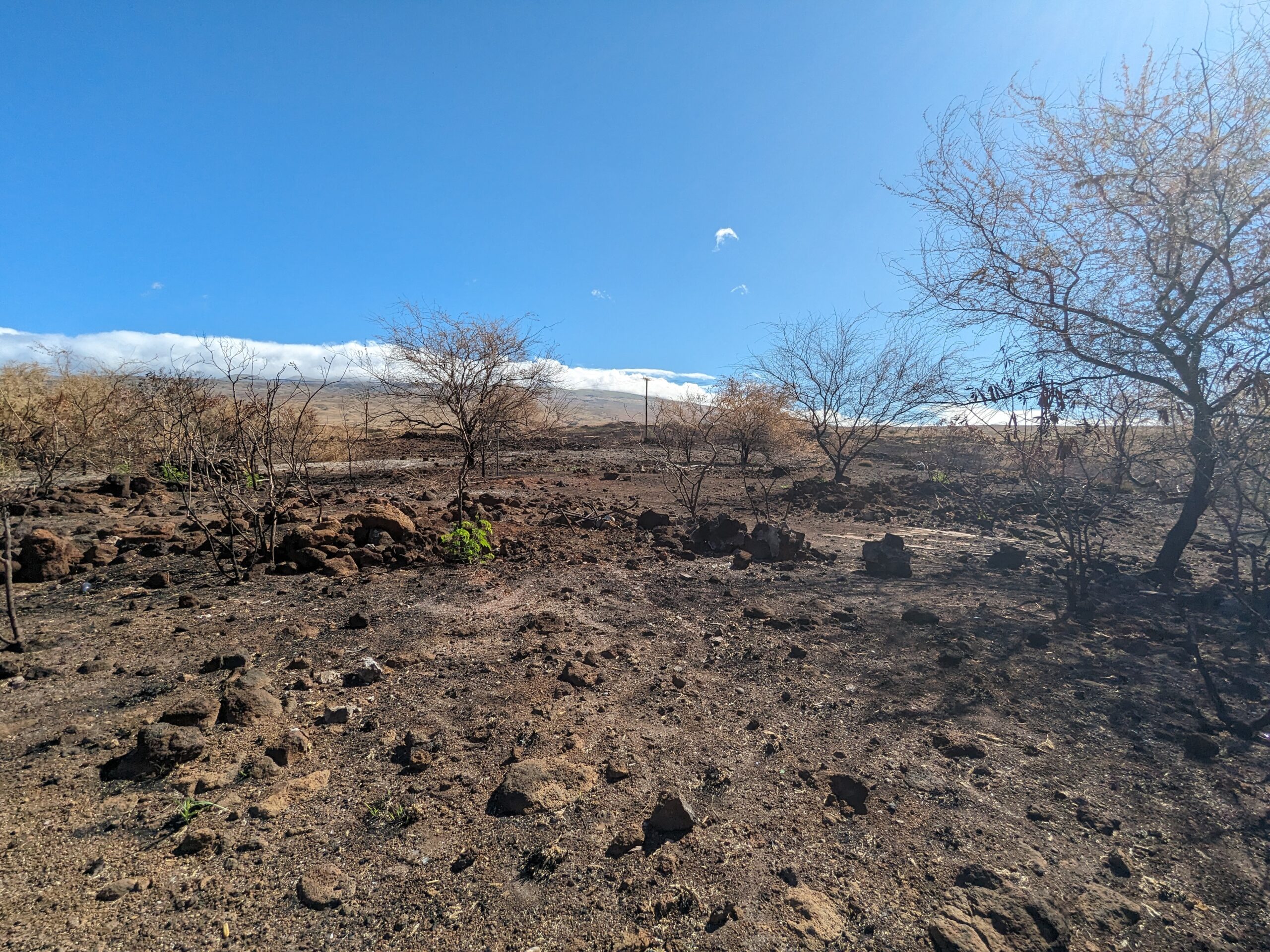
Natural solutions help cultivators conserve and collect water, revitalize the soil and increase production.
Many areas across Hawaiʻi are seeing increased drought conditions once again. Gardeners, farmers and foresters can be considerably affected by these severe droughts.
Even East Hawaiʻi island’s Hilo and Hāmākua districts rivers and creeks are dry much of the year now. Widespread increased drought means increased fire risk.
Thankfully, there are natural solutions that help cultivators conserve and collect water, revitalize the soil, and increase production.
To understand how to overcome drought, we need to consider what is leading to increased drought.
One of the factors behind persistent drought is the rain shadow effect, where rain is reduced behind mountains, as happens to Molokaʻi and Lānaʻi thanks to Maui’s tall mountains.
Other factors include deforestation of the uplands, uncontrolled grazing animals destroying vegetation, creek diversions for development and animals, water-hungry invasive species, and monocrops of water-guzzling crops such as the eucalyptus for pulp and timber.
Drought-Resistant Planting
While we can’t move mountains to increase rainfall, we can create drought-resistant plantings that conserve and collect water thanks to the many ecological agriculture systems and practices — such as agroforestry, permaculture, and agroecology — that replace inputs and labor with ecological processes.
Another method to address and overcome drought is the reforestation of the uplands. One well-known ‘ōlelo no‘ea (Hawaiian proverb) that supports this understanding is, “Hahai no ka ua i ka ulula‘au” (The rain follows the forest).
Indeed, many people doing broad-scale reforestation of severely degraded places are observing increased rainfall and the return of springs, creeks, and rivers that had long been dried up.
There are even “rainmaker” trees. According to the Lānaʻi Water Co., Lānaʻi’s predominant Cook Island Pines double the rainfall and collect an average of 200 gallons of water per day from water vapor, thanks to the high surface area of its branches and leaves. Hawaiʻi’s endemic ʻōhiʻa tree is believed to be a rainmaker tree as well.
Widespread increased drought means increased fire risk.
While it takes considerable ground to reestablish a forest that increases the rain, cultivators on the smallest patches of ʻāina (land, that which feeds) have plenty of options to become drought resistant such as utilizing perennial plants (deep-rooted, long-lived plants), windbreaks, biochar (wood burned in a low-oxygen environment), and beneficial microbes.
Perennial plants are generally drought-resistant due to their deep roots that can access water in the lower soil profiles. Windbreaks slow the wind down, which reduces the evaporation of water from the soil and plants.
Biochar is one of the best carbon sources that actually attracts and stores water. Studies have shown that non-irrigated plants with biochar can produce more than irrigated plants with no biochar. Beneficial microbes have also been found to increase drought resilience of plants.
While these practices are becoming more well-known across Hawaiʻi, few are aware of the benefit of bio-tilling, the physical improvement of the soil with the roots of plants and microbes.
Plants like daikon radish, pigeon pea, annual rye and kalo can break up the soil and reaggregate extremely compacted soils up to 3 feet deep.
Instead of rainfall running off compacted soils during heavy rains, the soil now can absorb considerably more water, which serves as a type of water bank that plants can access during droughts. When we combine the many multifunctional strategies and practices that ecological agriculture and forestry offer, our plants become much more drought resilient.
If you would like to learn more about developing your own drought resistant garden, farm, forest, or edible landscape, you are welcome to attend the June 14 free online class “Cultivating the Rain with Ecological Agriculture” with the me and Adam Russell, co-owner of Symbiosis TX, Texas’ largest permaculture contractor that is doing broad-scale land restoration of arid areas.
The event, from 9 a.m to 11 a.m., is sponsored by the U.S. Department of Agriculture, UH-Hilo Pacific Aquaculture and Coastal Resource Center, the Marine and Environmental Research Institute of Pohnpei, Revitalizing Hawaii, and Symbiosis TX.
Hawaiʻi residents will be eligible for rare plant seed prizes. Information can be found at HawaiiEdibleLandscaping.com.
Sign up for our FREE morning newsletter and face each day more informed.
Sign Up
Sorry. That’s an invalid e-mail.
Thanks! We’ll send you a confirmation e-mail shortly.