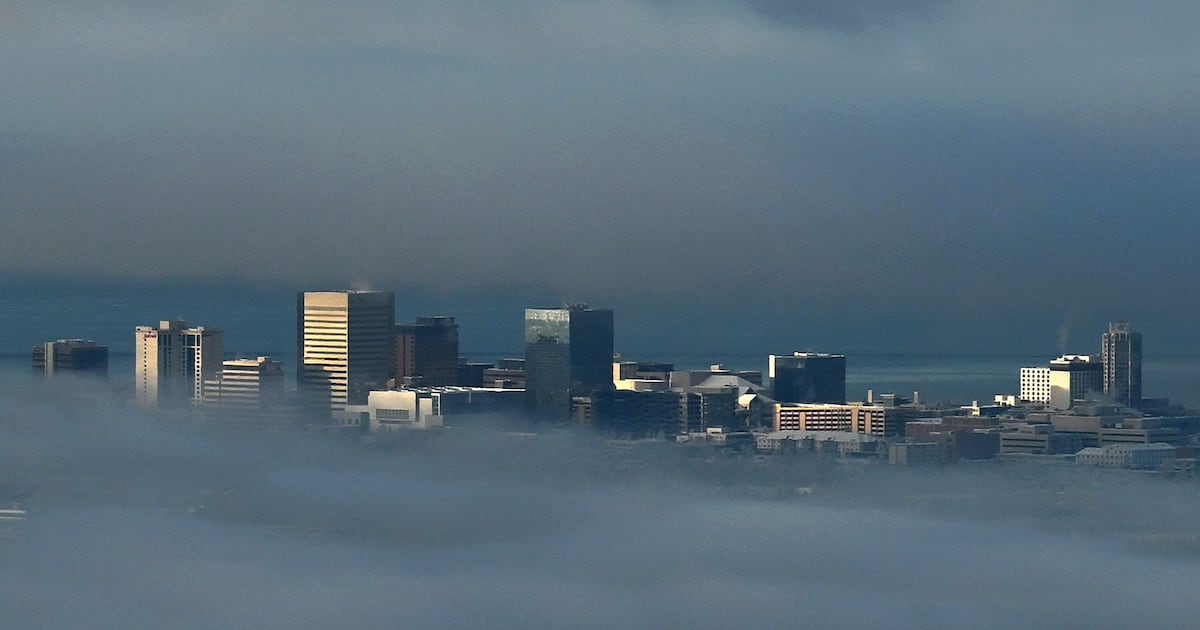
The Anchorage skyline is visible through broken layers of fog in a view from the overlook at Glen Alps in Chugach State Park. (Bill Roth/ADN)
Across Alaska, the ground beneath our feet is shifting — literally. From Southcentral highways to the Arctic tundra, thawing permafrost is buckling roads, cracking runways and sinking building foundations. In 2020, the trans-Alaska pipeline reported its first case of “slope creep” as thawing ground jeopardized the structural integrity of the artery that built our modern economy. For generations, Alaskans have prided ourselves on weathering the toughest conditions on Earth. But today, Alaska is the fastest-warming state in the nation by far — up 4.4 degrees since 1970. Long-term projections have become an urgent, everyday reality for our families, our industries and our pocketbooks.
Along our western coast, vanishing sea ice exposes low-lying villages to fierce storms. Two communities, Kipnuk and Kwigillingok, were devastated, and three people lost their lives last year by the remnants of Typhoon Halong. Severe and prolonged erosion has forced Newtok’s relocation and is pushing communities such as Shaktoolik to invest heavily in shoreline protection, evacuation infrastructure and long-term resilience planning. Longer, warmer and drier fire seasons are also increasing the risk of large Alaska wildfires. These are more than quarter-billion-dollar disasters; these are people’s lives and livelihoods.
As a commercial salmon fisherman, I’ve seen for 30 years how warming river temperatures and marine heat waves impact wild salmon and Alaska’s river and coastal communities. On the Yukon River, chinook runs have collapsed so severely that directed fisheries have largely been closed in recent years, and Alaska and Canada agreed in 2024 to a seven-year suspension of directed fishing for Canadian-origin chinook through 2030.
For Anchorage families, nowhere is the strain more immediate than in what we will pay to stay warm and keep the lights on this winter. The Cook Inlet gas supply that has heated our homes and powered our grid for decades can no longer reliably meet Southcentral’s long-term needs at historic prices. Utilities are developing plans to import LNG beginning around 2029 at substantially higher prices, while the Matanuska Electric Association has warned that a severe winter and insufficient gas deliveries could, in a worst-case scenario, require rolling power interruptions.
These disasters and disruptions carry an immense price tag: Research on Alaska’s public infrastructure estimates that permafrost thaw, erosion and flooding will cost the state billions in added maintenance and replacement in the coming decades — costs that ultimately land on families and taxpayers.
Here’s the encouraging part: Most of us already agree on both the problem and the need to act. According to the Yale Program on Climate Change Communication’s 2025 Climate Opinion Maps, six in 10 adults (61%) in Alaska are worried about a warming climate, and 57% want Congress to do more. In a state that spans the political spectrum, most neighbors understand that protecting our fisheries, our infrastructure and our household budgets isn’t a partisan cause — it’s common-cause and common-sense stewardship of a place we all love.
Alaskans are resourceful, and practical solutions are already taking root. Rural microgrids from Kotzebue to Kodiak demonstrate how wind, solar, hydropower and battery storage can reduce reliance on expensive diesel. In the Railbelt, grid modernization and new renewable generation can help diversify the energy supply and reduce our exposure to volatile fuel costs. And local engineers are using thermosiphons and other ground-cooling techniques to keep building foundations and roads stable as the soil thaws and shifts.
As Alaskans weigh candidates in the upcoming local, state and federal elections, safeguarding our infrastructure, protecting working fisheries and lowering energy burdens must take center stage. People want elected officials who are concerned and informed about climate. Regardless of whether a candidate is an independent, Republican or Democrat, voters should ask them direct questions:
• What is your plan to relocate communities and people who are heavily impacted by increasingly unstable and severe weather?
• What will you do to secure affordable, reliable homegrown energy — expanding clean power and upgrading our grids — so families aren’t left with soaring utility bills?
• A warming climate changes the suitability of natural conditions for salmon and caribou. What is your plan for dealing with declining food resources in rural Alaska?
• What is your concrete plan to fund and modernize the roads, runways and water systems threatened by thawing permafrost, and to support coastal communities facing erosion?
This election season, Alaskans should look beyond campaign rhetoric and demand real commitments. These aren’t partisan issues. They are matters of keeping our roads drivable, our fisheries abundant, our energy affordable and our communities secure. Alaska voters deserve clear answers — and leaders ready to deliver on them.
George Donart is a commercial salmon fisherman, retired teacher and forester, and Alaska state coordinator for Citizens’ Climate Lobby.
Rob Kahn volunteers as co-lead of the Meteorologist Outreach Team at Citizens’ Climate Education.
• • •
The Anchorage Daily News welcomes a broad range of viewpoints. To submit a piece for consideration, email commentary(at)adn.com. Send submissions shorter than 200 words to letters@adn.com or click here to submit via any web browser. Read our full guidelines for letters and commentaries here.