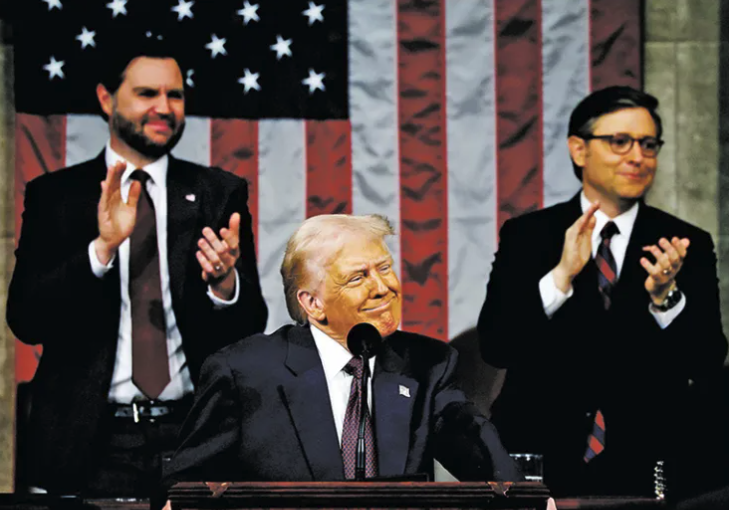
By the time he loses in court, the president has often already won.
Here are five tips for understanding Donald Trump and the legal system.
Only time will tell: That sounds like a cliche and it usually is. I once used that phrase doing political analysis on TV, and I still get laughed at about it.
But with Trump and the law, “time will tell” isn’t a cliche. It’s a guide — a reminder that as bad as you think things are or as happy you are with some bright legal light of resistance, most of the key issues between Trump and the law are still in flux, slowly grinding their way through the courts.
Damon Linker who just finished teaching an undergraduate class on Trump 2.0 at the University of Pennsylvania, had a really tough go of it.
What made the course so hard and unnerving to teach was “the intensive focus on rapidly unfolding current events, many of which seemed unprecedented and almost wholly destructive to liberal-democratic self-governance in the United States.”
Time and again, he told the class, “We’ll have to see how this gets resolved, and that won’t happen until this case makes it to the Supreme Court.”
The U.S., as he said, is moving in an authoritarian direction, but the move is like a jigsaw puzzle that is piece by piece, with unpredictable fits and starts. Lots of trees, but you can’t really make out the forest yet.
I am still amazed — I shouldn’t be because I made a living teaching about the legal process — by how many people respond to Trump by saying “but that’s illegal,” as if that’s the end of the story, full stop.
Trump is different: Of course, he is, but he’s different in ways that particularly apply to law.
As he has said, “I alone can fix it.” He also recently said, with great delight about his second term: “I run the country and the world.”
With that attitude, he believes that any legal attempt to hold him accountable is unacceptable, flat-out wrong, and subversive because he knows how to fix a thing while they — judges, plaintiffs, opponents, people opposing his executive orders, whatever — don’t.
When a TV interviewer recently asked Trump, “Don’t you need to uphold the Constitution of the United States as president?,” he answered, “I don’t know.”
If your attitude is I can fix anything, “I don’t know” means “I don’t care.”
By time the battles between the president and the legal system reach the U.S. Supreme Court, it may be too late. (AP Photo/Alex Brandon/2023)
Remember how much he is admired, even loved: Donald Trump is the most polarizing president in history. Less than 10% of Democrats approve of him. But about 90% of Republicans continue to approve of what he is doing — a lot of people, especially considering he won the popular vote in the 2024 election.
That’s a big cushion allowing him to do many things that may seem crazy and wrong.
You shouldn’t be diverted by arguments defending the rule of law: Lots of very smart people write very elegant, important books and articles defending the rule of law, its history, and its role in protecting our freedoms
I’m on their side. You should read them.
But not right now, not if you want to understand what’s going on.
Right now, that argument about law’s power is a diversion because the rule of law argument is about what ought to happen. It distracts from understanding what is in fact happening.
The common belief is you can depend on the law. But in today’s world, asking “How can he?” is not the end of the story. It’s the beginning.
Sure, the judicial branch is the last and best hope, but it may not be enough: Because Republicans control Congress, the judiciary is the only institution left to stop the president. Law has to be the bulwark. The judiciary is the only possible game in town. That does not necessarily mean the odds are good.
When they come to power in other countries, authoritarian regimes go after the judiciary. They do it by limiting the courts’ jurisdiction, getting rid of judges, and conducting anti-judiciary propaganda campaigns.
Some of what’s happening in the U.S. is like that, but it’s not the U.S. model yet. Not so blatant.
Yet with U.S. courts, there are other ways to handcuff the legal process. Most are built into the legal process itself.
Not All These Moves Can Be Undone
Trump has raised the ante, in an authoritarian style, by attacking individual judges. But that doesn’t really get at law’s basic limitations.
Litigation is by design a deliberative process. It’s supposed to be.
So, the fundamental simple dynamic is this: law is slow, Trump is fast — too fast for the courts to keep up.
With his sudden, huge executive orders, Trump has been able to do things quickly, well before any courts get their hands on them. Once they are rolling, the orders have momentum that’s very hard for courts to stop.
And when the courts have become involved, it’s generally just the very beginning of a long appeals process.
The courts are underdogs and in some cases underdogs willing to roll over.
Think of all the things that Trump has been able to do: thousands of people laid off, millions of dollars withheld, agencies shuttered. Even if the courts ultimately rule against the Trump administration, the damage is often done. The consequences remain.
Think of the complications involved in restarting and rebuilding or the workers who have left never to return. Or a medical research project stopped by the loss of funds, trying to come back.
And all of that is based on Trump losing in court. If he wins, well, that would be a very different story about presidential — that is, Trumpian presidential — power.
Both Trump and JD Vance have sent strong signals that the administration is willing to confront the court directly, but up to now Trump has avoided going to the brink.
The courts are underdogs and in some cases underdogs willing to roll over.
Considering the combination of law’s present pace and its traditional legitimacy, there really is nothing more that can be said than, only time will tell.
Sign up for our FREE morning newsletter and face each day more informed.
Sign Up
Sorry. That’s an invalid e-mail.
Thanks! We’ll send you a confirmation e-mail shortly.