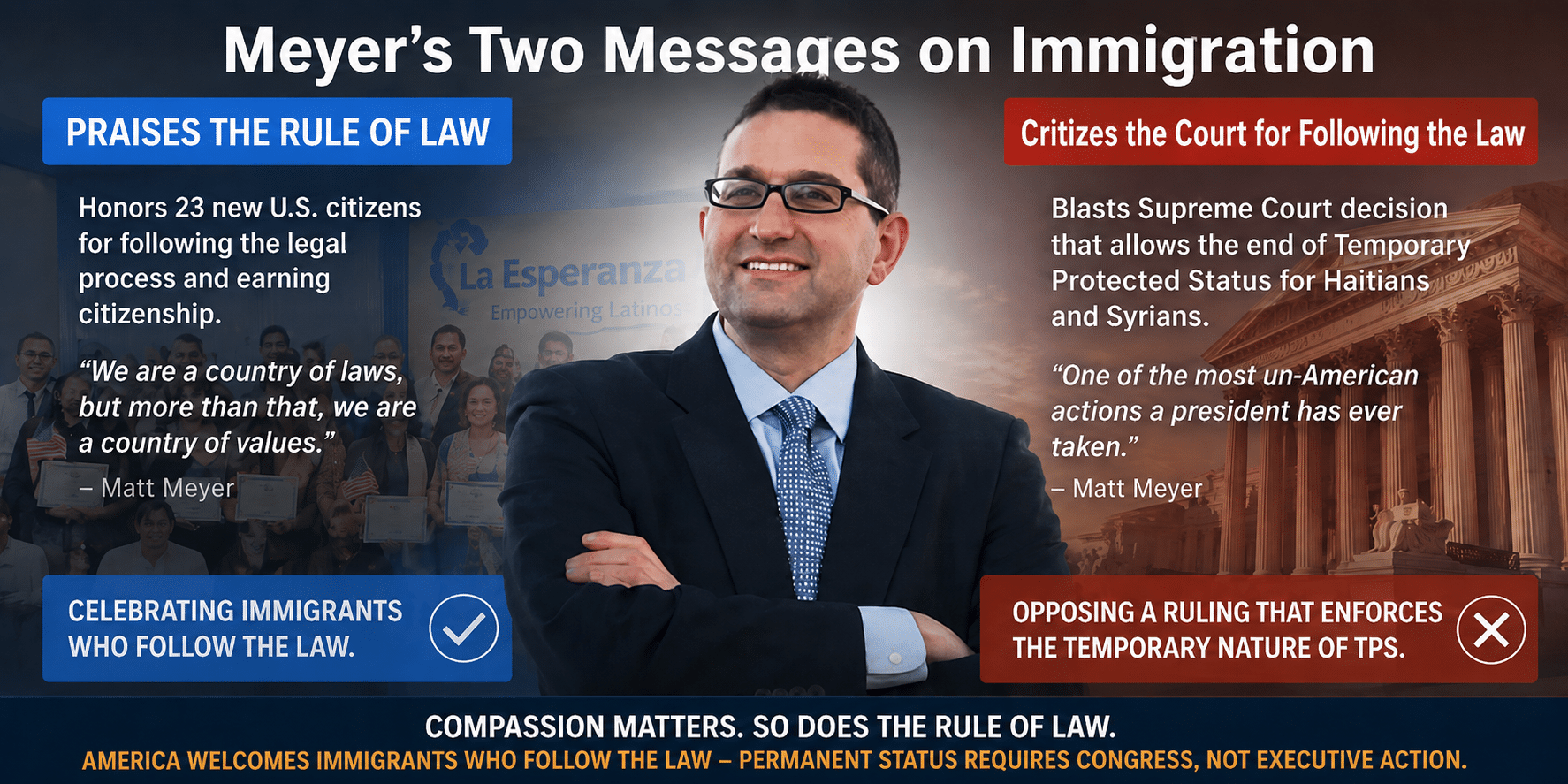
In two statements over two days, Governor Matt Meyer praised those who follow the Rule of Law regarding immigration and criticize the Supreme Court for following the Law.
Governor says decision hurts families and Delaware employers, criticizing the ruling that reinforces the current law that TPS is not a permanent legal status
DOVER — Gov. Matt Meyer sharply criticized a U.S. Supreme Court ruling allowing the Trump administration to end Temporary Protected Status for Haitians and Syrians, calling the decision harmful to families, employers and communities in Delaware.
But the ruling also highlights a central tension in the immigration debate: Temporary Protected Status, known as TPS, was created as a temporary protection for people from countries facing war, natural disasters or extraordinary instability. It was not designed to be a permanent immigration status, a green card or an automatic path to citizenship.
In a 6-3 decision, the Supreme Court sided with the administration and allowed the Department of Homeland Security to proceed with ending TPS protections for Haitians and Syrians, lifting lower-court orders that had delayed the terminations. The decision could affect hundreds of thousands of people who had been living and working legally in the United States under the program.
“President Trump’s decision to expel Haitians and Syrians who are living and working legally in Delaware and across our country is among the most un-American actions a president has ever taken,” Meyer said in a statement. “The Supreme Court’s decision today is a tragic one, not only for the families whose lives it will upend, but for our economy, our communities, and our character as a nation.”
What TPS is — and what it is not
Temporary Protected Status is a temporary immigration protection the U.S. government may grant to people from certain countries when conditions there make it unsafe to return.
Those conditions can include war, armed conflict, natural disasters, government collapse or other extraordinary temporary conditions.
In simple terms, TPS means the federal government is saying: “Your home country is unsafe right now. You can stay here legally until conditions improve.”
For people who qualify, TPS generally provides protection from deportation, permission to work legally through an employment authorization document and the ability to request travel authorization.
But TPS does not grant permanent residency. It does not automatically lead to citizenship. It does not create legal status for family members. And it does not erase or fix a person’s prior immigration history.
That distinction is at the heart of the legal and political dispute.
Meyer’s statement frames TPS as a promise to people who followed the rules, worked and built lives in the United States. Supporters of the administration’s position argue that the promise was always temporary — and that extending TPS year after year without congressional action effectively turns a temporary humanitarian program into a long-term immigration policy.
A humanitarian program or a backdoor immigration system?
For Meyer and other critics of the ruling, the issue is whether the country should remove legal protections from people who have been living, working and raising families in the United States while their home countries remain unstable.
“The Haitian and Syrian families affected by this decision are fleeing nations scarred by war, violence, and natural disaster,” Meyer said. “They are not asking for special treatment. They are asking for the chance to live safely, work honestly, raise their children, and contribute to the communities they now call home.”
That argument is likely to resonate with many Delaware employers and community leaders who see TPS holders as part of the workforce and local civic life. Losing legal work authorization could affect businesses, households and local economies, especially in industries that rely on immigrant labor.
At the same time, the court’s ruling reinforces a point often made by immigration hawks and legal conservatives: temporary status is not the same as permanent legal admission. Under the law, TPS designations are supposed to be reviewed periodically by the federal government, which can extend, redesignate or terminate them depending on country conditions and policy judgments.
If TPS ends, recipients generally return to whatever immigration status they had before TPS, unless they have obtained another lawful status.
Meyer invokes American identity
Meyer cast the ruling as a test of American values, invoking the Statue of Liberty and the country’s tradition of welcoming people seeking safety and opportunity.
“Inscribed on the Statue of Liberty are the words: ‘Give me your tired, your poor, your huddled masses yearning to breathe free,’” Meyer said. “Those words are not a footnote to the American story — they are the American story.”
He continued: “The hardworking people who come to this country seeking freedom and opportunity are often among our most patriotic Americans because they understand, firsthand, how precious freedom is.”
Meyer said TPS reflects “one of our nation’s core promises” that people who follow the rules, work hard and treat others with dignity can build a better life.
That is the moral case for maintaining protections.
The counterargument is institutional: Congress, not the courts or repeated executive extensions, should decide whether long-term TPS holders should receive a permanent legal pathway. Without that action, the executive branch retains broad discretion to decide whether temporary protections continue.
Delaware impact
Meyer said immigrants strengthen Delaware’s neighborhoods, businesses and future.
“They are our coworkers, our neighbors, our friends, and our family members,” Meyer said. “Turning our backs on them does not make America stronger. It makes America smaller. And history will remember the difference.”
For Delaware, the practical question now is what happens next for Haitian and Syrian TPS holders who have been working legally, paying taxes and participating in local communities.
The ruling does not settle the broader immigration debate. Instead, it underscores the unresolved divide between compassion for people who have built lives here under legal temporary protection and the rule-of-law argument that temporary programs cannot be treated as permanent substitutes for immigration reform.
For Meyer, the decision is a moral failure. For supporters of the ruling, it is a necessary reminder that temporary status means temporary — and that any permanent solution must come from Congress.
Delaware LIVE collaborates with a network of professional journalists to cover a diverse range of stories across various fields. Staff Writers include experienced journalists and young professionals. If you have questions, please feel free to contact [email protected] or our publisher, George D. Rotsch, at [email protected]