The $1.26 billion capital plan would boost spending by 28.6% on roads, schools, state facilities, and the Port of Wilmington expansion.
By George D. Rotsch, Contributing Journalist and Editor of Delaware LIVE
DOVER — Delaware’s proposed fiscal year 2027 Bond Bill would spend about $1.26 billion on capital projects, marking a sharp rebound after two years of restraint and raising familiar questions about spending discipline, transparency and return on investment.
House Bill 500, the state’s annual Bond and Capital Improvements Act, would fund roads, school construction, state facilities, housing, clean water, parks, economic development and local community projects. The bill was introduced June 25 and is one of the final major budget bills lawmakers must finish before the new fiscal year begins July 1.
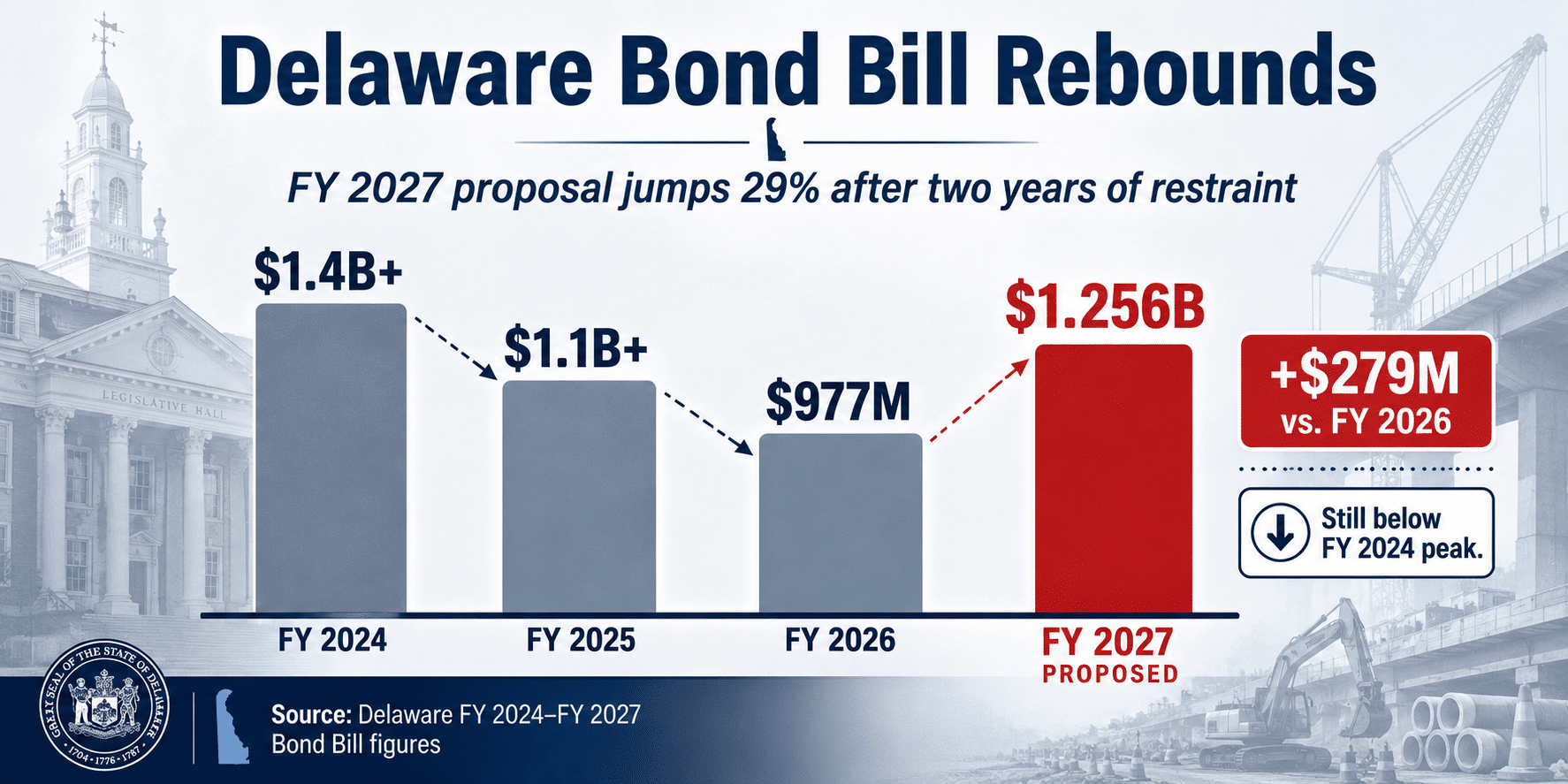
The proposal totals $1,255,978,059, according to the House Majority Caucus, up from the $977 million fiscal year 2026 capital budget. That is an increase of about $279 million, or nearly 29%.
The bill is still below the more than $1.4 billion capital budget approved during the ARPA-era spending period, but it reverses the downward trend lawmakers had followed in recent years.
Gov. Matt Meyer’s recommended fiscal year 2027 Bond and Capital Improvements Act totaled $934.4 million in January. The introduced bill is about $322 million higher than that recommendation.
Core infrastructure gets largest share
Much of the bill is aimed at traditional state responsibilities. The largest item is $273.3 million for statewide road projects, including money for roads in the poorest condition. That is higher than the $212.6 million transportation allocation in the current fiscal year, though below the transportation levels approved in fiscal years 2024 and 2025.
The bill also includes $235 million for school construction in the Appoquinimink, Brandywine, Colonial and Red Clay school districts. By comparison, the fiscal year 2026 Bond Bill included $211.2 million for K-12 educational facilities, while fiscal year 2025 included $160 million for school construction.
Other major areas include $164.1 million for deferred maintenance and state-facility capital improvements, $24.6 million for economic development projects, $24.5 million for affordable housing, $20 million for the Community Reinvestment Fund, $13.1 million for clean and drinking water revolving funds, $12 million for parks, $8 million for cover crops, $8 million for brownfields and $2.5 million for library construction.
That mix gives supporters a clear argument: capital spending is different from operating spending.
Roads, bridges, school buildings, roofs, public buildings and water systems are long-term public assets. When maintenance is delayed, the eventual repair bill often grows. Using one-time money for one-time capital needs is generally a more conservative approach than creating permanent programs that require ongoing revenue or future tax increases.
There is also a pro-growth argument for parts of the plan. Better roads, modern schools, clean water infrastructure and redevelopment of brownfield sites can make communities more attractive to employers, families and private investment.
Spending rebound draws scrutiny
The fiscal concern is not whether the projects sound worthwhile. Most of them do.
The concern is the size of the rebound and whether Delaware is rebuilding capital discipline quickly enough after several years of unusually large spending plans.
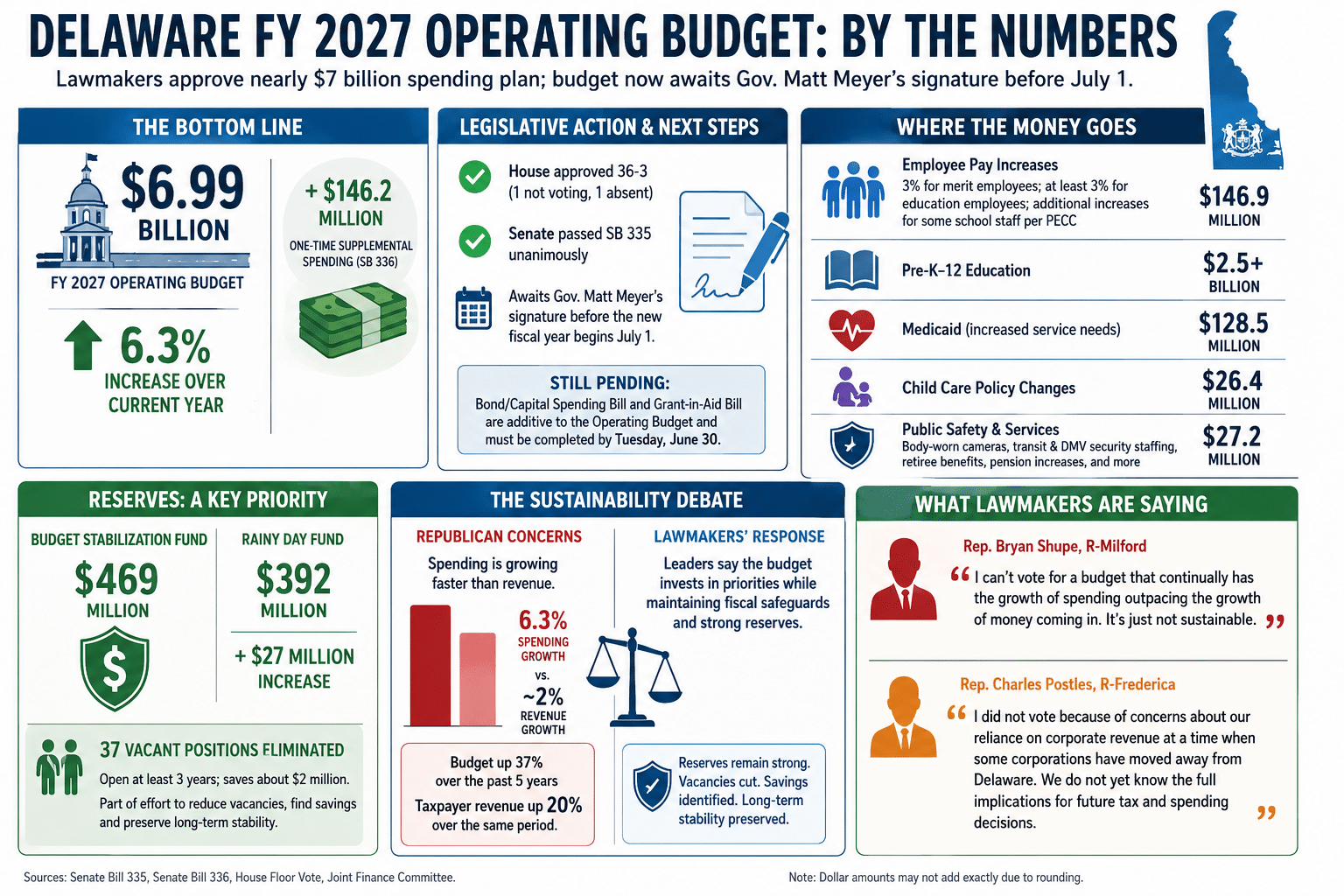
The Bond Bill was more than $1.4 billion in fiscal year 2024, just over $1.1 billion in fiscal year 2025 and $977 million in fiscal year 2026. The fiscal year 2027 bill moves the state back above $1.25 billion at the same time lawmakers are advancing a nearly $7 billion operating budget and a one-time supplemental spending bill.
That makes the capital budget part of a larger fiscal picture.
Delaware has long benefited from revenue sources tied to its legal and corporate franchise, including franchise taxes, entity fees and unclaimed property collections. Those revenues give the state advantages that many other states do not have, but they also depend on Delaware remaining competitive and trusted by the business community.
Critiques of the Bond Bill believe that state leaders are treating those revenues as a permanent guarantee or as a competitive advantage that must be protected.
If the corporate franchise weakens, large capital plans and fast-growing operating budgets become harder to sustain without broader tax increases.
Port funding raises transparency questions
The clearest flashpoint is the Port of Wilmington and the planned Edgemoor expansion.
The Bond Bill includes an additional $110 million for the Diamond State Port Corporation to help close a funding gap for the Port of Wilmington/Edgemoor expansion. Updated estimates have pushed the project closer to $670 million, leaving a gap of about $185 million. Federal funding and additional private investment from port operator Enstructure are also expected to help close the gap.
Supporters argue the port is a major economic asset with the potential to support blue-collar jobs and strengthen Delaware’s logistics economy.
Critics argue the state has already invested heavily in the project without seeing enough public return. They also have questioned whether the funding commitment was effectively made before the Bond Bill process was complete.
That concern goes beyond the port itself.
For large economic-development projects, taxpayers should know who made the commitment, what public dollars are at risk, what private partners are contributing, what benchmarks must be met and what happens if promised jobs, revenue or construction timelines are not delivered.
The state may ultimately make a strong case for the Edgemoor investment. But the larger the public contribution, the clearer the performance standards should be.
Local projects also deserve review
The Bond Bill also includes $20 million for the Community Reinvestment Fund, which supports nonprofit and local capital projects.
That is lower than the roughly $40 million approved in fiscal year 2025, when requests reportedly far exceeded available funding. The reduction may show some discipline, but the process still deserves scrutiny.
Community projects can meet real local needs. They also can look like political earmarks if standards are unclear. A stronger process would make it easier for taxpayers to see why one project was funded over another, what public benefit is expected and whether the recipient has the capacity to complete the work.
The bottom line
The fiscal year 2027 Bond Bill is not easy to dismiss as wasteful.
Much of it funds core infrastructure: roads, schools, state facilities, water systems, parks, housing and redevelopment. Those are legitimate public responsibilities, and delaying maintenance can cost taxpayers more in the long run.
But the bill also shows Delaware returning to a larger capital-spending posture after two years of reductions.
The key question is not simply whether the projects sound good. The key question is whether each major investment has a measurable public return, whether one-time funds are being used responsibly and whether lawmakers are resisting the habit of treating every available dollar as money that must be spent.
To Go Box
- What: Delaware fiscal year 2027 Bond Bill, House Bill 500
- Total: $1,255,978,059 in proposed capital spending
- Major areas: Roads, school construction, state facilities, housing, clean water, parks, economic development and community projects
- Status: Introduced June 25 in the Delaware General Assembly
- Deadline: Lawmakers must complete the state budget package before the new fiscal year begins July 1
- How to follow: Track House Bill 500 through the Delaware General Assembly website or watch final budget action during the closing days of session.
Delaware LIVE collaborates with a network of professional journalists to cover a diverse range of stories across various fields. Staff Writers include experienced journalists and young professionals. If you have questions, please feel free to contact [email protected] or our publisher, George D. Rotsch, at [email protected]