Concern Raised Over 6.3% Delaware Budget Spending Growth Rate, with Revenue Only Growing 2%.
Delaware lawmakers sent a nearly $7 billion fiscal year 2027 operating budget to Gov. Matt Meyer in the final days of the legislative session, pairing broad investments in state workers, education, health care and reserves with ongoing debate over whether spending is growing faster than the state’s revenue base.
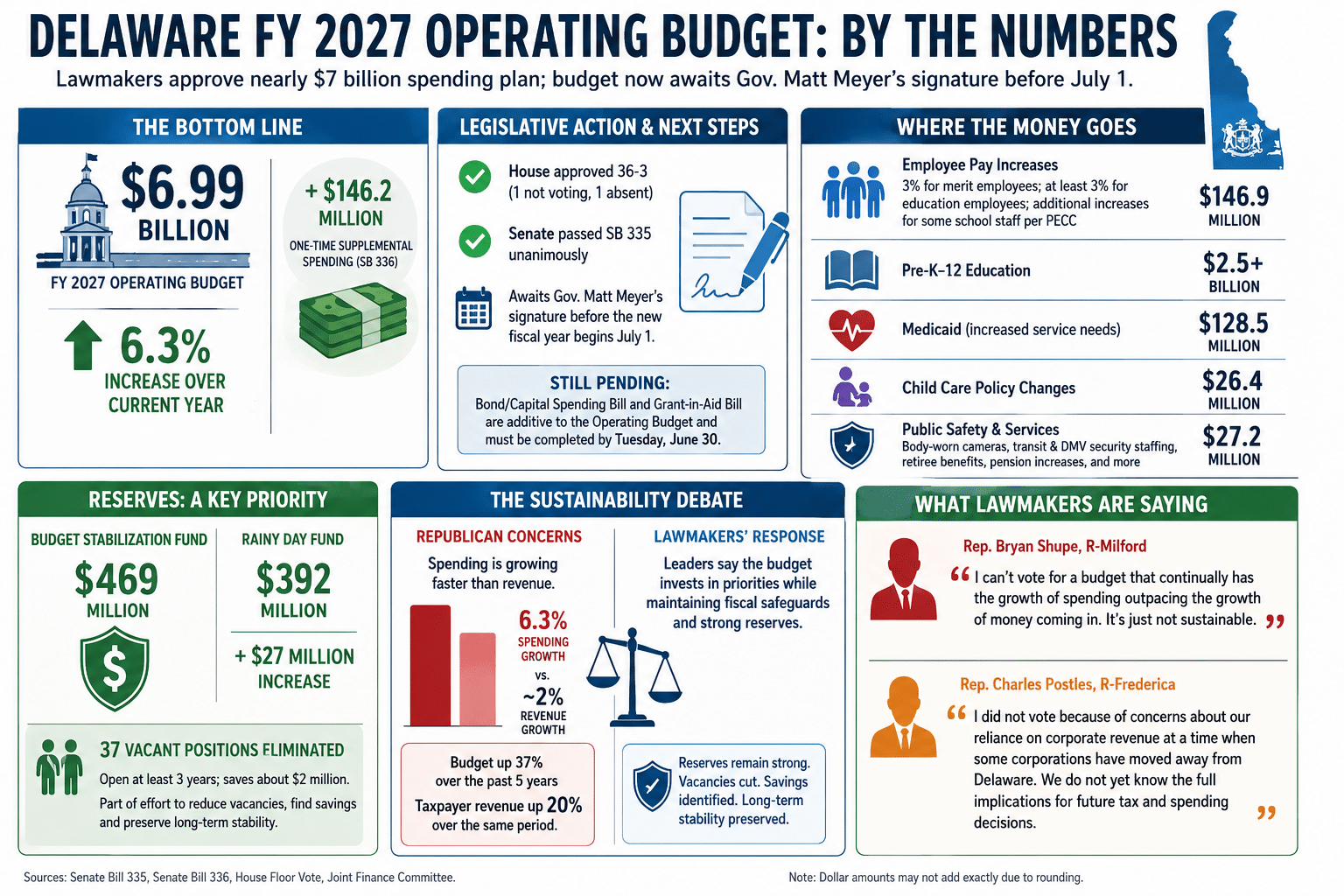
The House approved the spending plan 36-3, with one member not voting and one absent, after the Senate unanimously passed Senate Bill 335 earlier this month. The budget now awaits Meyer’s signature before the new fiscal year begins July 1.
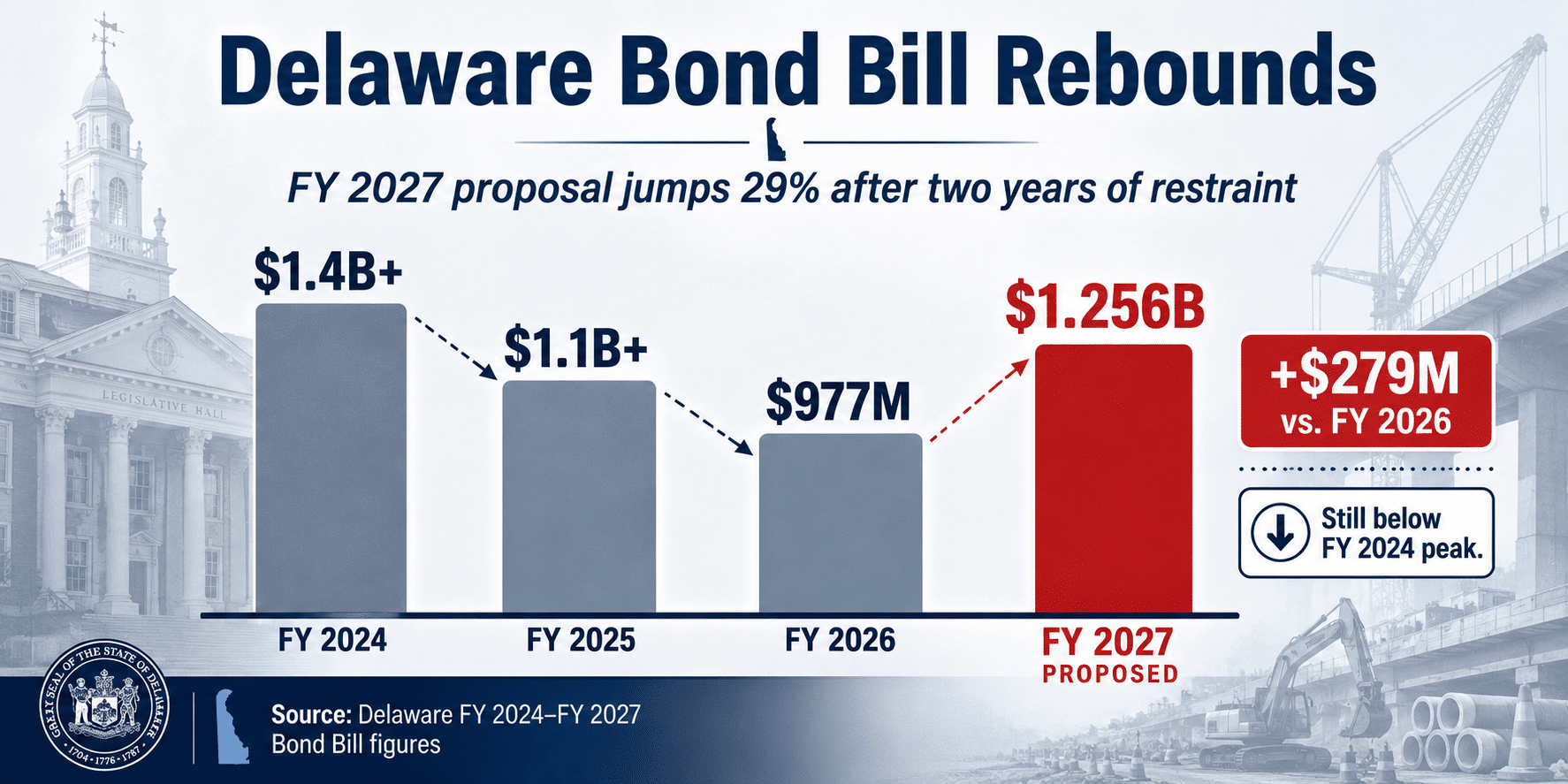
Still pending action in the General Assembly are the annual Bond/Capital Spending Bill and the Grant-in-Aid Bill. These are additive to the Operating Budget and required to fully fund the operation of the state. Both must be completed by the end of the final session on Tuesday, June 30.
Raises, schools and Medicaid drive spending plan
The operating budget totals about $6.99 billion and represents 6.3% growth over the current year. A separate one-time supplemental spending bill, Senate Bill 336, provides $146.2 million for statewide needs.
A major piece of the plan is employee compensation. The budget includes $146.9 million for pay increases, including a 3% raise for merit employees and at least a 3% raise for education employees. Some school workers, including teachers, nurses and non-administrator classroom staff, are slated for additional increases tied to recommendations from the Public Education Compensation Commission, part of the state’s longer-term goal of moving first-year teacher salaries toward $60,000.
State Rep. Kim Williams, D-Marshallton, co-chair of the Joint Finance Committee, said the spending plan is intended to help Delaware recruit and retain public employees while maintaining fiscal safeguards. Supporters also pointed to more than $2.5 billion for pre-K through 12th grade education, $128.5 million to cover increased Medicaid service needs, $26.4 million for child care policy changes, and funding for retiree benefits and pension increases.
The plan also includes public safety and service-related spending, including $2.8 million for Delaware State Police body-worn camera contract increases and $2.2 million for additional security staffing at transit facilities and Division of Motor Vehicles locations.
Reserves remain a central selling point
Budget writers emphasized that the state continues to preserve reserves even as spending rises. The Budget Stabilization Fund remains at $469 million, while the Rainy Day Fund increases by $27 million to $392 million.
The Joint Finance Committee also eliminated 37 vacant positions that had been open for at least three years, a move officials said would save about $2 million. Williams said the budget reflects both policy priorities and an effort to reduce vacancies and identify savings while preserving long-term stability.
Republicans raise sustainability concerns
Republican critics said the budget’s growth raises questions about sustainability. State Rep. Bryan Shupe, R-Milford, opposed the bill, saying the 6.3% spending increase is paired with only about 2% revenue growth.
“I can’t vote for a budget that continually has the growth of spending outpacing the growth of money coming in,” Shupe said. “It’s just not sustainable.”
Shupe said the state budget has grown by 37% over the past five years, compared with a 20% increase in taxpayer revenue over the same period.
State Rep. Charles Postles, R-Frederica, who serves on the Joint Finance Committee, did not vote. He cited concerns about Delaware’s reliance on corporate revenue at a time when some corporations have moved away from the state, saying lawmakers do not yet know the full implications for future tax and spending decisions.
Harm reduction bill heads to Meyer after divided vote
Beyond the budget, one of the most visible late-session debates centered on Senate Bill 249, a harm reduction measure that passed the House 22-16, with two members not voting and one absent, after previously clearing the Senate 15-6.
The bill would establish a regulatory framework for substance use harm reduction programs overseen by the Division of Substance Abuse and Mental Health. Programs would be licensed to distribute sterile supplies used for injecting, ingesting, inhaling or otherwise introducing substances into the body, including needles, syringes, cookers, cotton, tourniquets, clean water, mouthpieces, filters and straws.
Participants would remain anonymous but could receive referrals for primary and behavioral health care, vaccinations, transportation and housing assistance, and help enrolling in public benefits programs. The bill also decriminalizes possession of drug paraphernalia for people who use drugs, while preserving penalties tied to manufacturing, selling or distributing certain paraphernalia and illegal substances.
“Let’s stick with the science,” Jones Giltner told colleagues, urging lawmakers to focus on measures such as drug test strips, Narcan, syringes and longer inpatient treatment.
State Rep. Mike Smith, R-Pike Creek Valley, also urged lawmakers to consider a pilot program before statewide implementation, citing personal losses to overdose while saying policy should be data-driven.
The bill’s initial funding would come from Delaware’s share of opioid settlement money collected from drug companies, distributors and pharmacies.
“Skip the Stuff” remains pending in the Senate
Another closely watched measure, House Bill 111, known as the “Skip the Stuff Act,” would prohibit food establishments from automatically providing single-use food service items such as disposable utensils, napkins, condiment packets, straws and stirrers unless a customer requests them.
The bill, sponsored by Rep. Sophie Phillips, D-Bear, passed the House 27-12 and has been assigned to the Senate Environment, Energy and Transportation Committee. Supporters say the measure is intended to reduce unnecessary waste and litter by changing the default for takeout and delivery orders.
Under the latest substitute, restaurants and other covered food establishments would be allowed to provide self-service stations and would be required to give customers a way to request single-use items. The bill exempts nonprofits, schools, early childhood centers, health care facilities and certain correctional and state-operated facilities from the definition of food establishment.
Penalties would not begin until two years after enactment. After warnings for earlier violations, fines for third and subsequent violations could reach a cumulative maximum of $1,500 per year.
Session closes with spending, public health and environmental policy in focus
Together, the budget, harm reduction bill and single-use item proposal show the range of issues still moving in Dover as lawmakers approach the end of session. The operating budget appears on track for enactment with the governor’s signature, while Senate Bill 249 has also reached Meyer’s desk after a sharply divided House vote. House Bill 111, meanwhile, remains pending in the Senate.
Brent is a 35-year resident of Delaware, having retired after a 38 year career in Operations & Supply Chain with Dupont and Axalta. He is active politically and focuses primarily on Delaware legislative activities.