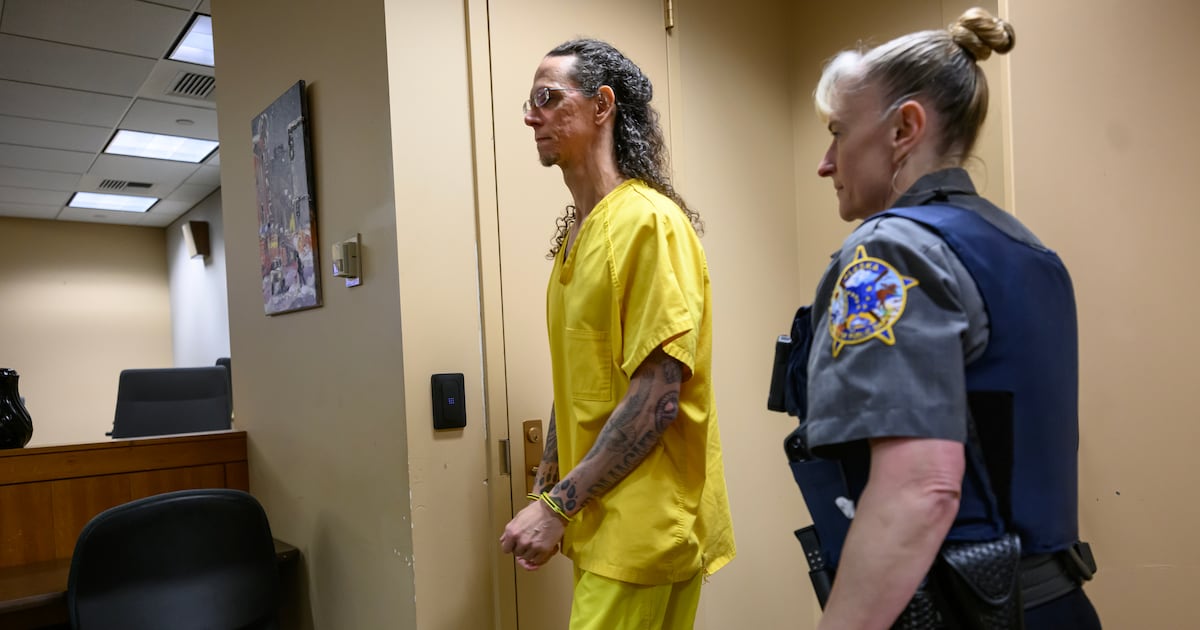
Brian Hall enters the courtroom after a break in a resentencing hearing in Anchorage on June 5. (Marc Lester / ADN)
A reduced sentence for a man who killed two young men in the woods of East Anchorage over 30 years ago did not result in his release last week, as supporters had hoped.
Although the new sentence for 50-year-old Brian Hall allows him to seek an early release on parole later this year, it could also mean decades more in prison.
Hall was 17 in 1993 when he shot and killed Stanley Honeycutt, 20, and Mickey Dinsmore, 24, during a dispute at a party. Hall was serving a 159-year prison term until a 2023 Alaska Court of Appeals decision opened the door for young people given lengthy sentences to receive new, reduced sentences.
On Friday, Anchorage Superior Court Judge Andrew Peterson reduced Hall’s prison time to a combined 99 years on first- and second-degree murder convictions in the deaths of Honeycutt and Dinsmore, according to a temporary order filed after the hearing.
Hall is eligible to apply for parole after serving one-third of his sentence, so he could apply to be released later this year, said Susan Orlansky, one of the attorneys who represented Hall on behalf of the ACLU of Alaska.
If not granted parole, Hall won’t be released until around 2059 under a mandatory parole provision that reduces an inmate’s sentence by a third for good behavior, Orlansky said.
Hall would be around 83 if released then.
The ACLU of Alaska said the decision could still amount to a “functional life sentence.”
“Mr. Hall has spent the last three decades of his life acknowledging and taking responsibility for the crime that he committed at a young age, a crime that has had a lasting impact on people who experienced great loss and our community at large,” the organization said in a statement. “This decision fails to balance the need for punishment with the rehabilitative promise of Alaska’s constitution and criminal legal system.”
Hall’s wife, Angela, whom he met when she was completing a college assignment, declined an interview request but said in a text message that she may want to speak about the case again after a parole board review, saying “we will remain hopeful and continue moving forward.”
Hall is the latest person serving a lengthy prison sentence in Alaska who was resentenced after the 2023 appeals court decision, which required judges to consider factors of youth, vulnerability and odds of rehabilitation when sentencing juveniles.
Unless there was evidence a teenager is “irreparably corrupt,” the appeals court decision said juveniles could not be sentenced to what amounted to a life sentence.
Since that ruling, several people convicted of high-profile crimes as teenagers in Alaska have been released, like Winona Fletcher, who served 40 years of an original 135-year sentence for her role in the deaths of three people in a 1985 Anchorage home invasion. Others have had their sentences reduced or are seeking a new sentence under the new criteria.
Fewer than 20 people convicted as juveniles who are serving lengthy sentences are eligible to have their sentences reviewed, ACLU of Alaska spokesperson Meghan Barker said.
In Hall’s case, prosecutors in court filings argued that the ruling didn’t apply to Hall because the judge who sentenced him in the 1990s had properly weighed Hall’s age.
Peterson disagreed and in a 2025 decision ordered Hall’s resentencing, saying the original sentence was unconstitutional and didn’t factor in “attendant characteristics of youth” that the appeals court now required.
Family members of Dinsmore and Honeycutt could not be reached for comment.
Relatives of victims of crimes that later came up for resentencing, including in Hall’s case, have spoken out against the resentencing process. In an op-ed published in the Daily News, family members said the Alaska Court of Appeals’ ruling was a “profound unfairness to victims” that “will have a dramatic impact on victims of crime.”
Family members also spoke during a June resentencing hearing in Hall’s case about the impact the murders have had on them and how upsetting Hall’s potential release was.
Hall and his attorneys said during testimony and in court documents that he has worked hard to rehabilitate himself while incarcerated and recognized the harm he caused. Hall, his attorneys wrote in a memo, had no disciplinary infractions in the previous 20 years, earned a GED diploma and numerous other educational certificates, and served as a leader and mentor for other inmates.
Had he been released, Hall planned to temporarily live in a transitional living facility before eventually moving in with his wife, according to a memo filed by his attorneys. Hall’s release plan also included receiving support and mentorship from an oil and gas industry union leader who said he would help Hall land a job in the field, Hall’s attorneys wrote.
His attorneys say Hall may have a chance to apply for parole later this year, depending on when the state Parole Board goes to Wildwood Correctional Complex in Kenai, where he’s been serving his sentence.