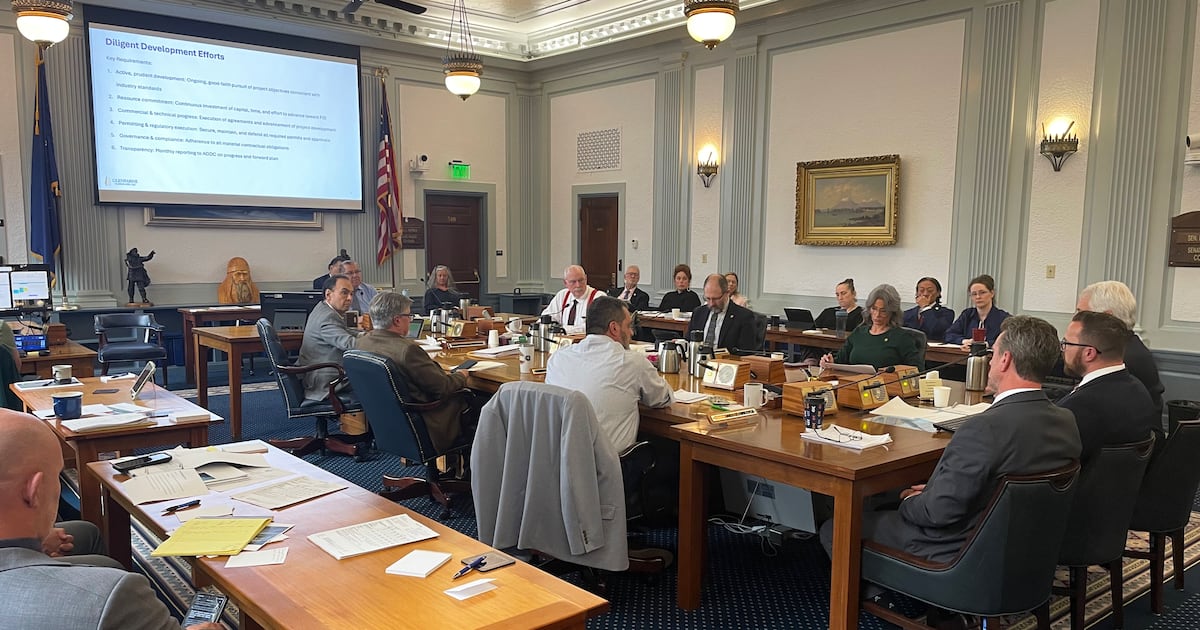
Alaska LNG project developers testify before the Alaska Senate Finance Committee on June 16 at the Alaska State Capitol building in Juneau during the first special session on a tax break bill for the megaproject. (Mari Kanagy / ADN)
Alaska lawmakers are scheduled to reconvene in Juneau this week with an eye toward voting on a bill that would grant tax cuts to the developers of a long-sought natural gas pipeline megaproject.
But the final version of the bill has yet to be agreed on by a six-member bicameral conference committee, and it is unclear whether the committee can reach agreement before the full House and Senate sessions scheduled on Thursday, according to committee members.
Rep. Calvin Schrage, an Anchorage independent who chairs the conference committee, said Monday that the committee will meet before Thursday to advance a version of the bill to the full House and Senate.
“Obviously, that’ll depend on actually having support for that conference committee product. Whether or not we’re actually able to get there by Wednesday, time will tell,” said Schrage.
Rep. Calvin Schrage, I-Anchorage, left, reflects on comments by Rep. Justin Ruffridge, R-Soldotna, right, on July 2 on the most recent version of a bill that would cut property taxes in an effort to facilitate the construction of the Alaska LNG project. (Mari Kanagy / ADN)
Schrage returned to Juneau on Monday, after departing the Capitol on July 2, when a new version of the tax break bill was introduced. Progress on the legislation has been on hold.
The committee was tasked last month with negotiating a compromise between versions of the tax bill passed in the House and Senate last month. The conference committee initially planned to advance the compromise bill to the full Legislature on July 1, but that was postponed as debates on the contents of the bill continued.
The legislation was originally introduced by Gov. Mike Dunleavy, who in March proposed lowering taxes for the Alaska LNG megaproject, then called lawmakers into two consecutive 30-day special sessions after they were unable to reach agreement on the bill.
The current special session is scheduled to end Sunday.
With the deadline looming, House and Senate members are returning to Juneau this week with the hope of passing a bill that can be signed by the governor.
The main disagreement remains whether to include a change to the state’s corporate income tax structure. The tax currently applies to publicly traded companies. A majority in the Senate support applying the tax to privately held oil and gas companies, which include Glenfarne, the New York City-based gas line developer that controls a 75% stake in the Alaska LNG project, and Hilcorp, one of the largest oil and gas companies operating in Alaska.
The tax on so-called “pass-through entities” is “one of the critical issues that needs to be decided on,” Schrage said. “Ultimately, we want to make sure that we have a bill that can pass the Legislature. And what we’re hearing from many legislators is that it is a key provision that they are looking for.”
But Dunleavy, along with most Republican lawmakers, has remained staunchly opposed to including such a tax change in a bill that they say is intended primarily to make the gas line viable by reducing the developers’ tax liability.
“That’s part of why we need to get everyone back into Juneau and have some of those caucus discussions, have conference committee member discussions, and figure out what it’s going to take in order to get a bill successfully across the line during the special session,” Schrage said.
At stake are hundreds of millions of dollars in annual revenue to the state of Alaska, if the pipeline is built.
Even with billions of dollars in proposed tax breaks, the construction of the 800-mile pipeline and associated infrastructure, estimated to cost over $50 billion, is not guaranteed. A final investment decision, which ensures funding is available to complete the project, has yet to be reached.
Rep. Justin Ruffridge, a Soldotna Republican who represents the House minority on the conference committee, said he remains opposed to the corporate income tax change and warned that the ongoing disagreement could prevent lawmakers from passing a bill before the special session ends.
“I think if there isn’t clear agreement on what has to be in there, there’s a real possibility that it doesn’t come out of conference,” said Ruffridge.
Rep. Justin Ruffridge, R-Soldotna, speaks during floor session at the Alaska State Capitol in Juneau on May 18. (Bill Roth / ADN)
Committee members must agree on a final version of the bill before sending it to the full House and Senate for consideration. Lawmakers in each chamber can only vote the measure up or down — they cannot amend it on the floor — putting pressure on the conference committee to produce a version that can win approval in both chambers.
The pass-through entity tax “has not been well-vetted or really modeled at all,” said Ruffridge, echoing a viewpoint that has been central to a flurry of opinion pieces and social media posts on the topic in recent days.
Ruffridge said he’s also concerned that the tax on Hilcorp, the primary developer of dwindling natural gas reserves in Cook Inlet, could lead to higher natural gas prices for Southcentral consumers, who are already facing the prospect of higher prices as natural gas reserves are drawn down.
Another concern of opponents of the tax is that it could lead privately held companies like Glenfarne to reduce their tax liabilities by altering their business model.
“Even if you pass an S-corp provision, there’s a real potential, for Glenfarne especially, that they don’t actually pay any pass-through tax for two decades because the sheer volume of capital expenditure would be a write-off against their profitability,” said Ruffridge. “So these entities will find ways, I think, of mitigating or moving around whatever those taxes are.”
Sen. Bill Wielechowski, an Anchorage Democrat spoke during a joint session at the Alaska State Capitol in Juneau on Tuesday, May 19, 2026. (Bill Roth / ADN)
Sen. Bill Wielechowski, an Anchorage Democrat, has been a vocal proponent of updating the state’s corporate income tax structure to apply to privately held companies. He said Monday that a majority in the Senate remain in favor of the provision.
“I think when you look at this logically, and you look at this from what’s in the state’s best interest, and you look at the economics of the project, I think rationally and logically there’s not even a question,” Wielechowski said. “The sole question here is whether or not another couple of huge outside wealthy corporations and individuals will be able to exert their political influence over the state of Alaska.”