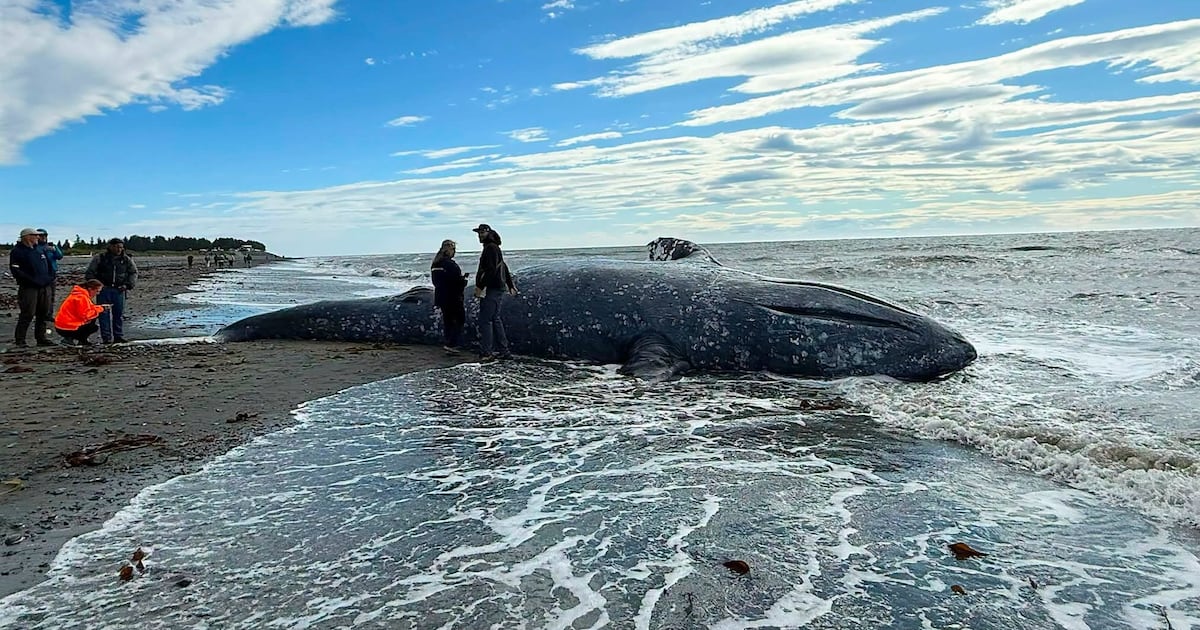
A gray whale that washed up at Anchor Point on June 29, 2026 appears to be part of a larger West Coast die-off this year, advocates say. (Photo by Tim Hatfield)
A dead gray whale that washed up on an Anchor Point beach late last month is part of a West Coast die-off that biologists expect to worsen.
As of this week, federal officials say they have documented 150 gray whales stranded from Mexico to Alaska, where 18 of them have been found. A dead gray whale in Chiniak on Kodiak Island was the most recent discovery.
“We expect this number will increase as the gray whales continue their migration north,” Jennifer Angelo, an Anchorage-based spokesperson for the National Oceanic and Atmospheric Administration, said in an email.
The gray whale that appeared on the beach in Anchor Point on June 29 was the 13th found in Alaska this year, according to Angelo. There have been five beached gray whales since.
Homer resident Tim Hatfield said people flocked to see the carcass of the huge animal — “it’s like a tourist attraction” — that washed up on an easily accessible beach.
A beached gray whale that washed up at Anchor Point on June 29, 2026 appears to be part of a larger West Coast whale die-off this year, advocates say. (Photo by Tim Hatfield)
NOAA Fisheries officials, with Alaska Veterinary Pathology Services and the University of Alaska Anchorage, conducted a necropsy of the whale on June 30 with help from Alaska Marine Mammal Stranding Network partners, the Kenaitze Indian Tribe and community volunteers.
Preliminary findings indicate the whale “was an adult female in thin body condition,” Angelo wrote in an email. “The official cause of death is pending further histological and diagnostic testing of collected samples, which can take months to complete.”
Gray whales migrate thousands of miles every year between winter calving lagoons off Baja California and Arctic feeding grounds.
Federal officials declared a yearslong die-off involving eastern North Pacific gray whales from 2019 through 2023. The investigation and related research found the strandings were related to ecological changes in the Arctic that have affected the availability of sea-floor prey that most gray whales feed on each summer, Angelo said.
This summer, NOAA is tracking the elevated number of gray whale strandings along the West Coast, she said. The same factors are involved.
The strandings this year represent what Public Employees for Environmental Responsibility, a whistleblower protection and environmental advocacy group, is calling a new catastrophic die-off. This year’s count most likely underestimates the actual number of gray whales dying off the coast because the carcasses tend to sink, the group said.
The whales seem to be starving, PEER board chair and Alaska marine biologist Rick Steiner said in a statement. As declining Arctic sea ice reduces the tiny shrimp-like crustaceans the whales feed on, the group is pressing for action on shorter-term threats including ship strikes, oil spills, fishing gear entanglement, ocean noise and disturbance.
Anyone who finds stranded, injured, entangled or dead marine mammals can report them to the Alaska Marine Mammal Stranding Network 24-hour hotline at 1-877-925-7773.