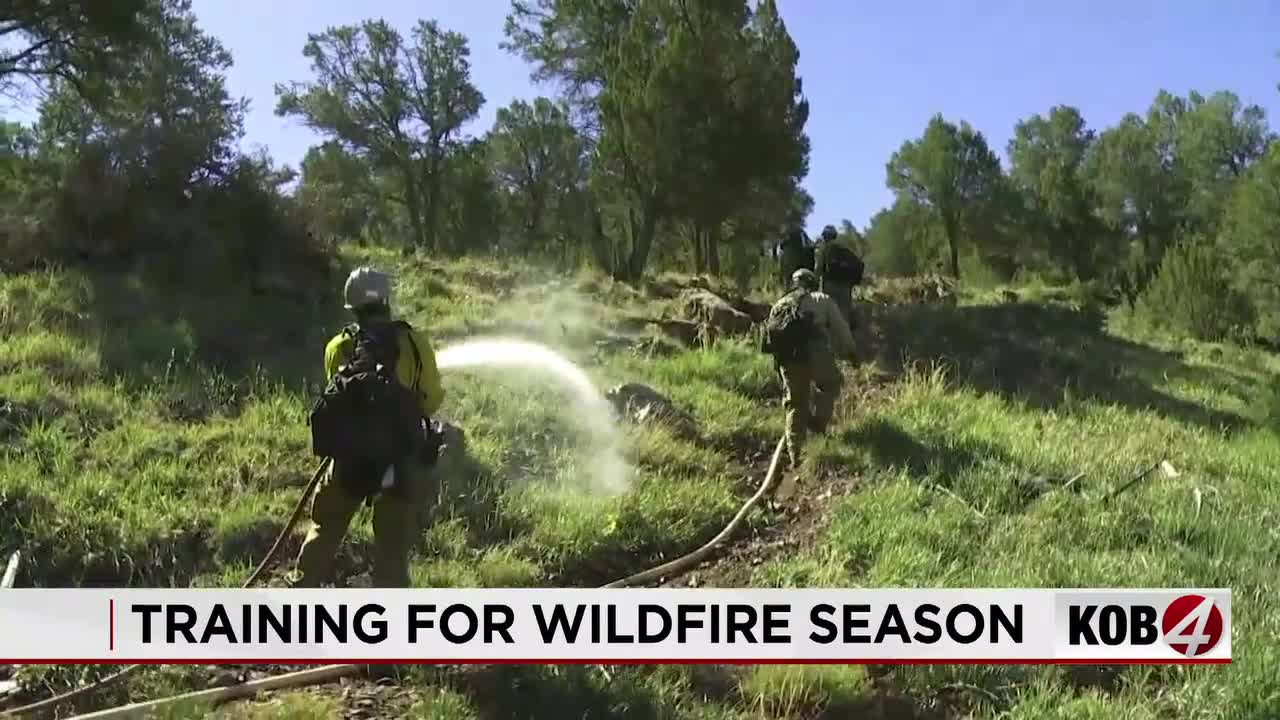
ALBUQUERQUE, N.M. – U.S. Forest Service crews in New Mexico are already training for wildfire season, with daily preparation and helicopter support to assist on fires.
The U.S. Forest Service said low snowpack this year is making that preparation even more critical.
“There’s no lag time here,” Matt Rau, a fire staff officer for the U.S. Forest Service said. “And so we’re prepared as we were last year for an early start for fire season, and the potential for large fire growth is present all across the southwest this year for sure.”
Peak fire season typically hits in May and goes through late June.
Rau said every fire is different, which means every response has to be different too.
“You can be put into a situation where you have to have your wits about you very soon this season,” Rau said.
How do crews prepare?
Rau said coordination starts with an incident commander, who directs work on the fire, oversees safety and handles tactics and strategy.
“Fom there, there’s different qualifications and positions that you use depending on the size of the fire, the but you’ll have people that are engaged in mid-level supervision, so maybe supervising three or four or five engines or several bulldozers, and then down from there you’ve got just the actual crews that are doing the work,” Rau said.
The role of the lookout and air support
One of the most critical positions is the lookout, which gives crews a full view of fire movement and conditions.
“We practice in all scenarios to be prepared for that. So we train with how to use aircraft, how to properly identify what the needs are on the ground, whether you need heavy equipment, bulldozers, logging type of equipment, or whether it can just be performed by hand crews or engine crews going out,” Rau said.
Helicopters also play a big role in tracking fire movement and bringing in water, food, tools and chainsaws to help clear vegetation and build fire lines.
“What we say to all our firefighters is don’t rely solely on the aircraft. Things happen and so it’s not uncommon for firefighters on a heli-tech crew or any firefighters to be inserted via helicopter and they have to hike off,” Rau said. “That’s something that you just have to be prepared for and that’s one of the reasons why physical training and physical fitness is so key.”
The Sandia heli-tech crew is now inspecting its helicopter so it can be ready to assist on fires as early as Thursday.
The U.S. Forest Service said the helicopter can drop 170 gallons of water at a time, pulling from sources like rivers or ponds.
For bigger fires, the U.S. Forest Service also has an air tanker stationed at Kirtland Air Force Base, ready to drop large amounts of fire retardant.
- For Related Stories: Melissa Wright New Mexico Fires