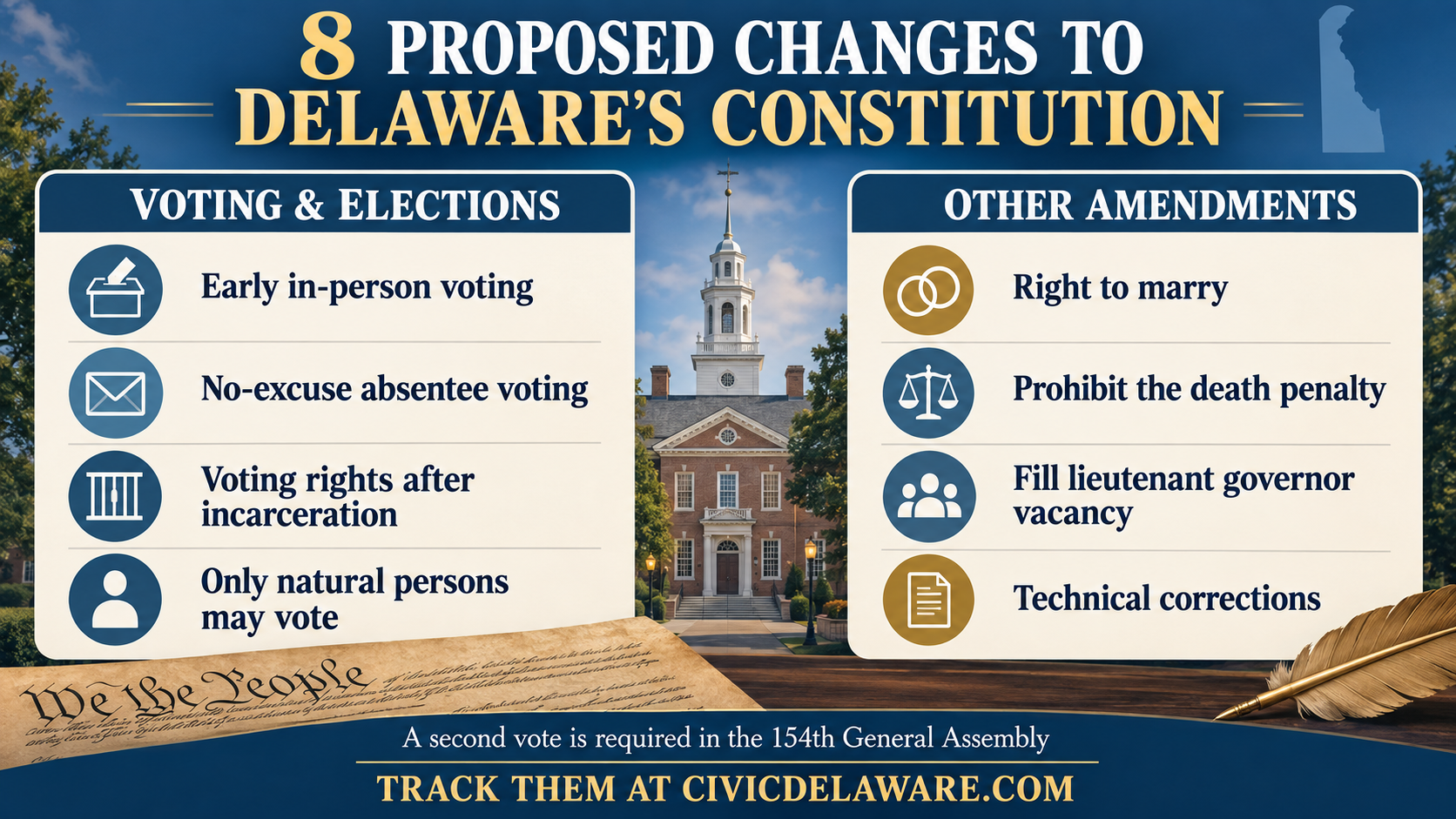
Four amendments involve voting rules, while others address marriage, the death penalty and vacancies in the lieutenant governor’s office
DOVER, Del. — Delaware’s next General Assembly will inherit eight proposed amendments to the state Constitution, including four that could change voting rights and election procedures.
Vil Ramunno, a public policy researcher and Delaware LIVE contributing journalist, outlined the proposals during an appearance on “A Better Discussion,” hosted by former Delaware Attorney General Jane Brady for A Better Delaware.
The amendments already received the required approval from two-thirds of the members elected to each chamber of the 153rd General Assembly. However, none is part of the Constitution yet.
Under Delaware’s amendment process, the same proposed changes must receive two-thirds support in the House and Senate again after a general election. Unlike most states, Delaware does not routinely place individual constitutional amendments before voters for ratification. The governor also has no power to sign or veto them.
That means the lawmakers elected in November will decide whether the eight proposals become part of Delaware’s foundational legal document.
Four voting amendments
Ramunno said four of the pending amendments involve elections or voting rights:
• Senate Substitute 1 for Senate Bill 2 would authorize 10 days of early, in-person voting before general, primary and certain special elections.
• Senate Substitute 1 for Senate Bill 3 would create a constitutional right to vote by absentee ballot without providing an excuse. Voters generally would still have to request a ballot for each election cycle unless they qualify for permanent absentee status.
• House Bill 180 would generally restore voting rights to people convicted of felonies after they are released from incarceration. It would prohibit making restoration contingent upon restitution or another monetary payment and remove obsolete residency and literacy provisions.
• House Bill 430 would specify that only natural persons may vote in Delaware elections, preventing corporations and other artificial entities from being granted voting rights.
Ramunno said her initial impression was that the four voting measures weren’t a major concern, though she offered a clarification after the interview.
Brady disagreed with that initial assessment, raising concerns about the details lawmakers could later establish through statute. She particularly questioned the no-excuse absentee proposal.
Ramunno said she wanted to clarify her position on the felon voting rights amendment: on reflection, she agreed with Brady’s concern that restitution should be addressed before voting rights are restored, since the amendment as written would prevent the state from ever requiring that.
Their exchange demonstrated why the second round of legislative consideration could produce significant debate, even though each proposal secured the supermajority needed to clear its first constitutional hurdle.
Marriage, death penalty and state offices
The four remaining amendments would address other parts of the Constitution:
• Senate Substitute 2 for Senate Bill 100 would establish marriage as a fundamental right that cannot be denied based on gender or another characteristic protected by the Constitution. It also contains language protecting religious freedom.
• House Substitute 1 for House Bill 35 would constitutionally prohibit the death penalty. Delaware currently has no enforceable death penalty statute, but the amendment would prevent a future General Assembly from restoring capital punishment without another constitutional change.
• Senate Bill 264 would establish a special-election process for filling most vacancies in the lieutenant governor’s office.
• House Substitute 1 for House Bill 320 would make a series of technical corrections to the Constitution, including removing duplicated words, correcting punctuation and clarifying several provisions.
Brady cautioned against treating the Constitution like ordinary legislation, saying it should remain a foundational document that is changed carefully and infrequently.
Making legislation easier to follow: CivicDelaware.com
Ramunno’s analysis is informed by nearly a decade in public policy. She previously served as a senior editor at the Caesar Rodney Institute, where she worked to make policy reports clear and accessible to general readers.
She now covers government and politics for Delaware LIVE and also works as a public policy researcher.
Ramunno also created Civic Delaware, a legislative information platform designed to help residents follow bills moving through Legislative Hall. Its primary tool, Dover Dash, tracks legislation from introduction through committee hearings, floor consideration and final action.
She said she developed the platform after watching complex bills move from introduction to passage in a matter of days during the final weeks of a legislative session.
Dover Dash uses automated updates from the General Assembly’s website and organizes bills according to the people most likely to be affected. Users can select profiles such as homeowner, parent, young professional, retiree, senior or veteran.
Instead of displaying only bill numbers, the platform gives proposals descriptive names, plain-language summaries, their official legislative synopses and current status. Users can also browse bills by subjects such as taxes, energy, alcohol and cannabis, and the state Constitution.
“You want to only know the ones that affect you, and it helps you to be more engaged,” Ramunno said. “And it makes it a little personal, too.”
She said Civic Delaware will archive legislation from the outgoing General Assembly when the new session begins in January. The eight proposed constitutional amendments will remain active because they must be considered again by the incoming lawmakers.
Ramunno said the goal is to help residents learn about proposals before they become law, ask informed questions and engage directly with their elected representatives.
TO GO: Track legislation with Civic Delaware
• What: Civic Delaware’s Dover Dash tracks legislation moving through the Delaware General Assembly.
• How it works: Choose a profile, homeowner, parent, young professional, retiree, senior or veteran, to surface bills that affect you, or browse by subject instead.
• What you’ll find: Plain-English summaries, official legislative synopses and real-time status for every bill in the pipeline.
• Visit: CivicDelaware.com
• Why it matters: Bills can move from introduction to passage in days, especially late in a session. Dover Dash gives residents time to catch a proposal and ask their legislator about it before the vote.