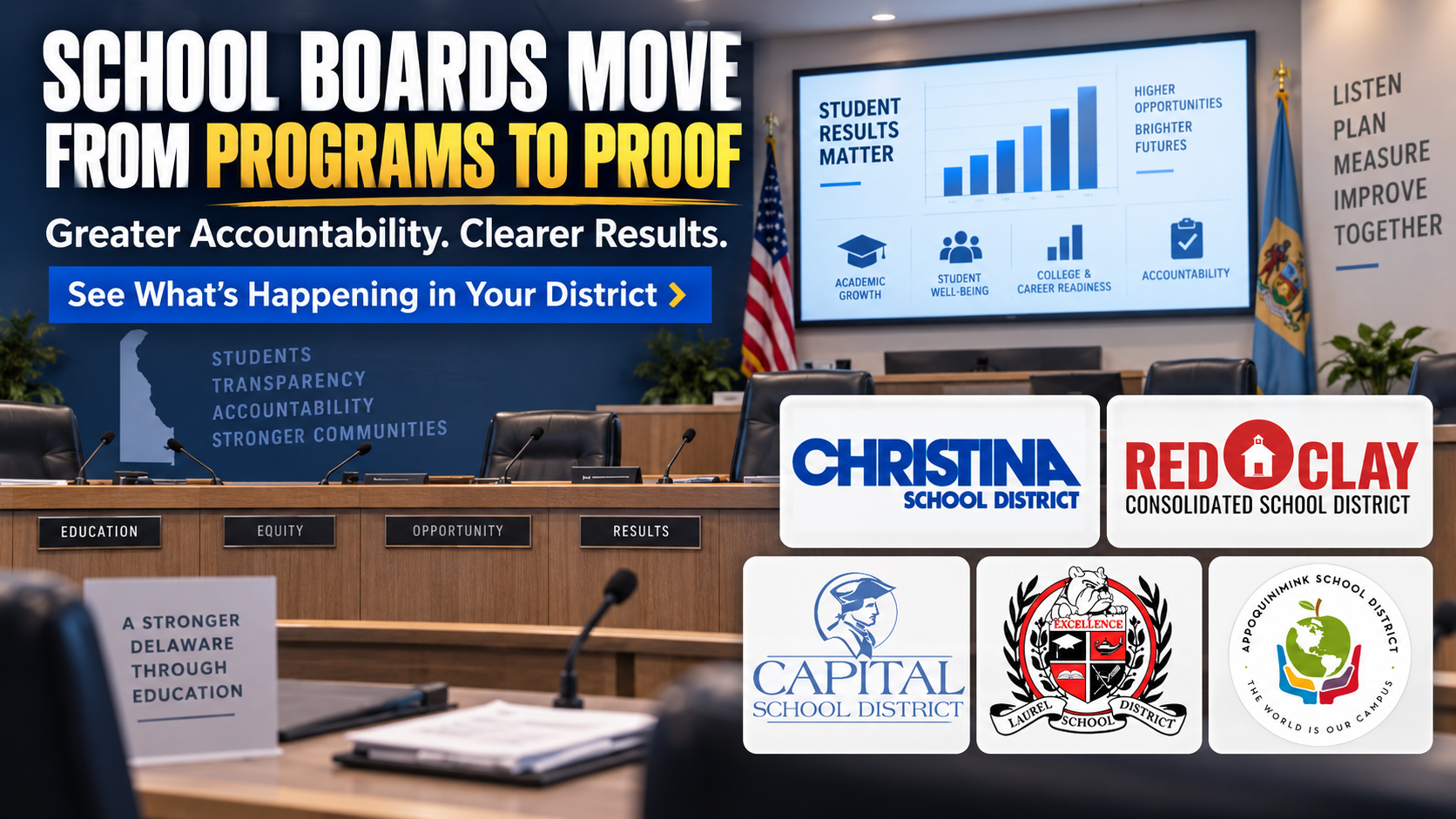
First State Educate’s School Board Roundup, published monthly, brings together discussions from Delaware’s 16 traditional public school districts… and it’s free!
First State Educate’s August School Board Roundup brings local meetings together to show the issues taking shape across Delaware.
DOVER, Del. — Decisions about student progress, district budgets, school buildings, and student support appeared across Delaware school board meetings in August. The details differed by district, but the discussions raised a shared question: How will boards know whether their plans are meeting students’ needs?
First State Educate’s August School Board Roundup brings together discussions from Delaware’s 16 traditional public school districts. It gives residents a way to follow their own board while seeing how issues in one district connect to those facing others.
FSE publishes the School Board Roundup monthly. Readers can find the latest edition in the Knowledge Hub.
The August meetings raised questions about measuring student progress, explaining financial choices, addressing building needs, and reporting back to the public. Some boards made decisions; others reviewed plans that will return for further discussion.
Turning priorities into measurable goals
Some boards adopted measurable academic goals, while others outlined how they plan to review progress during the school year. Their discussions covered reading, mathematics, attendance, and school climate.
Setting a long-term target is one step. Boards also need information during the year to see whether students are progressing toward it. The superintendent and district staff develop and carry out strategies; boards establish the outcomes they expect and monitor progress.
The August discussions show why progress and continuing gaps belong in the same conversation. An improvement in one measure may be encouraging while results in another grade or subject still call for attention. Families and community members need both to understand the full picture.
Asking what spending should accomplish
School boards discussed how targeted funding can respond to student needs. Some considered plans or greater flexibility for resources supporting multilingual learners, students from low-income households, mental health services, and other needs.
Approving a spending plan does not yet show what students gained from it. Future reports can help residents understand which students the spending is meant to help, what result the district expects, and how progress will be measured.
Those questions help boards connect proposed investments to district goals while leaving the development and implementation of strategies to district leaders and staff.
Making district finances easier to understand
Financial discussions varied across districts in August. Some reported enough cash to cover near-term obligations. Others discussed projected deficits, use of reserves, delayed revenue, or the possibility of a future referendum.
A district may have enough money to pay immediate bills while budgeting to spend more over the year than it expects to receive. Several boards asked for clearer reports to help them and the public understand the difference between available cash and longer-term financial pressures.
Clear information matters when a district considers reducing spending or asking residents for additional revenue. People need to understand what is driving the need, how current funds are being used, and what choices the board is weighing.
Following building needs and state funding requests
Facilities were a recurring subject at August meetings. Boards discussed overcrowding, aging buildings, renovations, new construction, and how to finance proposed work.
Several districts are resubmitting projects that have not received state funding. Board members also raised questions about how the state prioritizes requests and how long documented building needs may wait.
Submitting a construction request does not mean a project or referendum has been approved. Knowing where a proposal stands helps residents understand what their district is seeking, what need it would address, and what decisions may come next.
Connecting student supports with learning
Attendance, behavior, mental health, special education, and academic support appeared in discussions across multiple districts.
Some districts described efforts to make services more consistent across schools. Others discussed wellness centers, family outreach, or ways to identify why students are missing class. Together, the discussions show how access to support can affect a student’s ability to participate in learning.
The meetings describe services being developed or put into place; they do not yet establish their effects. As districts continue this work, boards can ask whether services reach the intended students, whether they are delivered consistently, and whether attendance, engagement, or other outcomes improve.
Watching safety and technology policies take shape
School safety remained on board agendas in August. Discussions covered equipment and building procedures, staff training, emergency planning, student discipline, and communication with families.
Districts also addressed personal electronic devices, artificial intelligence, and the role of technology in classrooms. Some adopted policies; others began reviewing proposals or changing how existing rules will be carried out.
Boards discussed device distractions, expectations for AI use, and how technology supports instruction. Safety discussions likewise extended beyond equipment to training, procedures, and communication. Future reports can show how these decisions were implemented and whether they served their intended purposes.
Staffing and student pathways
Districts entered the school year with different staffing needs. Some reported relatively few general vacancies but continued to have difficulty filling specialized positions, including roles in special education and student services. Others discussed how vacancies and compensation decisions affect their budgets.
Boards also heard about opportunities intended to connect students with college and careers, including internships and career and technical education. These discussions raise questions about access: which students can participate, what they learn or earn, and how programs connect to opportunities after graduation.
Making board decisions visible to the public
Several boards discussed how residents can better understand decisions before and after they are made. Topics included clearer financial reports, publication of board priorities and calendars, public access to committee meetings, and opportunities for community input.
A proposed policy, a state funding request, and an approved district plan are different steps. Explaining what has happened—and what remains undecided—helps residents know when and how they can participate.
What is happening in your district?
The statewide themes are shared, but the decisions remain local. One board may be reviewing student goals while another is considering a building request, changing a technology policy, or seeking a clearer financial report.
By bringing the meetings together, the August Roundup helps residents see both their district’s decisions and the questions other Delaware boards are facing. Readers can use that context to follow what happens at the next public meeting.
TO GO BOX: Follow Your School Board’s Decisions
The August School Board Roundup covers discussions across Delaware’s 16 traditional public school districts. Create a free Knowledge Hub account to find the report and learn:
-
What your district’s board discussed as the school year began
-
Which student goals, policies, and spending plans are moving forward
-
What financial and building needs could affect your community
-
Which plans still need measures or follow-up reports
-
What questions may return to the board’s agenda
Find the August School Board Roundup in the Knowledge Hub: https://www.firststateeducate.org/knowledgehub
Delaware LIVE collaborates with a network of professional journalists to cover a diverse range of stories across various fields. Staff Writers include experienced journalists and young professionals. If you have questions, please feel free to contact [email protected] or our publisher, George D. Rotsch, at [email protected]