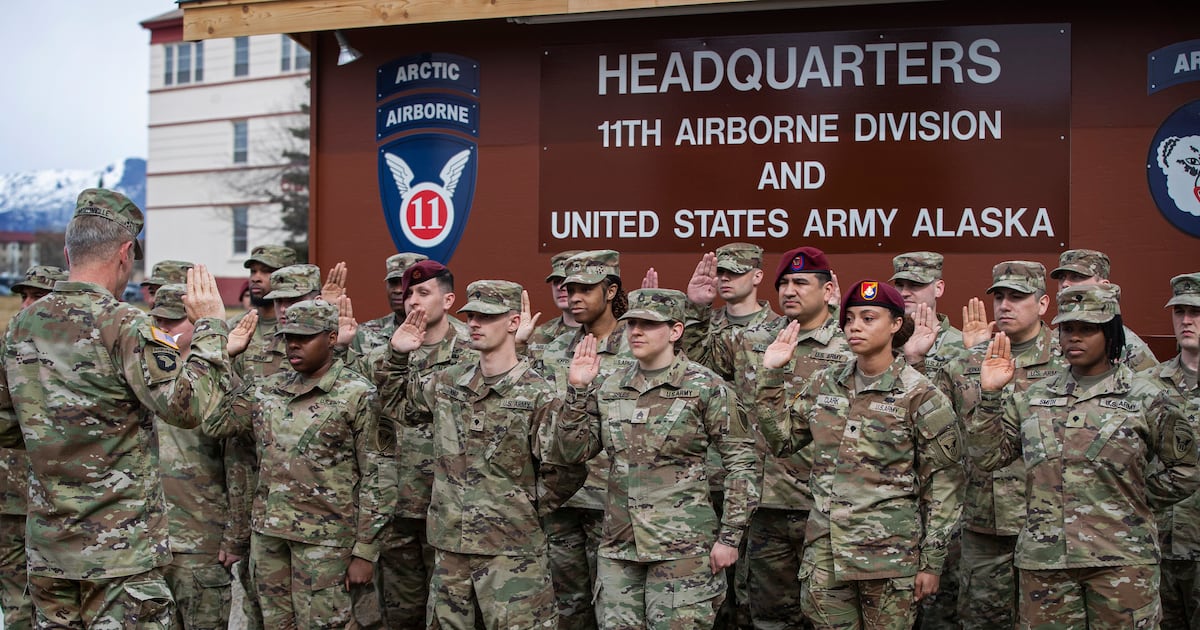
Gen. James C. McConville, U.S. Army chief of staff, delivers the oath of reenlistment to 20 11th Airborne Division soldiers on Joint Base Elmendorf-Richardson in Anchorage on Friday, May 5, 2023. (Emily Mesner / ADN)
Alaska Gov. Mike Dunleavy said Thursday that the state is setting up a new office to handle coordination on military matters among various stakeholders.
The Alaska Military Affairs Office will fall under the state’s Department of Military and Veterans Affairs and coordinate among federal bases, private industry, communities and government entities.
“The creation of the Alaska Military Affairs Office demonstrates our commitment to protecting and expanding our military presence while ensuring our communities, infrastructure, workforce, and industries are prepared to support the missions that defend our nation. This office will strengthen coordination across state government and help position Alaska for continued military investment and economic growth,” Dunleavy said in a statement.
The new office will be made up of three employees based in Fairbanks and Anchorage, according to the Department of Military and Veterans Affairs, with funding provided by a grant from the federal Defense Department’s Office of Local Defense Community Cooperation.
“As focus on the Arctic and national security continues to increase, the governor recognized the need to centralize coordination to ensure Alaska remains a strategic, competitive and capable hub for current and future defense missions, prompting the creation of the Alaska Military Affairs Office,” wrote legislative liaison Angela Laflamme with the state military and veterans affairs department.
In recent years, the Office of Local Defense Community Cooperation has funded tens of millions of dollars in grants on dual-use projects in Alaska that serve military priorities and personnel as well as civilians. Those grants included $5.78 million for rebuilding the Ursa Major Elementary School at Joint Base Elmendorf-Richardson and $5.3 million to build a micro-grid energy system at the Port of Alaska, among other projects.
Alaska has long benefited economically from defense spending on infrastructure, personnel and technology.
Fort Richardson, part of Joint Base Elmendorf-Richardson, is seen from Arctic Valley Road in September 2022. Mount Susitna, also known as Sleeping Lady, is in the background. (Emily Mesner / ADN archive)
JBER in Anchorage is expected to see a construction boom in the next several years. Federal officials are preparing to renovate and replace a huge chunk of the base’s physical infrastructure, anticipating $7 billion in federal funds to pay for airfield paving, new housing, additional training buildings, maintenance shops and other facilities deemed critical to operations. A significant share of that money could go to Alaska-based companies and contractors, many of whom hold preferential bidding status under federal procurement guidelines.
Military-funded construction is coming to other parts of Alaska, too. The announcement of new Coast Guard icebreakers set to be home-ported in Kodiak and Seward will require the addition of new housing, services and shore-side infrastructure to handle personnel, support staff and dependents. Alaska’s congressional delegation and local officials continue pushing forward an expansion of the Port of Nome to accommodate deep-draft vessels, including military ships. An experimental project to add a micro-nuclear reactor to power portions of Eielson Air Force Base outside Fairbanks is steadily advancing, and is expected to be completed by 2030, according to the Office of the Deputy Assistant Secretary of the Air Force for Infrastructure, Energy and Environment.
According to Dunleavy’s office, the new Alaska Military Affairs Office will “coordinate long-range planning for infrastructure that supports operations;” “strengthen partnerships among military installations, local governments, Tribal organizations, industry, educational institutions, and community organizations”; and “coordinate closely with Alaska’s congressional delegation.”
Maj. Gen. Torrence W. Saxe, Adjutant General of the Alaska National Guard and Alaska Department of Military and Veterans Affairs, speaks during a press conference held by Gov. Mike Dunleavy, left, in Anchorage on Oct. 13, 2025. (Bill Roth / ADN archive)
The Department of Military and Veterans Affairs is led by Maj. Gen. Torrence Saxe, who also serves as the head of the Alaska National Guard.
“The Alaska Military Affairs Office will strengthen the relationships between our military installations and the communities that support them while helping ensure Alaska remains the premier location for defense investment and military readiness‚” Saxe said in a statement provided by Dunleavy’s office.
In addition to the Alaska National Guard, the department led by Saxe oversees veterans affairs, emergency management and Alaska’s Naval Militia, among other entities. Though funded with federal dollars, the new office’s employees will work for the state.
Laflamme said the goal is to have the office up and running by the end of August.