BENTONVILLE — Calling for connection among humans who stand to benefit from unity was a recurring theme Friday during Ken Burns’ appearance at Heartland Whole Health Institute.
He elicited enthusiastic laughs from the crowd of hundreds while underscoring this point.
“The late historian Arthur Schlesinger Jr. said that we suffered today from too much pluribus and not enough unum,” he said. “It’s nice to arrive in a place that’s all about unum, and it’s really clear that’s the case here.”
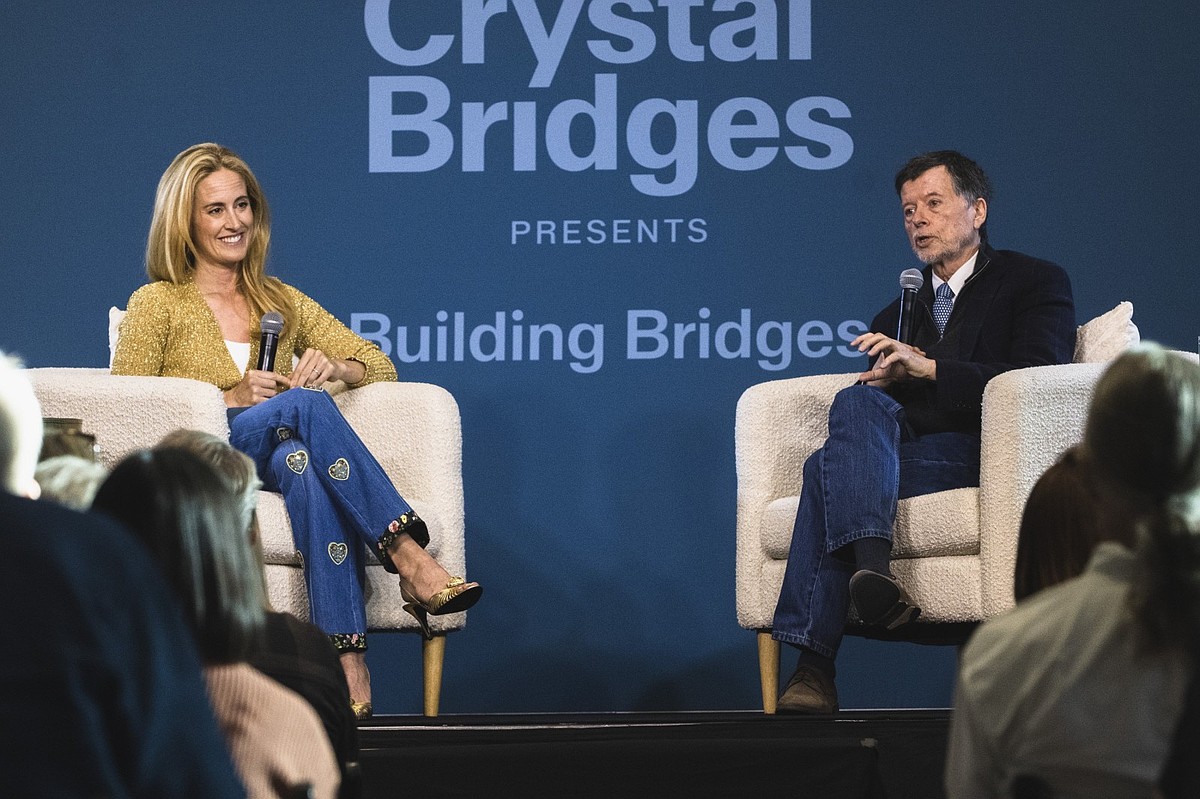
Burns, known for his documentary films and television series examining U.S. history and culture, visited Bentonville Friday as the featured speaker for the latest installment of Crystal Bridges Museum of American Art’s “Building Bridges” series.
The lecture series is intended to bring together thought leaders, thinkers and artists to demonstrate civic dialogue in celebration of the country’s semiquincentennial. Rod Bigelow, executive director of Crystal Bridges and the Momentary, said Burns, 72, underscores this ideal in his work.
“We are especially mindful of the importance of engaging with our shared past thoughtfully and our willingness to consider both where we’ve been and where we’re going,” Bigelow said. “It’s hard to imagine a storyteller better suited to do that and reflect upon it than tonight’s guest.”
Each installment of “Building Bridges” is moderated by Olivia Walton, board chairperson for the museum. Former President Barack Obama was the first speaker in the series when he visited Heartland Whole Health Institute in December.
“I think we share a belief in the power of stories to actually create understanding, and the belief that you can do things with great, wide access that are also really substantive, so you’re the perfect person to be here,” Walton said of Burns.
The conversation centered on Burns’ recent six-part documentary, “The American Revolution,” which aired on PBS in November. The miniseries covers events leading up to the American Revolution, the war itself and its aftermath.
Burns said he hopes to offer balance in his work when examining historical figures by showing what makes them essential to American and world history without fetishizing them. He refers to it as “calling balls and strikes.”
People have become desensitized to the violence of the American Revolution over time to a greater extent than other conflicts, Burns argued.
“It becomes the obligation of anybody who’s doing any serious history to remove the certain layers and layers of the barnacles of sentimentality and nostalgia,” he said. “And I think that’s what it is. Mostly, we’ve accepted the violence of our Civil War and the violence of the 20th century wars that we’ve been involved in, but we like to see the American Revolution as a kind of in bloodless, gallant terms. And it’s not. It is a horrific revolution. It is a bloody civil war.”
Burns said it is easy for people to fall into the trap of thinking the American Revolution is something every citizen today would have supported full throttle at the time.
“I assume that everybody in this audience thinks for sure they’d be a patriot,” he said. “And you have to understand that at least 20% of you are loyalists. And at least 20% of you are disaffected and are trying to just keep your head down and not be bothered by it.”
The diversity of thought in colonial America and the racial and ethnic diversity of the colonies’ allies during the Revolution meant different people rallied around a common, yet unintended, societal goal: democracy. Burns argued this goes hand in hand with citizens’ collective pursuit of happiness — a pursuit that never stops.
“It’s not material stuff, it’s lifelong learning,” he said. “That’s what every founder meant by pursuit of happiness, that in order to be virtuous, to earn that huge responsibility and citizenship, you had to be constantly educating yourself.”
Burns then drew strong laughs from the crowd, contrasting this ideal to modern leadership and how ordinary citizens must navigate it.
“Authoritarians who have subjects want people to be distracted by misinformation and disinformation and conspiracies and all,” he said. “But it is important for citizens to be actively engaged in understanding opposing points of view, to listen to be civil, and this compact is really a spectacular part of our story.”
Walton asked Burns how he believes the Founding Fathers would feel about the United States today. He said they would probably come around to understanding that ending slavery and granting women’s suffrage were necessary strides in line with their core ideals.
The Founding Fathers would likely be disappointed in the legislative branch for ceding power, Burns suggested.
“They saw the executive as the manager carrying out the wishes of the legislative branch, the legislative being the voice of the people,” he said. “I don’t think they’d be surprised at any given time when someone was taking more authoritarian or monarchical powers, but I think they’d be more disappointed that there would be acquiescence in the legislative and also the judicial.”
Burns noted similarities between the political climate around the Revolution and today. He referenced one Thomas Jefferson quote he decided to remove from the documentary because he thought it was almost too on-the-nose to be believable.
“What if someone should lose an election but pretend false votes and reap the whirlwind?” he said, quoting Jefferson.
Walton closed the conversation by asking Burns what the “American spirit” means to him. Burns said it is all about liberty and agency.
“There is this word, freedom, that we use with almost uniform mindlessness. And we sort of, if we think about it, think that it’s what I want. But we also know that it’s what we need, and there’s an inherent tension. And I think the American spirit is the reconciliation of what I want and what we need.”
Edward McKinnon
[email protected]
Edward McKinnon was born and raised in Memphis, Tenn., before relocating to Northwest Arkansas in high school. He earned his degree in journalism from the University of Arkansas in 2024. He spent his high school and college years as a basketball columnist, sports and culture reporter and long-form narrative feature writer. He has reported on K-12 education and related subjects at the Northwest Arkansas Democrat-Gazette since February 2025. His hobbies include watching NBA games, listening to ’90s Britpop music and binging prestige TV shows.