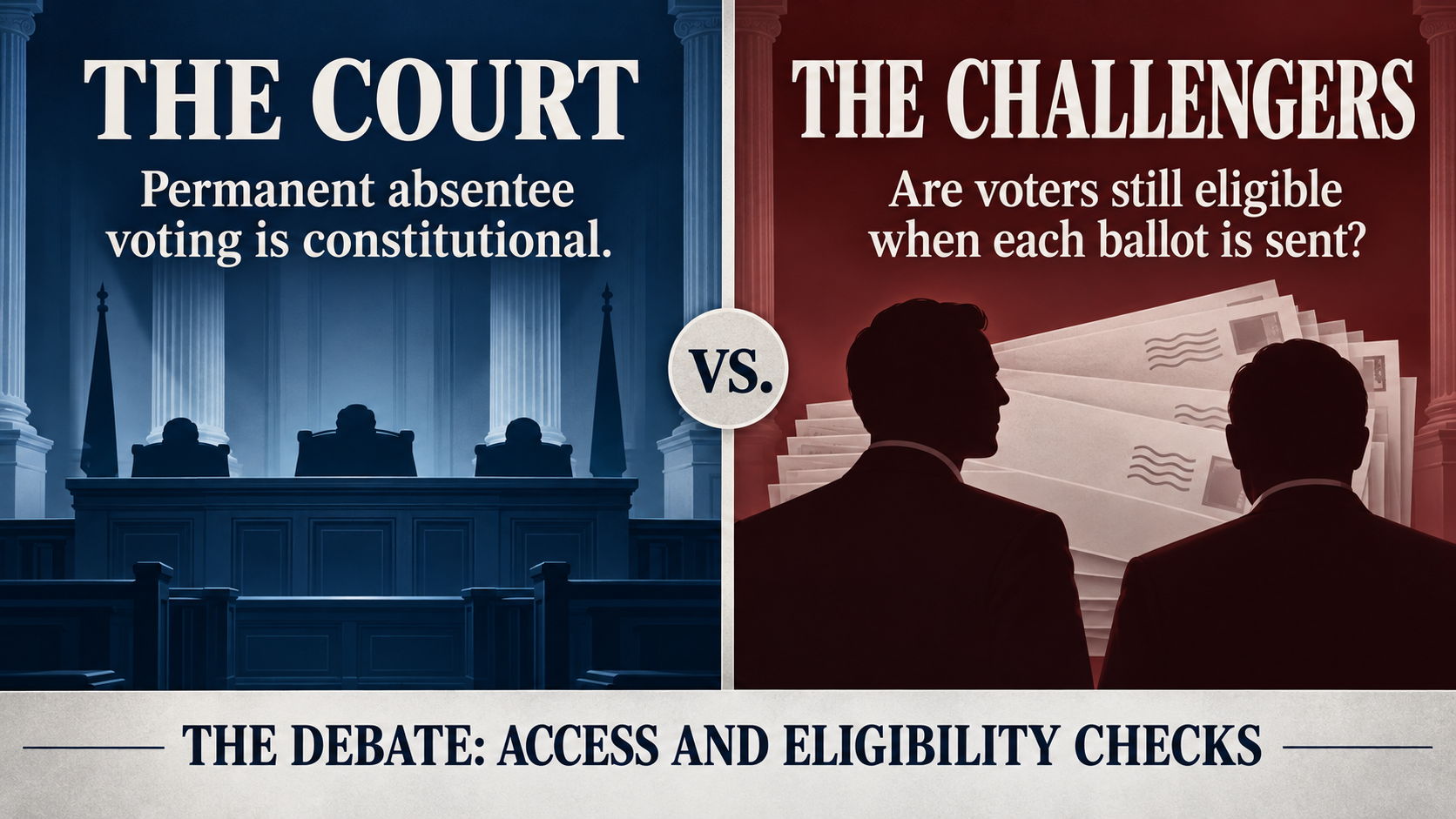
The court drew a distinction between receiving a ballot and being legally entitled to cast it. Today, permanent absentee voting procedures rely in part on voters reporting changes and affirming that they remain eligible. Hocker and Washington argued the checks are insufficient. The court said the Constitution leaves the choice of election safeguards to the General Assembly.
Justices say voters must qualify for each election; challengers question how the state checks whether they still do
DOVER, Del. — The Delaware Supreme Court upheld the state’s permanent absentee voting law Monday, clearing the way for qualified voters on the permanent absentee list to receive ballots for the Nov. 3 general election. The ruling leaves lawmakers with a policy question: How much should election officials do to verify that a voter’s reason for voting absentee still applies?
In a unanimous decision, the justices said the law does not expand absentee voting beyond the categories allowed by the Delaware Constitution. Permanent absentee status allows a voter to receive a ballot automatically, but it does not allow someone whose circumstances have changed to cast that ballot, the court said.
Why the law was challenged
State Sen. Gerald Hocker and fellow Senate candidate Steven Washington argued that a voter who qualified for one election could continue receiving ballots years later without election officials adequately confirming that the original reason still applied.
The Constitution permits absentee voting when a registered voter cannot appear at a polling place for a specified reason, including illness, physical disability, certain work or public service obligations, vacation or religious observance. The permanent absentee law applies to a narrower group, including voters with qualifying illnesses or disabilities, military service obligations or jobs that require constant care for a relative.
Must voters qualify again?
Hocker and Washington focused on the Constitution’s language about a voter’s inability to appear at a particular election. An illness can end, a caregiving responsibility can change and public service can conclude. They argued that automatically sending another ballot places too much weight on an earlier application and on the voter’s willingness to report a change.
The justices agreed that a voter must qualify to vote absentee in each election. They rejected the argument that the Constitution requires the state to recertify each permanent absentee voter before every election.
How the state checks eligibility
The court drew a distinction between receiving a ballot and being legally entitled to cast it. The law requires permanent absentee voters to report changes affecting their eligibility. The Department of Elections sends reminders before election cycles, removes voters from the permanent absentee list in specified circumstances and requires voters to affirm their eligibility when returning each ballot.
Those procedures rely in part on voters reporting changes and affirming that they remain eligible. Hocker and Washington argued the checks are insufficient. The court said the Constitution leaves the choice of election safeguards to the General Assembly.
The challengers sought to invalidate the law in all its applications. To prevail, they had to show it could not operate constitutionally. Imperfect procedures do not meet that standard when eligible voters can use the law, the justices said.
What the ruling means for voters
Voting rights advocates emphasized the law’s value to people whose qualifying circumstances persist. In a statement after the ruling, the Delaware Voting Rights Coalition said permanent absentee voting helps eligible voters with disabilities, illnesses, caregiving duties and other qualifying obligations participate without submitting a new application for every election.
The ruling differs from the Supreme Court’s 2022 decision striking down Delaware’s no-excuse vote-by-mail law. That law allowed people outside the Constitution’s absentee voting categories to vote by mail. The permanent absentee law, the justices found, serves only a subset of voters within those categories.
A Superior Court judge ruled against permanent absentee voting in 2024, but the Supreme Court vacated that decision because the plaintiffs lacked standing. Monday’s decision reached the constitutional issue and upheld the law. The Department of Elections says it is sending permanent absentee voters their general election ballots.
TO GO
- Who: Delaware voters who qualify for permanent absentee voting.
- What: Voters already on the permanent absentee list will automatically receive a ballot for the Nov. 3 general election. They must still qualify to vote absentee when they cast it.
- Check your status: Visit iVote.de.gov. “Indefinite” means you are on the permanent absentee list.
- Request a ballot: Eligible voters can apply through iVote.de.gov or contact their county elections office.
- Deadline: Completed absentee ballots must reach the county elections office by 8 p.m. on Election Day.
Delaware LIVE collaborates with a network of professional journalists to cover a diverse range of stories across various fields. Staff Writers include experienced journalists and young professionals. If you have questions, please feel free to contact [email protected] or our publisher, George D. Rotsch, at [email protected]