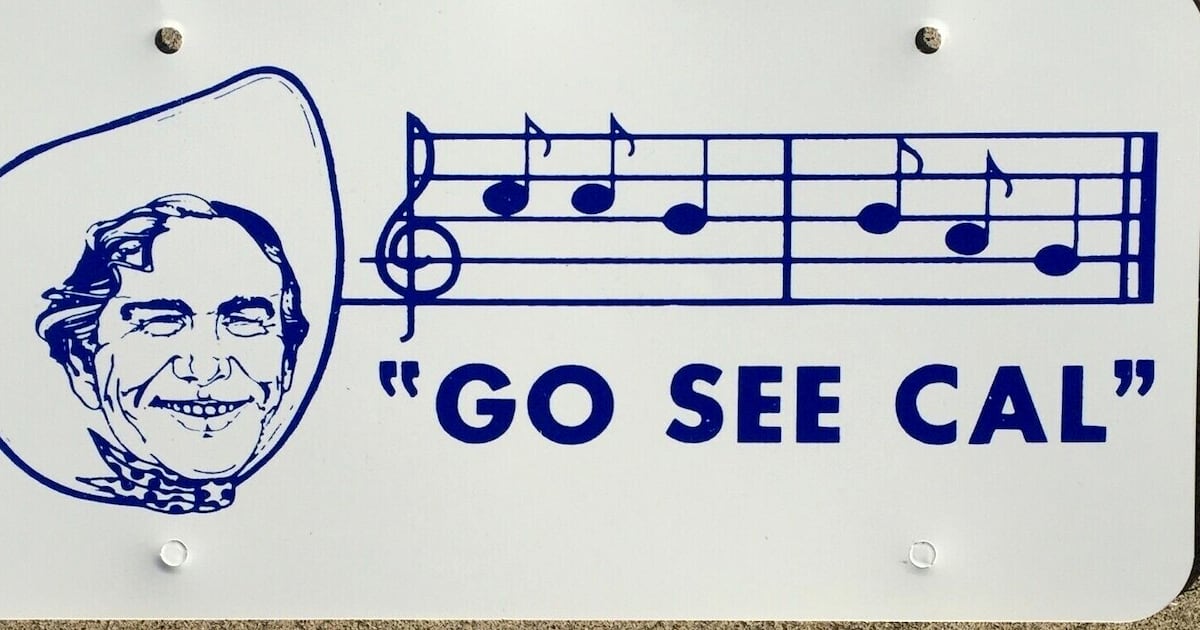
The dealer plate for Cal Worthington featuring a couple measures of a jingle. (Photo provided by David Reamer)
Part of a continuing weekly series on Alaska history by local historian David Reamer. Have a question about Anchorage or Alaska history or an idea for a future article? Go to the form at the bottom of this story.
For more years than many of you have been alive, Cal Worthington was a leading West Coast celebrity, a television star with a more prominent, consistent presence on your sets than any mere actor. He had catchphrases, a theme song and a dizzying assortment of pets. And he was just a car salesman, not the first huckster with a schtick, but perhaps the most enduring.
After his January 1977 arrival in Anchorage, he became a part of Alaska lore as well. To have lived here during his tenure is to have a story, memory or possibly even grievance about the tall, cowboy-hat-wearing car dealer. This is the second in a two-part series. Each article offers five facts and five classic commercials, so here’s some more.
[Previously: 5 facts and 5 commercials about legendary car salesman Cal Worthington]
First, while most people, especially in Anchorage, knew Cal Worthington primarily as a Ford dealer, he had no particular allegiance to that brand. As covered in the first article in this two-part series, he was infinitely more interested in the income from a dealership than the cars themselves. According to multiple interviews, he spent most of his life without a personal car, just repeatedly borrowing one off his lots.
He entered the car game with a Hudson dealership in Huntington Beach, California. His empire at its heyday included a Chevrolet dealership in Sacramento.
But he also experimented heavily with cheaper imports, particularly in the 1980s, and especially with the Yugo, one of the more fondly forgotten cars of the era. The Yugo was a series of subcompact hatchback models produced by Zastava Automobiles. It took its name from the country of origin, the now-dissolved Yugoslavia. Parts were produced in multiple regions with final assembly in what is now Serbia.
Beginning in 1985, the Yugo was marketed in the United States as a cheap alternative to the existing market, at less than half the price of the average new car. The original price tag was a mere $3,990. And for a brief moment, it was a massive success. The low cost was far and away their primary feature. As Joe Walkden of Anchorage told the Daily News in 1988, the appeal was “Mostly the price. I liked them so well I bought two.”
Then people started driving them, and the cars near instantly gained an earned reputation as unsafe, fragile wrecks in the waiting. Such was the design that if a rubber timing belt broke, the engine was destroyed. Quality control seemed nonexistent, and the Yugo was labeled “the worst car in history.”
For a local example, in April 1988, an Alaskan lacking the finances for anything else bought a new Yugo at Worthington’s Anchorage dealership. It came with a limited 30-day or 1,000-mile warranty. The buyer wrote to the Anchorage Times that November, “Before my warranty was up, I had the horn and the driver’s seat replaced. After the warranty expired, the door handle came off, the detachable mirror fell off, the blinkers work intermittently, the engine frequently stalls, and my family has had to get the vehicle jump-started.”
In 1991, Yugoslavia devolved into a series of conflicts, wars for independence mixed with genocides. Trade sanctions in 1992 ended Yugo exports to America.
Second, a beloved pizza parlor was razed in favor of Worthington Ford.
When Cal Worthington arrived in Anchorage, he first occupied what had been John Stepp’s Friendly Ford on Fifth Avenue, with the Ford franchise license transferring on Jan. 1, 1977. That location was always intended as a temporary base of operations. Worthington then bought two properties along Gambell, parcels then home to Nu-Kar Sales and Uncle’s Pizza Parlor.
The pizza joint was one of the more beloved Anchorage eateries of the era, and its main attraction was a pipe organ with 750 pipes, a former silent movie organ rebuilt by Anchorage resident Frank Butte. That was part of the entertainment at the pizza parlor; an organist played as accompaniment to old movies.
An advertisement for the opening of Cal Worthington Ford from the Jan. 27, 1977 edition of the Anchorage Times.
Butte was a broadcasting engineer by trade but an organist at heart. He moved to Alaska in 1954, and soon bought an organ from a church, a different organ from the one at Uncle’s Pizza Parlor. This other instrument wound up in Juneau, where it was soon left unused and in pieces. Butte bought it again and reassembled it in his Baxter Road home, complete with drum, bird-call, xylophone, glockenspiel, chimes and siren noisemakers, much to the dismay of his neighbors. For the sake of their ears and his personal safety, he moved to a more isolated home on Huffman. After Butte died in 1979, a friend in Juneau bought the organ.
With the arrival of Cal, Uncle’s Pizza Parlor was bulldozed down. The organ was shipped to the Uncle’s location in Fairbanks. That location was rebranded as Steak ‘n Pipes around 1980, with the organ still a featured attraction. In 1983, the owner sought to sell the instrument to free up space for a private dining room. The organ wound up in storage at the Lacey Street Theatre, which is now the Fairbanks Ice Museum.
Third, Cal Worthington’s introduction to Anchorage was generally smooth, except for Binky the polar bear.
Cal Worthington was naturally famous for the various iterations of “my dog Spot,” which began as a parody of his rivals, as detailed in the previous article. Most of the animals — from goats to elephants — were provided by Hollywood wranglers and circuses. Now in Alaska, he understandably wanted to feature some more northern species, like polar bears. This meant the Alaska Zoo, which had a young resident named Binky.
Now, Binky (1975-1995) was a grumpy exemplar of his people. He became a folk hero in 1995 after attacking an Australian tourist who decided to jump a couple of barriers to the bear’s cage. He grabbed her leg, breaking it in the process and eventually making off with one of her sneakers, which he held on to for three days. That shoe is still at the zoo, on display in the gift shop. And the locals loved it. There were Christmas ornaments, songs and countless T-shirts, plus a restaurant and a fan club.
Binky, Alaska Zoo’s male polar bear, chews on a tennis shoe belonging a Australian woman who was grabbed by the bear when she got to close to his cage July 29, 1994, in Anchorage. The woman was rescued by other zoo visitors and zoo personnel. The red on the shoe is part of the design of the shoe. (Eric Sowl / KTUU via AP)
The issues with shooting a commercial with him were twofold. First, there was his cantankerous personality. During the filming, Binky stole Worthington’s trademark cowboy hat. When the salesman tried to retrieve it, Binky grabbed his leg and refused to let go, one of his own trademarks. While at the zoo, Worthington also rode Annabelle the elephant, who was also in less-than-peak mood. With Cal on her back, she reared while he held on for dear life and so forth.
Worthington told the Anchorage Times, “I was more terrified of Binky than the airplane.” He referred to one of his most famous commercials, in which he was strapped on top of a biplane that looped through the air, a stunt covered in the previous article.
The second issue was compensation. The zoo was facing an unexpected debt of $19,000, and some zoo staff allowed the shoot only with the understanding that Worthington would donate to the zoo. The phrase “substantial amount of money” was tossed about more than once. Caretaker Jim Lund said, “Our main interest at the zoo is to do as much for our animals as we can. When someone offers us a cash fee that more than compensates for any so-called exploitation, the question becomes, can we say no?”
Larry Sawyer of Worthington Ford in Anchorage told the Times, “Mr. Worthington was planning on making a personal contribution to the zoo, but I believe he will rescind the offer now.”
On the other hand, zoo founder Sammye Seawell denied that any financial promises had been made. And Worthington said, “My contribution will be in the way of TV time. I’ll use the commercials to let people know the zoo still needs money.”
This controversy erupted in February 1977, shortly after the expansion to Anchorage. In the cloud of confusion and contradictory statements, everyone seemed to lose. The zoo denied use of the footage and remained in debt. And Worthington absorbed a severe blow to his public image.
Fourth, as for certain other aspects of Alaska life, Worthington quickly found his place.
The 1978 Alaska governor Republican primary was one of the nastier state elections of its era, notably because the two front-runners, incumbent Jay Hammond and former Gov. Wally Hickel, did not like each other — in part due to wildly different personalities. Hammond was an irreverent, self-described bush rat. Hickel was a more humorless and aggressive boxer turned developer.
Hammond staged a late comeback to take the primary with an initial count of only 37 votes. After a recount, the gap grew to 98 votes, but an enraged Hickel sued to have the entire election thrown out, a request the Alaska Supreme Court rejected. To thine own self be true, thought Hammond, albeit surely with a different choice of words. So, he celebrated by co-writing the equivalent of a folk diss track.
[An election win so satisfying, Gov. Jay Hammond had to write a song about it]
Fundraising improprieties were a notable campaign issue. Hammond illegally began raising funds without formally declaring his campaign. And he had to return a loan that failed to meet requirements. But then there was Worthington and Hickel.
Cal Worthington, a possible hale fellow well met, gave 50 employees a $100 bonus. Except, they also agreed to sign those checks over to the Hickel campaign, totaling a $5,000 donation. This manner of giving violated laws on donating in the name of others and corporate donation limits. Hickel’s people returned the $5,000 the same day.
On the recommendation of the Alaska Public Offices Commission, the state opened an investigation. The employees were subpoenaed, and Worthington testified at length. He claimed he was only following the instructions of Hickel campaign treasurer Loren Lounsbury. In the end, the grand jury declined to indict Worthington, and the matter died.
Fifth, all things end.
There is nothing that yet lives which will not die. Cal Worthington passed on Sept. 8, 2013. Just 10 days earlier, he was in Alaska, fishing and checking in on his business interests. At that time, he owned three Anchorage dealerships: the flagship Worthington Ford Lincoln on Gambell Street, the Mercedes-Benz of Anchorage and Cal’s Park & Sell.
In 2016, Kendall Auto Group purchased the remaining Worthington locations in Anchorage, adding to its expansive collection of Alaska dealerships.
And in 2023, the Worthington family sold the last remaining dealership in their holdings, 73 years after Cal took over his first lot in Huntington Beach, California. His grandson, Nick Worthington, stated, “If he were to live forever, he would have been a car dealer forever. He was so good at it, it’s part of who he was.”
• • •
Key sources:
Abbott, Jeanne. “Go See Cal—And You May Be Surprised.” Anchorage Daily News. August 13, 1977, 12.
Andrews, Susan. “Cal Worthington Says He Was Just Trying to Help.” Anchorage Times. October 7, 1978, 1, 2.
“’Cal’ Moving to Gambell Location.” Anchorage Daily News. October 12, 1977, 12.
“Car Dealer Turns Back on His ‘Dog Spot.’” Anchorage Times. February 26, 1977, 2.
Epler, Patti. “Binky Stars As ‘Dog Spot.’” Anchorage Times. February 24, 1977, 1.
Hollander, Zaz. “Cal Worthington, Car Dealer and TV Showman, Dead at 92.” Anchorage Daily News. September 9, 2013.
Miller, Martin, and Elaine Woo. “Car Dealer with Dog Spot.” Los Angeles Times. September 10, 2013, 1, 10.
Piper, E.W. “How Much Car for $5,000.” Anchorage Daily News. April 18, 1988, D-1, D-2.
Seawell, Sammye. Letter to editor. “Zoo Commercials.” Anchorage Times. March 7, 1977, 5.
“Tell It to Bud.” Anchorage Times. November 21, 1988, B-2.
Weiss, Janice. “Whatever Happened to Frank Butte’s Pipe Organ?” Anchorage Times. January 15, 1983, C-2.
“Worthington Family Sells Its Last Dealership, Marking an End of an Era.” CBS News. February 28, 2023.