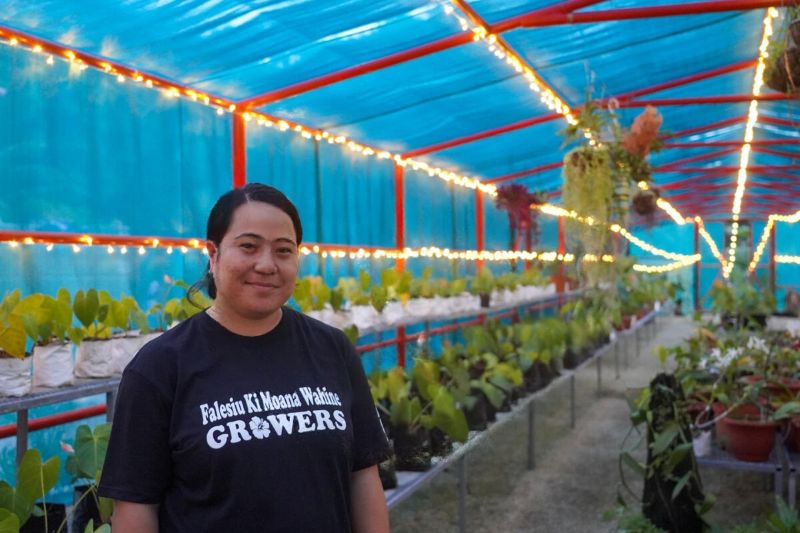
A tourism graduate who had no previous farming experience has become one of Tonga’s emerging vanilla producers, using agriculture to create new opportunities for women and young people in rural communities.
Elema ‘Uhatahi’, 30, co-founded Falesiu Ki Moana Wahine Growers on Tongatapu after deciding to pursue farming despite having no agricultural background.
Her journey has been supported by the Food and Agriculture Organization of the United Nations (FAO) through the UN Joint Programme on Rural Women’s Economic Empowerment (JP RWEE), delivered in partnership with Tonga’s Ministry of Agriculture, Food and Forests.
Vanilla is one of the world’s highest-value spices but requires patience, with vines typically taking at least three years before producing their first harvest. To improve resilience and income, FAO has trained Ms Uhatahi in mixed-cropping techniques, combining vanilla with pineapples, bananas, breadfruit, coconuts, taro and kava. The approach provides natural shade for vanilla vines while generating year-round income.
She has also received technical assistance in seedling propagation, compost production, natural mulching using banana stems and coconut fibre, and farm planning. Because vanilla belongs to the orchid family, FAO has additionally provided floriculture training and supported the establishment of an orchid nursery.
Ms Uhatahi said she was grateful for FAO’s support in helping transform an ambitious idea into reality. She said success was “not defined by gender, but by resilience, perseverance and unwavering dedication”, while encouraging women to continue lifting one another up and creating opportunities for future generations.
According to FAO, Ms Uhatahi is among around 500 women farmers in Tonga benefiting from the programme, which is funded by Ireland, Norway, Sweden, Switzerland and the Bill & Melinda Gates Foundation. The initiative aims to strengthen women’s economic participation and build more resilient rural livelihoods across the Pacific.