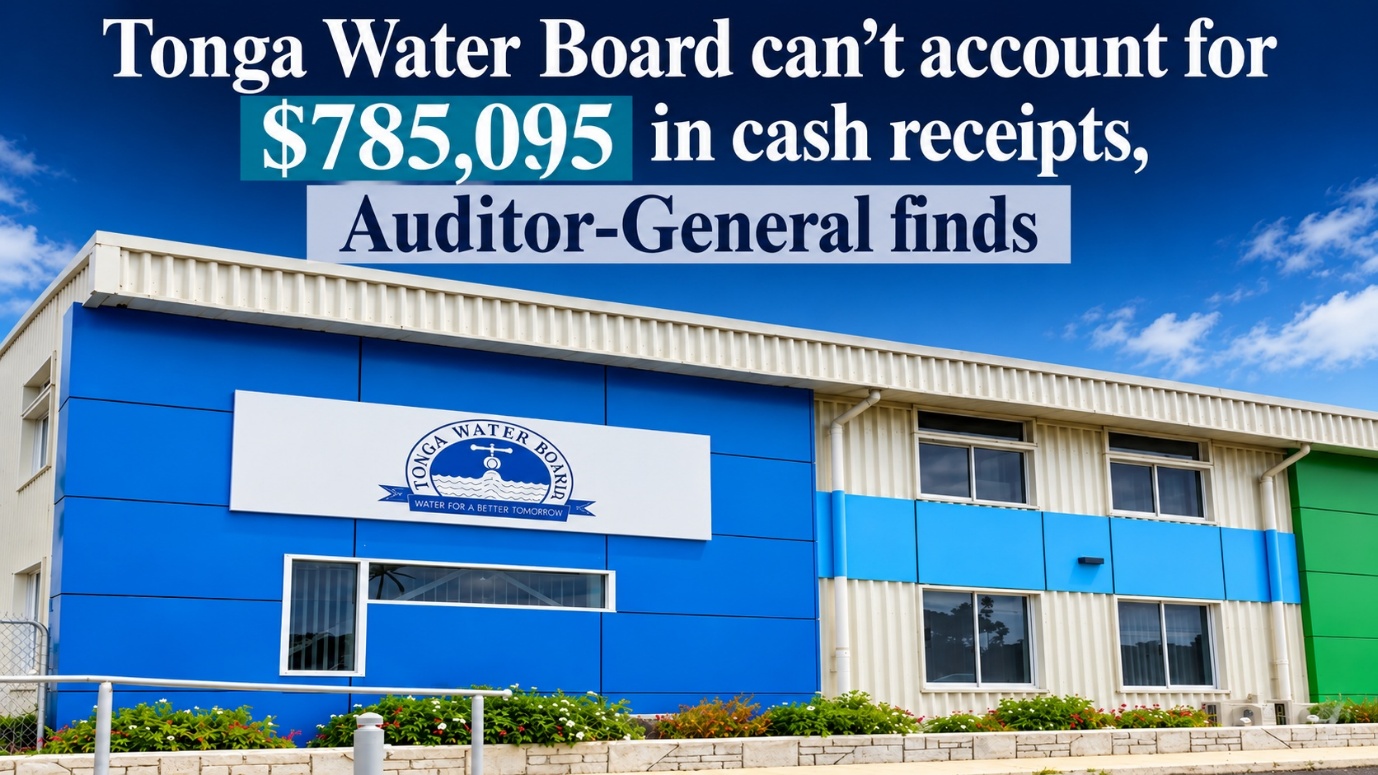
Tonga Water Board cannot explain where $785,095 went
Cash was kept in a safe for weeks. Some bank pay-ins held cheques and no cash at all. And when auditors tried to trace $785,095 in recorded cash receipts, they could not find it in the Tonga Water Board’s bank deposits.
That is the central finding of a special audit carried out by Tonga’s Office of the Auditor General (TOAG) into the Tonga Water Board (TWB) for the 2023/24 financial year.
Auditors compared receipts recorded by TWB with deposits appearing in the Board’s bank statements. The two did not match. TOAG could not account for $785,095 of what TWB’s own records said it had received.
The amount was recorded in TWB’s financial statements as an “Unaccounted Loss.”
TOAG found that TWB’s internal controls had been overridden, and that this had caused the loss. It called for an investigation and disciplinary measures against the officers responsible, describing what happened as a serious breach of discipline.
It is important to be clear about what the audit does and does not say. It does not establish that $785,095 was stolen. What it establishes is that TWB’s records showed the money had been received, but auditors could not trace it to the bank, and the records needed to explain the difference were not produced.
Cash not banked daily
The special audit set out to check whether receipts collected during 2023/24 had been fully deposited into the bank, and whether TWB had effective controls over that money.
Daily receipts collected at TWB’s main office and in the Central Business District were recorded in a Cash Book kept by the Revenue Officer, using an Excel spreadsheet.
That money was supposed to go into the bank every day. It did not always happen.
TOAG found that the full amount received on a given day was not always deposited, and that deposits were not always made on the day the money came in. Auditors identified what they called “Late Bankings” and “Teeming and Lading” running through the financial year.
What is “teeming and lading”?
Teeming and lading is an accounting term for using later receipts to cover an earlier cash shortage.
Put simply: if $1,000 received on Monday does not reach the bank, $1,000 received on Tuesday can be used to make Monday’s accounts look complete. But now Tuesday is $1,000 short. Later receipts fill that gap instead, and the shortage keeps moving through the accounts, making it harder to work out when the money first went missing.
TOAG found this happening, alongside late banking, throughout TWB’s financial year.
Cash kept in a safe for weeks
What TWB staff told auditors helps explain how the controls broke down.
Bank reconciliation had often come up as a problem in management meetings. But deposits were still not being made daily.
Staff said daily cash receipts were often locked in the safe for three or four days, and in some cases for weeks. At times, the bank pay-in contained only cheques. No cash.
The cashier passed each day’s cash receipts to the Risk and Compliance Manager, who decided when the money would be paid into the bank.
Customer cash used to pay expenses
Auditors were also told that TWB debts and expenses were being paid directly from cash kept in the safe. At other times, money was taken straight from the cashier’s daily takings to pay expenses before it was ever deposited.
The Risk and Compliance Manager told auditors this was a “common practice” allowed at the time for immediate procurement or “rush commitments.” TOAG also found cash payments being made above the limit set for petty cash.
Put simply: some of the money TWB customers paid in was spent before it reached the bank at all. If those payments were legitimate TWB expenses, there should be records showing what was bought, how much was paid, who received the money, and who authorised it.
Those records became critical once auditors tried to explain the gap between what TWB recorded as received and what actually reached the bank.
$785,095 could not be traced
Auditors worked backwards from TWB’s bank statements to its Cash Receipt Book, trying to reconstruct the trail. They found $785,095 in recorded receipts that could not be traced to any bank deposit.
TWB staff said some debts and expenses had been paid directly from cash in the safe. But when auditors asked for records to support those transactions, the documentation was not produced.
The unresolved difference was recorded in TWB’s financial statements as an “Unaccounted Loss” of $785,095.
That distinction matters. An unaccounted loss does not by itself prove theft. It means TWB has not produced the records needed to explain where $785,095 in recorded receipts actually went.
Why was Excel being used?
TOAG found the Cash Book was kept by the Revenue Officer on an Excel spreadsheet. Tonga Independent understands TWB also has accounting software built to provide a controlled audit trail. Once a transaction is entered into that system, it cannot simply be deleted. An incorrect entry has to be reversed, and that reversal, along with the reason for it and the login of the person who made the change, is recorded.
An ordinary Excel spreadsheet offers none of that protection.
The issue is not that TWB used Excel. The issue is why daily cash receipts were kept in a spreadsheet at all, rather than entered directly into a system built to leave a stronger audit trail. TIN will put that question to TWB.
A second discrepancy, in water sales
The special audit was not the only place TOAG found a mismatch in TWB’s revenue records. In its separate financial audit, TOAG compared monthly billing reports against water sales recorded in the General Ledger. The figures did not match.
Auditors found water sales had been understated in the General Ledger by $14,592.41, and an adjustment was made.
This figure is separate from the $785,095 unaccounted loss. The report does not establish that it represents an additional cash loss, and it should not be added to the $785,095 total. It does, however, point to a second, unrelated weakness in how TWB’s revenue was being recorded.
What did the Board know?
The findings raise a further question: what did TWB’s Board of Directors know, and when?
The $785,095 figure did not come from a single transaction that auditors spotted. It was the difference that emerged once auditors tried to reconcile recorded receipts against the money that actually reached the bank over the full financial year.
If directors were receiving monthly financial reports through that year, the question is whether those reports contained enough detail to show a growing gap between recorded revenue, cash collected, and money actually reaching TWB’s bank accounts.
TWB’s annual report does not include the Board’s monthly financial reports, and it does not establish what information directors were actually given. But TOAG does confirm that bank reconciliation had often been raised as an issue in management meetings.
Despite that, the practices continued. Deposits were delayed. Cash sat in the safe for days or weeks. Some bank pay-ins held cheques but no cash. And cash kept being used to pay expenses before it reached the bank.
That leaves one central question: did the information reaching the Board show this gap, and if it did, what was done about it? If it did not, that points to a separate failure, a Board responsible for overseeing TWB’s finances not getting the information it needed to catch the problem.
Proper financial oversight is about catching warning signs before a problem grows, not only explaining a loss after it has happened.