By:Tuífua Vailena
Tonga can recognise the One China policy and remain a friend of Beijing. But that does not mean China, or any other outside power, gets to decide who sits at the Pacific’s regional table. The controversy in Palau has shown why that distinction matters.
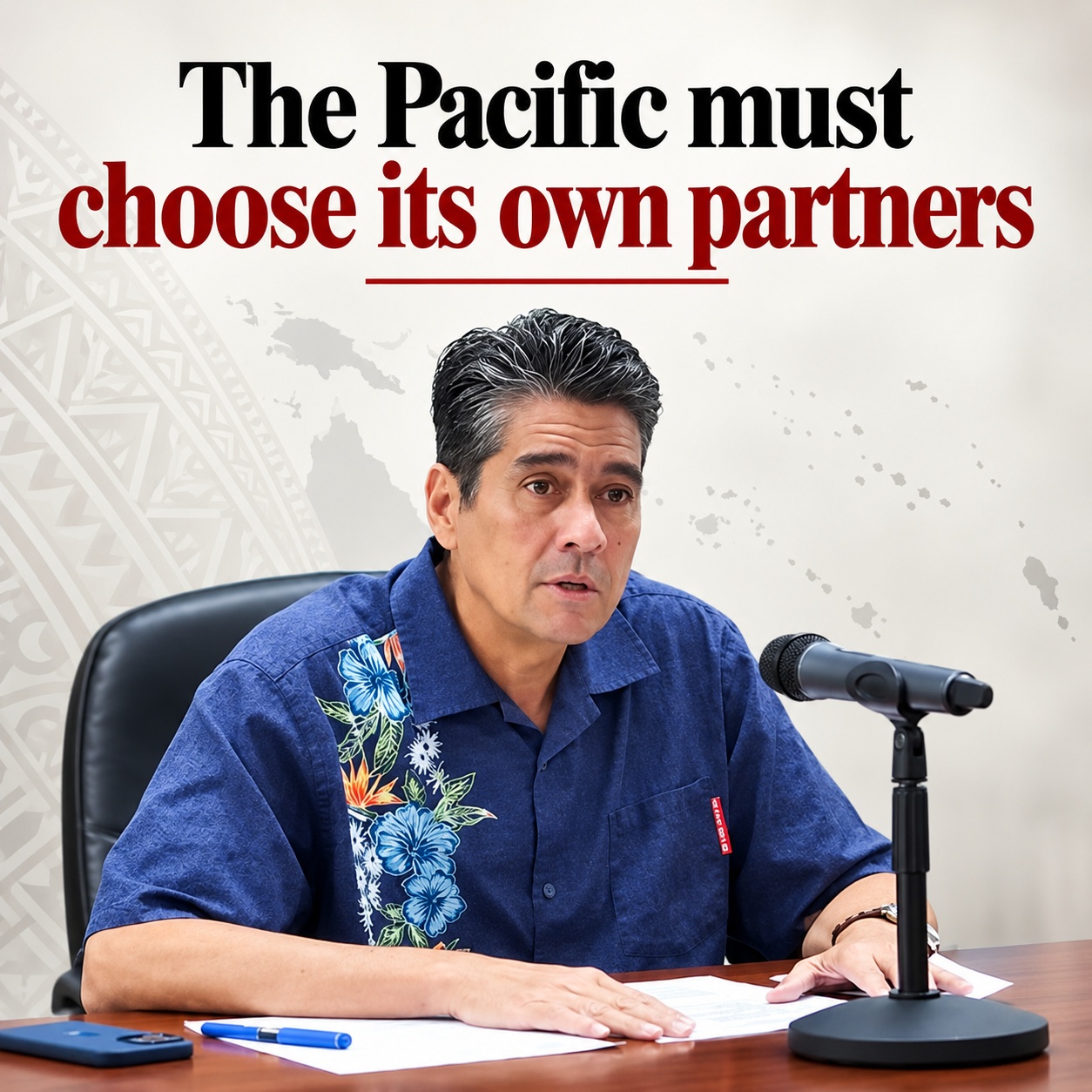
Palau President Surangel Whipps Jr. had a simple message for the outside powers gathered at this year’s Pacific Islands Forum meeting: partners are welcome, but they do not choose the Pacific’s destination.
He had reason to say it plainly.
The Forum meeting in Palau should have been about the Pacific. Instead, one of its biggest controversies became China, Taiwan, and who has the right to decide which partners Pacific nations engage with.
There is an important distinction here.
Most Pacific Island countries, including Tonga, recognise the People’s Republic of China. Australia and New Zealand also recognise Beijing rather than Taipei.
Palau does not. It is one of three Pacific Island states, alongside the Marshall Islands and Tuvalu, that maintains diplomatic ties with Taiwan.
Those are sovereign decisions. And that is precisely the point.
Palau invited Taiwan’s Foreign Minister Lin Chia-lung to take part in activities around this year’s Forum, under Taiwan’s longstanding relationship with the regional body. China objected. Beijing was entitled to object and restate its position on Taiwan.
But China’s special envoy to the Pacific, Qian Bo, went further, warning there would “always be consequences” for Taiwan’s participation. Beijing has also argued that Taiwan is not qualified to take part in Forum activities “in any capacity.”
That is where this stops being simply a China-Taiwan dispute. It becomes a Pacific issue.
Whatever position Tonga, Australia, New Zealand, Palau or any other member takes on Taiwan, the Pacific Islands Forum must remain an institution governed by its members. China does not get to decide. Neither does the United States. Neither does Australia or New Zealand.
The Pacific does.
That principle is now effectively written into the outcome of the Palau meeting. In their final communiqué, Pacific leaders reaffirmed the sovereignty of Forum members and their collective right to determine their own priorities, shape their own agenda and, importantly, choose their own partnerships.
After the controversy over Taiwan’s presence, those words carry considerable weight.
Interestingly, the communiqué does not mention Taiwan. Nor does it publicly reveal how individual countries and organisations have been placed within the Forum’s newly agreed partnership structure. Instead, leaders instructed the Secretary-General to communicate those decisions directly to the partners concerned.
That leaves questions unanswered. But the principle should not be ambiguous. The Forum belongs to the Pacific.
One China does not mean one Pacific position
There is no contradiction in Tonga recognising Beijing while defending Palau’s right to make its own diplomatic choices.
There is equally no contradiction in Australia and New Zealand keeping their One China policies while insisting that the Forum, not Beijing, decides its own arrangements.
Recognising the People’s Republic of China does not require Pacific governments to give up their independence. Nor should support for Taiwan require the Pacific to become part of someone else’s power struggle.
For years our leaders have talked about the “Blue Pacific” and Pacific-led regionalism. Those words mean little if they disappear whenever a major power becomes unhappy with a Pacific decision.
And the standard must apply equally. If Washington tried to dictate who the Forum could engage with, we should object. If Canberra tried it, we should object. If Beijing tries it, we should object.
That is not anti-China. It is pro-Pacific.