The United Nations Organization Stabilization Mission in the Democratic Republic of Congo is about to call it quits.
The mandate of the United Nations Organization Stabilization Mission in the Democratic Republic of Congo (MONUSCO) approaches its December 2026 expiry date.
Already divisions are widening over whether the UN mission should remain in the DR Congo.
While President Félix Tshisekedi seeks international support for an extension, Joseph Kabila’s FRN opposes another renewal.
Persistent insecurity in eastern DRC and the humanitarian crisis in Minembwe intensify the scrutiny of the mission’s record.
After 27 Years in DR Congo, MONUSCO Faces Growing Criticism.
Suspected fighters from the Allied Democratic Forces (ADF) recently killed 33 civilians in the Cantine-Aloya area of Beni territory.
More than 60 homes and businesses were also burnt, and survivors fled to neighbouring areas.
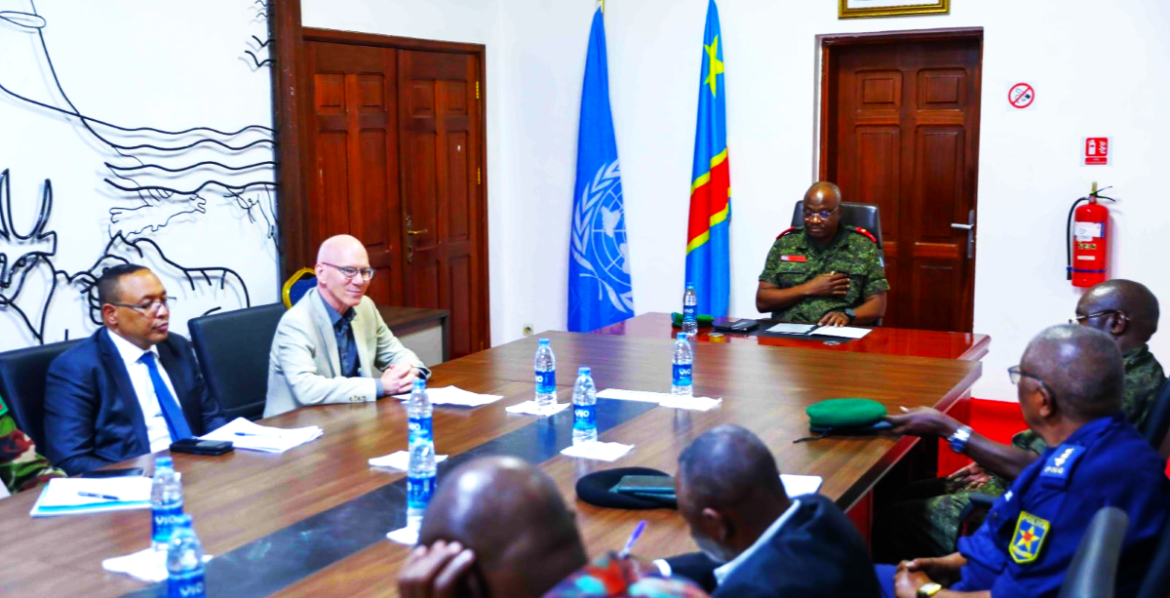
The attack came while the United Nations’ top official in the country, James Swan, was touring the eastern DR Congo.
The incident has intensified scrutiny of MONUSCO, the UN stabilization mission, as the Security Council wonders whether it should stay.
Beni’s territorial administrator, Charles Omeonga, said the assailants struck several villages simultaneously, using machetes and firearms.
Congolese forces (FARDC) and Ugandan troops (UPDF), supported by Wazalendo fighters, reportedly launched operations to track them down.
Local civil society representatives said they had raised security concerns before the attack, but that the warnings did not prevent the killings.
The incident highlights the gap between MONUSCO’s stated priority of protecting civilians and the daily reality for communities in the east.
Despite this terrorist attack, James Swan had met North Kivu Governor Major General Somo Kakule Évariste in Beni.
“Protecting civilians remains our priority,” he said, pointing to ground presence, regular patrols, early warning and rapid responses.
The mission’s current mandate runs until 20 December 2026 under Resolution 2808, adopted on 19 December 2025. Its core responsibilities remain civilian protection, support for the peace process and strengthening state institutions.
Kinshasa wants that mandate renewed and is lobbying influential Council members.
President Félix Tshisekedi raised the issue with Russian President Vladimir Putin in the Kremlin on 30 October, saying: “We are also counting on Russia to help us secure an extension of this mandate.”
Foreign Minister Thérèse Kayikwamba Wagner advocated the same issue in Paris on 3 November, meeting her French counterpart, Jean-Noël Barrot.
France drafts the Council’s texts on the DRC, so the talks gave Kinshasa direct access to a key player.
The Front pour la Refondation de la Nation (FRN), the alliance led by former president Joseph Kabila, takes the opposite view. After meeting Swan in Goma on 3 November, vice-president Bertrand Bisimwa said: “More than two decades later, when you take stock of MONUSCO’s activities, you find that it has been a total failure.”
The FRN wants the withdrawal to continue, though it says the mission could still give logistical and technical support to the ceasefire verification mechanism created under the Doha process. It opposes using that role to justify redeploying UN troops to FRN-held areas of South Kivu, which Bisimwa says are already stable. That is the FRN’s own position, not an independent assessment.
Resentment against the mission is also strong among some Kinyarwanda-speaking communities.
Residents of Minembwe have reportedly lived under a renewed military siege for nearly a month, with medicines running short and movement restricted. One resident quoted by local media said a kilogram of salt can cost as much as US$30 (about Rwf 40,000).
Analyst Alex Mvuka has described the situation as famine used as a weapon of war and has compared it to the Holodomor. That characterisation, including the term “silent genocide”, is his own and has not been established by independent investigators. Deliberately starving civilians is, however, prohibited under international law.
Discontent with MONUSCO is not new. The mission replaced the UN’s earlier operation, MONUC, which began in 1999, and took on a broader stabilisation mandate in 2010. In 2022, protests in Goma, Beni and Butembo turned violent, with deaths and injuries, as demonstrators asked why the mission had stayed so long while insecurity persisted.
Some Congolese however, fear that a premature withdrawal, before national forces can protect civilians, would leave a dangerous security vacuum. The question is therefore less whether MONUSCO should stay or go than who will protect civilians if its footprint shrinks.
The decision will ultimately be taken by the Security Council, not by Kinshasa or the FRN.
For communities in the east, though, MONUSCO’s record will be judged less by diplomatic statements or years of service than by whether they can live without the constant threat of attack, displacement and death.