After 11 years of construction, the National Theater opened in Dushanbe, the country took new steps in tourism development, and three years later, investigators detained suspects in the arson of a market in Gissar.
What else important happened this week – in our review.
Poverty declined, but inequality persists
Over the years of independence, the poverty rate in Tajikistan decreased from 83% to 19%. However, a new report by civil society organizations shows that access to basic services remains unequal: 41% of the population has access to drinking water from water supply systems, 15% have sewerage, and up to 56% of households cannot afford sufficiently caloric and nutritious food.
Economic growth has also not eliminated employment and labor migration problems. Remittances from migrants over the past four years reached 48% of the country’s GDP, and the World Bank’s unemployment estimate is significantly higher than the official figure.
New National Theater opens in Dushanbe
A new building of the National Theater of Tajikistan opened in Dushanbe, with construction beginning in 2015. Work was suspended in 2017 due to financial difficulties and resumed only in 2024.
The complex includes a main hall with 2,500 seats and two multifunctional halls with 1,000 seats each. The 34.5-meter-high building is located in the center of the capital next to the National Museum and the State Flag Park.
The opening was timed to coincide with the 35th anniversary of Tajikistan’s independence.
Tajikistan preparing for skyscrapers
Tajikistan has begun using the ETABS engineering program to calculate the strength of high-rise buildings, including structures over 75 stories. The Committee on Architecture believes that with modern technologies and pile foundations, the country is technically capable of constructing buildings 70-80 stories high and above.
The program allows modeling of a building’s structure and checking its resistance to various loads, including seismic ones. For Tajikistan, this is particularly important due to high seismic activity.
Since 2023, specialists have already checked pile foundations and seismic resistance of 144 new high-rise buildings. In the first half of 2026, 10 high-rises in Dushanbe, one in Khujand, and a bridge in Voseysky District underwent expert review.
Tourism: new plans and millions of somoni
Tajikistan is preparing a new domestic tourism development program for 2027-2031. The authorities intend to develop tourism infrastructure, preserve historical and cultural heritage, and increase tourist flow.
Additionally, a plan for implementing the Tourism Development Strategy for 2027-2030 has been approved. 273.4 million somoni has been allocated for its implementation. Almost half of the funds – 123.5 million somoni – will go to tourism infrastructure. Funds will also be directed toward promoting the country, security, developing tourism clusters, training personnel, and international marketing.
The private sector will bear the main financial burden – 143.6 million somoni, or 52.5% of the total amount. The state budget will provide 22.3%, with development partners’ funds making up the remaining 25.2%.
In the first half of 2026, Tajikistan was visited by 889,400 foreign tourists. The authorities expect to attract more than 2 million guests per year.
Growth to 8.8% and focus on industry
Tajikistan expects to accelerate economic growth to 8.8% by 2029. GDP should approach 291 billion somoni, and industrial production – 165 billion somoni.
The authorities are betting on investments. By 2029, their volume in fixed capital should reach 51.4 billion somoni, and foreign direct investment – nearly $1 billion per year. Growth in electricity production and freight transportation is also expected.
A fresh forecast also shows changes in the structure of growth. Expectations for industry and investments have been raised, while the forecast for aluminum production has been lowered.
Tajikistanis increasingly taking out loans
In the first half of 2026, Tajikistan’s banks issued 16.9 billion somoni in loans. This is 23.6% more than a year earlier. Consumer loans grew by 40.6%, reaching 7.03 billion somoni, and now account for 41.5% of all issued loans.
About 4.3 billion somoni, or 25.2% of loans, was directed toward business development. Industrial lending declined by 9.2%, while loans to the service sector increased by 36.1%. The average interest rate on loans in national currency remains high – approximately 23.8% per annum.
Growth in consumer lending supports demand but simultaneously increases the debt burden on the population.
Average salary in Tajikistan rose to $411
The average salary of employees in Tajikistan in June 2026 reached 3,804.63 somoni, or approximately $411. The indicator grew by 21.3% over the year, but in terms of income levels, the country remains one of the lowest in Central Asia.
The highest average salary in the region is in Kazakhstan, almost 2.4 times higher than Tajikistan’s. Within Tajikistan, workers in the financial sector, IT, and energy earn the most, and the gap between sectors remains significant. In the financial sector, the average salary is more than six times higher than in agriculture.
Prices in Tajikistan rose by 2.6%
From January to July 2026, consumer prices in Tajikistan rose by 2.6% – 0.6 percentage points higher than in the same period last year. Paid services increased the fastest – by 3.8%, and non-food goods – by 2.1%.
Among food products, fruits rose the most in price – by 22.2%. In the non-food group, prices for fuel and lubricants increased notably. Liquefied gas rose by 35.8%, diesel fuel – by 48.9%, gasoline – by 19.2%. Utilities increased in price by 12.2%.
Meanwhile, monthly inflation in July was only 0.1%.
Hundreds of families in Kulob found themselves on disputed land
In Kulob, approximately 600 land plots were identified that were allocated for residential construction in violation of the law. Over the years, residents managed to build houses on them and now live there with their families.
The problem was discovered in 2020 following a General Prosecutor’s Office inspection. Some decisions on land allocation were made back in 2015-2017. The city authorities are now working with the prosecutor’s office and courts to find a solution for residents.
An investigation continues against former officials suspected of illegal land allocation. In the first half of 2026, 7,661 violations of land legislation were identified throughout the country.
Humanitarian aid to Tajikistan cut by almost half
From January to July 2026, Tajikistan received humanitarian aid from 34 countries totaling $17.96 million. This is almost 38% less than in the same period last year. The volume of cargo also decreased: from 10,300 to 6,200 tons.
The structure of donors has also changed. Russia now provides the largest share of aid – 23.5%, or approximately $4.2 million. The United States follows with 19.3% and China with 11.4%. A year earlier, China held first place with 37.2% of all aid, while Russia’s share was 5.7%.
However, official statistics do not show how the received humanitarian aid is distributed among regions and population categories.
Cement plant producing 1.2 million tons per year to be built in Khatlon
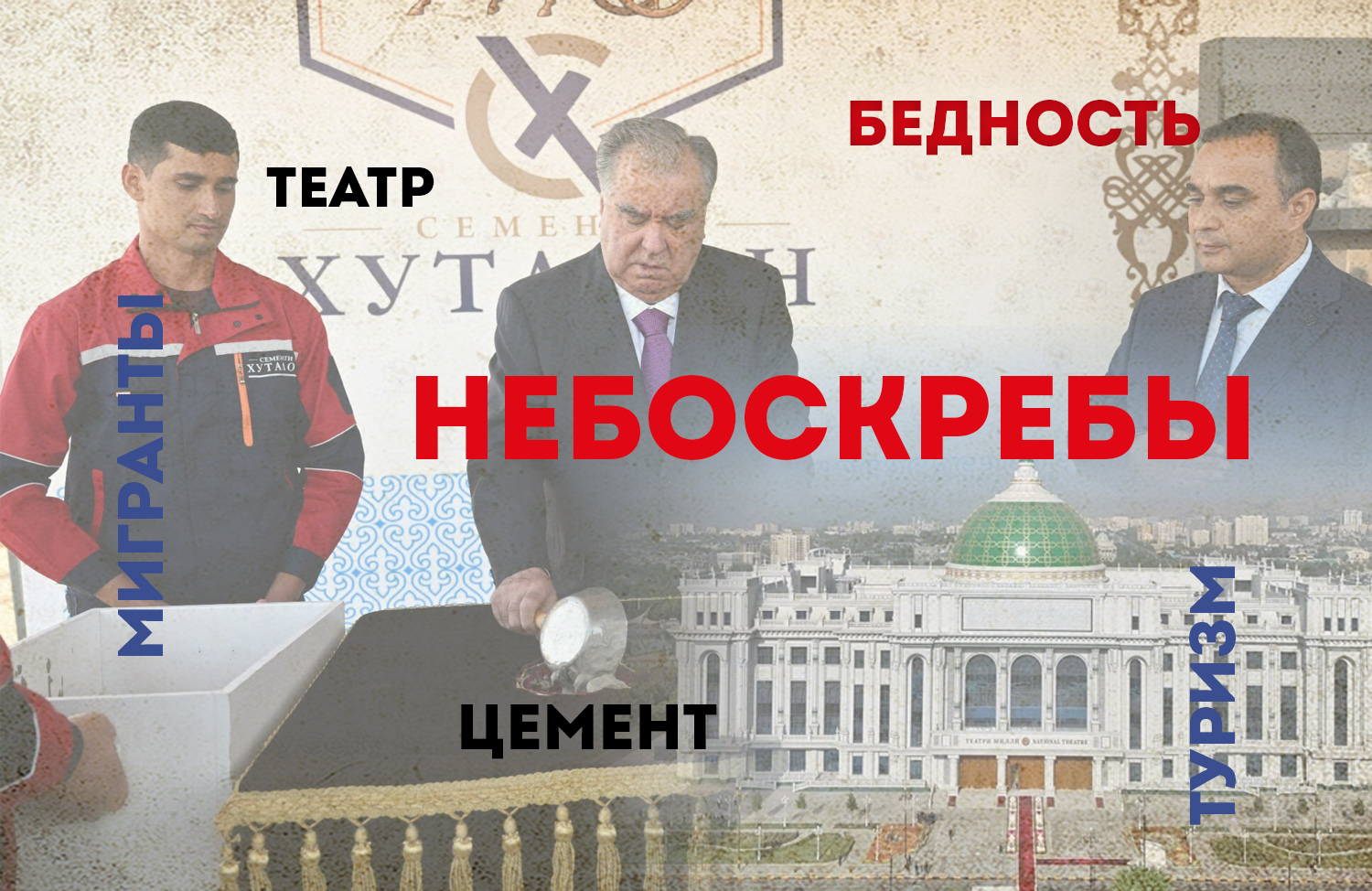
Construction of a new cement plant has begun in the Kushoniyon district of Khatlon Province. The facility is planned to be commissioned by 2029. Its capacity will be up to 1.2 million tons of cement per year, and after launch, more than 700 people will be able to work there.
This is already the fourth cement plant whose construction has begun in Tajikistan in the past two months amid cement shortages and rising prices. About a thousand people will be employed during the construction phase of the new plant.
555 new charging stations to appear in Dushanbe
In 2026-2028, Tajikistan plans to install 1,100 charging points for electric transport, with 555 in Dushanbe. Another 200 stations will appear in Sogdiana Province, 200 in Khatlon Province, 110 in cities and districts of republican subordination, and 35 in GBAO. About 167 million somoni has been allocated for developing charging infrastructure.
In parallel, the authorities plan to purchase 210 new electric buses – 70 annually. The total cost of the second phase of the electric transport development program is 888 million somoni, with the majority of funds – 782 million somoni – expected to be attracted from the private sector.
165 Tajikistanis received state awards
For the 35th anniversary of independence, Emomali Rahmon presented state awards and honorary titles to 165 representatives from various fields – science, culture, medicine, production, civil service, and business. Among them, seven people received the title “People’s Artist of Tajikistan,” and another 10 received “Honored Artist.”
State awards provide certain social preferences. For example, Heroes of Tajikistan are entitled to a 100% pension supplement, preferential housing provision, free transportation, and other benefits. Holders of orders and honorary titles also receive monthly pension supplements – depending on the award, from 10% to 50%.
In 2026, ten citizens were also awarded the State Prize named after Abuabdullo Rudaki.
Center for training labor migrants opens in Dushanbe
A center has begun operating in Dushanbe where those wishing to go abroad to earn money can receive free consultations, undergo training, and prepare for labor migration. Specialists will help with documents, legal requirements, working conditions, and residence rules in the destination country.
At the center, it will also be possible to study foreign languages and take short-term professional courses, for example, in cooking, sewing, hairdressing, service sector work, and computer literacy. Assistance is also provided for returned migrants, helping them with employment and using skills acquired abroad.
Tajikistan launches mountain lake monitoring system
Tajikistan has begun implementing THAW – an automated system that uses satellite data to identify new and anomalously changing mountain lakes that are potentially dangerous due to the risk of outburst.
The system uses data from Sentinel-1 satellites and allows regular monitoring of water body changes even in remote mountainous areas. Specialists have already tested the tool and discussed criteria by which identified lakes require further monitoring.
The implementation of THAW is particularly relevant given glacier melting and climate change, which can affect the size and condition of mountain lakes.
Tajikistan’s telecommunications operators earned over 3 billion somoni in six months
Revenues in Tajikistan’s telecommunications sector in the first half of 2026 exceeded 3 billion somoni, increasing by 26.8% compared to the same period last year. More than 80% of this amount – over 2.4 billion somoni – came from private telecommunications operators.
By July, there were 5.3 million internet users and 7.9 million mobile subscribers, of which approximately 6.1 million were active.
Market arson case in Gissar solved three years later
Three men were detained in Gissar on suspicion of deliberately setting fire to a building materials market in August 2023. According to the Interior Ministry, the motive was personal animosity of one of the suspects toward an entrepreneur.
The investigation believes that two men organized the arson, while the third carried it out. After this, he received 15,000 somoni. All three have been detained, and a criminal case has been opened for intentional destruction of another’s property.
The 2023 fire covered approximately 400 square meters, and the damage to entrepreneurs was estimated at 12.82 million somoni. Initially, the cause was attributed to a short circuit.
Surov appointed head coach of Tajikistan U-17
40-year-old Russian specialist Igor Surov has been appointed head coach of Tajikistan’s youth team. He has previously worked in Tajik football as a CSKA
Now Surov faces a new challenge – to prepare the U-17 team for the World Championship, which will take place in Qatar from November 19 to December 13. There is little time for restructuring, so the new coaching staff will need to quickly determine the team’s roster and playing model.