On September 9, Tajikistan celebrates the 35th anniversary of its independence. For a sovereign republic, the flag, coat of arms, and national anthem – are not only state symbols, but also a vivid reflection of the rich culture of the Tajik people.
Their status and the procedure for their use are determined by the country’s legislation, including the Constitution and the Law “On State Symbols of the Republic of Tajikistan.” Let us explain these three symbols.
State Flag of Tajikistan
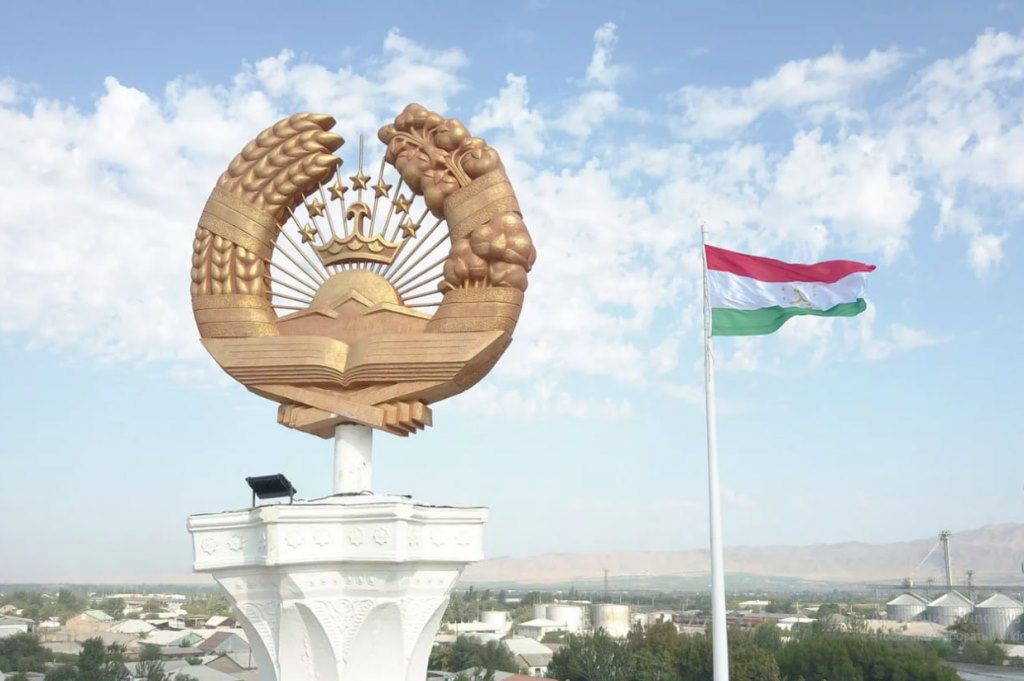
The state flag was adopted on November 24, 1992. It consists of three horizontal stripes – red, white, and green, in the center of which are depicted a crown and seven stars. Each stripe, or rather each color, has its own special meaning:
Red – a symbol of the struggle and self-sacrifice of the Tajik people for freedom and independence;
White – a symbol of purity, justice, and peace;
Green – a symbol of fertility, beautiful nature, and agriculture of Tajikistan. It is a sign of prosperity and hope for a bright future.
The crown and seven stars in the center of the flag reflect the statehood and ancient history of the Tajiks. The seven stars possibly symbolize seven historical regions of Tajikistan or seven bright stars that have special significance in Tajik culture.
According to Article 5 of the Law “On State Symbols,” the flag constantly flies on the buildings of the official residence of the president, the Majlisi Oli, the government, courts, ministries, diplomatic missions, as well as in meeting halls.
The law also grants citizens the right to use the flag in the context of private events.
The ratio of the width to the length of the flag is 1:2.
State Coat of Arms of Tajikistan
The coat of arms is described in Chapter 3 of the aforementioned law and is a symbol of national identity and statehood. It was approved on December 28, 1993.
According to the description in the law, the coat of arms consists of an image of a crown, seven stars, a rising sun, snow-capped mountains, wheat ears, and cotton stalks.
In the lower part of the coat of arms is an open book.
Crown with seven stars – a symbol of the country’s independence;
Wheat ears – a symbol of agriculture, fertility, and abundance;
Rising sun – a symbol of a bright future and the country’s development;
Mountains – a symbol of strength and the mountainous character of the territory;
Cotton – a symbol of wealth and the country’s agricultural potential;
Open book – a symbol of knowledge and the nation’s literary culture.
These symbols together reflect the great aspirations of the people: to live in peace, to achieve economic and cultural prosperity.
According to Article 8 of the Law “On State Symbols,” the image of the coat of arms is placed on the facades of all supreme state bodies (including the residence of the president, parliament, government, courts), in the offices of leaders, on seals, letterheads, and official documents.
The law also establishes that when the state coat of arms is displayed together with the coats of arms of public organizations and other legal entities, regardless of the form of ownership, the sizes of their coats of arms must not exceed the size of the state coat of arms. In this case, the state coat of arms should be placed on the left.
State Anthem of Tajikistan
The text for the state anthem was written by people’s poet Gulnazar Keldi (the text was approved on September 7, 1994), but the music was borrowed from the state anthem of the Tajik SSR from 1946 (!) and its author is Soviet composer Suleiman Yudakov.
“
“In Soviet times, it was always said that the most beautiful music was that of Tajikistan’s anthem. And when writing the text, I was guided precisely by Yudakov’s composition,” noted earlier Gulnazar Keldi. “The author of the previous anthem, Ustad Lahuti, wrote about the party, the Soviet people, Lenin. But after the collapse of the Soviet Union, there was neither a party nor its ideology left.”
Keldi believed that the text should not express the interests of any group, party, religion, or individual. He submitted several versions to the announced competition.
Their own versions of the anthem text were also proposed by well-known poets Loik Sherali and Gulrukhsor. In total, according to Gulnazar Keldi, 114 works participated in the competition. But his song text was recognized as the best.
Interestingly, after the collapse of the USSR, only three CIS countries kept their anthem melodies (changing only the text): Belarus, Uzbekistan, and Tajikistan. The other former Soviet republics adopted completely new or historical melodies for their anthems.
The state anthem of Tajikistan reflects the dreams and aspirations of the Tajik people. It is not just a symbol of the state, but an expression of the devotion, unity, and deep love of Tajikistan’s citizens for their Homeland.
Our worthy land,
May your sacred head be held high forever,
May your happiness, your state remain inviolable.
We have come through the centuries,
Under your flag we have taken our stand, taken our stand.
Long live the Homeland,
My free Tajikistan!
In the name of our honor and glory
You are the symbol of hope of our ancestors,
You are eternal peace for descendants,
Autumn does not threaten you,
For at your edge is a field of loyalty, a field of loyalty.
Long live the Homeland,
My free Tajikistan!
You are our only mother,
Your existence is the existence of our home,
Your goal is the goal of our body and soul,
From you – eternal happiness – is our lot,
You exist, and the whole world is our beloved, our beloved.
Long live the Homeland,
My free Tajikistan!
Articles 9 and 10 of the Law “On State Symbols” precisely define the procedure for performing and the cases of using the state anthem, including:
- at the opening and closing of sessions of the Majlisi Oli and local assemblies;
- daily at the beginning and end of state television and radio programs;
- at the reception and farewell of heads of foreign states;
- during international sporting competitions;
- at military ceremonies and other celebrations.
According to the law, during the official performance of the state anthem of Tajikistan, all those present stand as a sign of respect for the state symbol.
These three symbols – the flag, coat of arms, and anthem – together reflect the rich history, vibrant culture, and bright aspirations of the Tajik people. They remind every citizen of Tajikistan that the Homeland is a single home, and for its preservation and development, unity is essential.