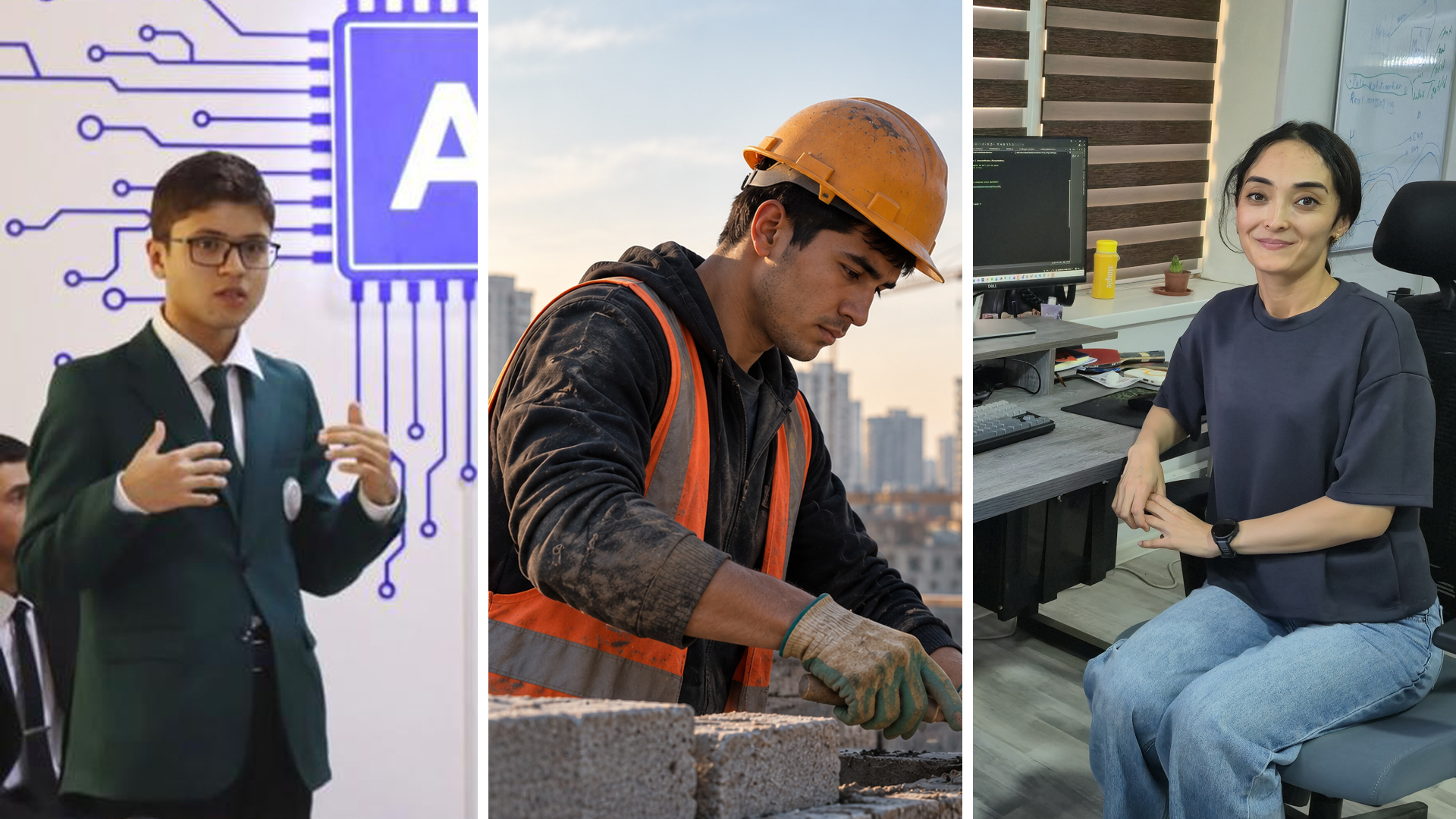
They belong to different generations, grew up in different regions of Tajikistan, and have different interests, education, and experience. But all three of them share one thing in common – they are building their lives in an independent country.
How has independence influenced their life choices? What keeps them in Tajikistan, and what makes them want to leave? How do they want to see their country in ten years?
Meoraj, 16 years old, high school student
For those born in independent Tajikistan, the internet and technology have become part of everyday life. Today, young people can independently acquire knowledge, learn languages, and try their hand at new professions. Some go to foreign universities after school and stay there, while others choose from the start to build their future in their homeland.
Meoraj Mirzoshirinov is 16 years old, born and raised in Khorog, and currently studies at a lyceum for gifted children.
He has managed to visit several countries and see how people live outside of Tajikistan. But he still likes his native Khorog the most.
Meoraj is attracted to the opportunities that other countries offer, especially in education and technology. But it is in Tajikistan that he sees space for his own ideas.
“
“In countries with developed entrepreneurial environments, there are already many companies and projects, so it’s harder for a young person to find their place. In Tajikistan, many fields are still only developing, which means there is an opportunity to create what is currently lacking,” says Meoraj.
He believes that his generation has far more opportunities than his parents had at the same age. The internet, competitions, technology, and access to educational resources allow people to learn much on their own.
“
“A person can develop themselves simply by having internet access. You can learn languages without leaving your home. I prepared for many exams this way, especially with the help of artificial intelligence, because when you interact with it, you can understand your weak points and know exactly where your mistakes are,” says the student.
Along with opportunities, competition has also grown. Meoraj says that young people have to accomplish more and constantly develop if they want to take advantage of these opportunities.
“Getting into a university, for example, a foreign one, is much harder. So you have to do a lot and not stop,” he says.
In the future, Meoraj wants to pursue technological entrepreneurship. While still in school, he started working on projects that solve specific problems.
In seventh grade, he noticed that it was difficult to keep track of books in the library, and information had to be searched in paper tables. Meoraj created his own database that allows you to see with one click what books are available, who took them, and when they should be returned. At first, the system was used by his school, and later he implemented it at Khorog State University and even conducted training for staff.
With prize money he won in one of the competitions, he bought a computer and continued working on his projects.
Currently, one of his ideas is related to safety on mountain roads. He wants to create a system that will warn drivers about dangerous sections, sharp turns, and places where rockfalls frequently occur.
Meoraj understands that one idea is not enough: you need money, a team, people who are ready to work together on a project. And there’s also constant curiosity – without it, a person simply won’t seek new solutions.
After school, Meoraj views studying abroad as the next stage of his development, not as a permanent move. He wants to see how strong universities and the technology environment are organized, gain new knowledge, and then apply it where he already understands specific problems.
“
“I can live in another country, but still not see the real problems in my own. Living here, I see what is needed and where. I want to solve these problems and be part of it. That’s why I’m drawn back to my homeland,” explains Meoraj.
In ten years, he would like to see more technological projects and startups in Tajikistan. Especially in the regions. He believes that in Khorog itself, there are enough problems that young people can solve using technology.
Faridun, 24 years old, labor migrant
Over the years of independence, labor migration has become part of everyday life for many Tajik families. For some, it’s a temporary way to earn money for housing or a wedding; for others, it’s a way to support parents and children. And some leave with their families and try to build a new life far from home.
Faridun (name changed at the request of the subject) is 24 years old and comes from Khatlon Region. After graduating from a polytechnic lyceum with a specialty in “motorist,” he returned home and spent several months looking for work. Then he served two years in the army. After returning, there were only temporary jobs again, and no permanent income.
Faridun’s family has four children, and his parents are no longer young. It was necessary to help the family. At that time, his friends one by one began leaving for Russia. They said that in a month you could earn as much as you sometimes can’t earn at home in several months.
Faridun thought for a long time, but ultimately decided to try. At first, he planned to leave for just a few months, but the trip gradually became permanent.
“
“I didn’t leave because I wanted to live in another country. If there had been an opportunity to earn normally at home, I would have stayed. I needed to help my parents, and after the army, I couldn’t find permanent work again. So I decided to try leaving. At first, I thought it would be just for a few months, but then I realized that in Russia I could earn more and regularly help my family,” says Faridun.
Now he is in his third year working in Russia on construction sites. The main result for him is the ability to support his family. He regularly sends money home: for food, home repairs, and expenses for his younger brothers and sisters. During this time, he has managed to save money for his future wedding.
But earning money far from home has another price.
“
“Of course, when you’re far away, money helps your family, and you feel like you’re doing something useful. But there are things you can’t buy with money. When your parents have problems or something important happens in the family, you’re not there. Over these three years, I’ve missed a lot. Sometimes you think: I earned money, I helped, but I wasn’t home at that moment,” admits Faridun.
Life in Russia has also changed his attitude toward what once seemed ordinary. When you’re far from home, you begin to perceive your family, native language, and the people around you differently.
At the same time, he understands those who continue to leave. According to him, young people go abroad not necessarily because they want to live in another country. Some are interested in independent life, some want to help their parents, some are saving for a wedding or housing.
“I think many people leave not because they don’t like Tajikistan. It’s just that at a young age, you want to earn money yourself, help your parents, and start a family. If you don’t have that opportunity at home, you start looking for it elsewhere. I went through this myself, so I understand well those guys who leave,” explains Faridun.
Before leaving, Faridun tried working in Tajikistan too. You can earn money on construction sites here as well, he believes, but it’s hard to find stable work. Much depends on connections and recommendations. If there’s someone who can recommend you, it’s easier to find a job.
There’s also the problem of official registration. Many work without labor contracts, and agreements remain verbal. After work is completed, this sometimes leads to payment problems.
“
“Sometimes you agree with someone, do the work, and then payment problems start. When you try to prove something, they ask you: ‘Did you have a contract?’ But many don’t. So the problem isn’t just how much you’ll be paid. It’s also important to understand that you’ll get that money and have some guarantees,” says Faridun.
However, he hasn’t yet tried to get additional training or take courses. He says he doesn’t know where to turn and what learning opportunities are available. Right now, his main task is to earn money and help his family.
Despite three years in Russia, Faridun doesn’t plan to tie his entire life to this country. For now, he continues to go to earn money – he needs to save up and get on his feet.
“I don’t want to work on someone else’s construction site in another country for my whole life. Right now I go because I need to earn and save. Then I’d like to return home, start a family, and open a small business. I’m 24 years old, and I want to live near my parents. If there was work here that would allow me to properly support a family and make plans, I would choose to live and work in my homeland,” he says.
In ten years, Faridun would like to see a country where labor migration is not perceived by young people as the only way to earn money.
“
“I want a guy from the district to be able to get a good education and find work at home. I want parents not to send their children abroad just because they can’t earn at home. Then young people would have a choice – to go or not to go, rather than the necessity to leave,” says Faridun.
Parvina, 37 years old, IT specialist
A few decades ago, IT in Tajikistan was not as widespread as it is today and was largely considered a predominantly male profession. Now the situation is gradually changing. More and more Tajik women are choosing programming, analytics, digital marketing, and other technology-related fields.
Parvina Zulfikarova from Khujand is 37 years old. She works as a software developer at Silk Road Professionals, where she creates digital solutions for business.
She didn’t enter this field right away. First, she received an education in information systems in economics, then taught programming and information systems at a university for several years. In 2021, she moved into development.
Parvina’s interest in programming appeared in childhood, largely thanks to her father, who himself worked as a programmer. She saw his attitude toward the profession, his interest in technical tasks, and his constant desire to learn. But she made the final choice herself.
“
“I like that IT combines logic, creativity, and constant development. Here you can not only study technology but also create products that help people, business, and society,” says Parvina.
She spent her first years of professional work in education. She taught, worked with students, and explained programming and information systems. This experience, she says, taught her not just to understand technology but to explain complex things in understandable language.
She came into development in a different reality. When Parvina started her professional journey, IT in Tajikistan was a much less widespread field.
“
“At first, it was difficult to find a clear path for professional development. There were fewer training courses, professional communities, and opportunities to communicate with developers, and information technology itself was more often associated with computers, technical support, and basic programming. And you had to independently search for information and constantly learn,” she recalls.
The industry itself has changed during this time. Today, Tajikistan is developing application development, cloud technologies, artificial intelligence, cybersecurity, data analysis, and digital entrepreneurship. Young specialists can study online, participate in hackathons, startup programs, and international competitions.
For Parvina, it’s especially important that today IT offers women more and more opportunities. At the beginning of her professional career, she had to face the stereotype that technology is primarily a male field.
Today, she herself helps girls take the first step in this direction. In 2026, Parvina became a technology mentor for the Technovation Girls program. Her team reached the semifinals, and participants learned to analyze problems, understand user needs, work in teams, and present their own ideas during the program.
“
“Support for girls should start in school. It’s important to show them that technology is not just a male field. Girls can be developers, engineers, researchers, entrepreneurs, and leaders of technology companies,” believes Parvina.
Work in IT, she says, has given her professional independence and confidence in her abilities. But most importantly, it’s the opportunity to constantly move forward. Now Parvina is not limited to development; she teaches, mentors, participates in educational initiatives, and studies artificial intelligence and AI agents.
In ten years, she would like to see Tajikistan as a country with a strong digital economy and modern education.
“
“I would like young people to be able to get quality education, master modern technologies, and build international careers while staying in their country. For this, we need to develop technical education, provide access to the internet and digital resources in all regions, create IT parks and startup incubators, and develop artificial intelligence research centers,” says Parvina.
Girls hold a special place in her vision of the future. She hopes that in ten years they will more often choose technical professions, create their own projects, and hold leadership positions in IT.
She hopes that in ten years, girls in Tajikistan will more often choose technical professions, create their own projects, and hold leadership positions in IT.