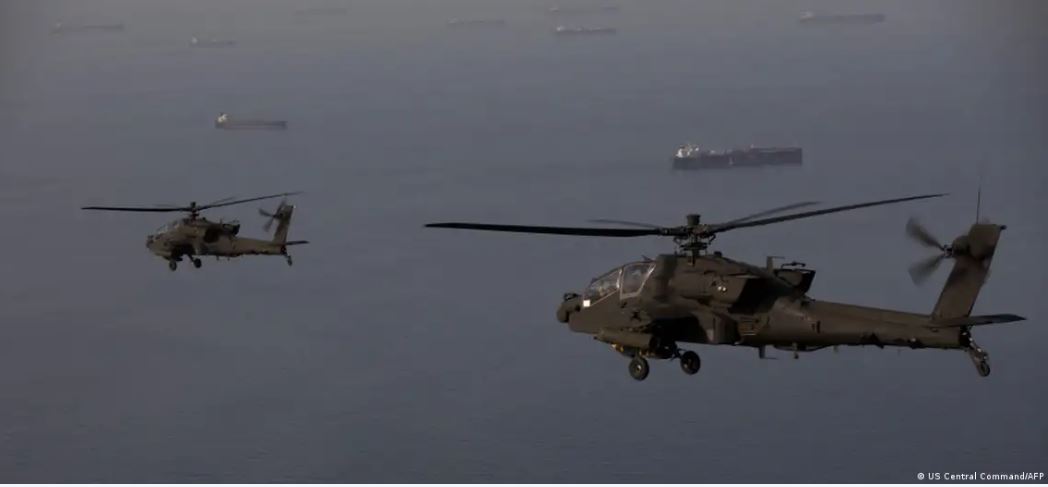
The United States launched a series of strikes against targets in Iran after an American Apache attack helicopter was reportedly shot down over the Strait of Hormuz, according to U.S. President Donald Trump.
According to the U.S. Central Command (CENTCOM), the operation began on Tuesday at 5:00 p.m. Eastern Time. The military said the strikes were carried out in response to the destruction of the helicopter, the BBC Russian Service reported.
“This mission is a proportionate response to unwarranted Iranian aggression,” CENTCOM said in a statement.
Axios, citing a U.S. official, reported that the strikes targeted several Iranian air defense systems and radar installations.
Earlier on Tuesday, Trump said Iranian forces had shot down an American Apache helicopter while it was conducting a patrol mission near the Strait of Hormuz.
“Our military just informed me that last night the Iranians shot down one of our high-tech Apache helicopters. There were two pilots on board, both unharmed. However, the United States must respond to this attack,” Trump wrote on his Truth Social platform.
In an interview with ABC News, the U.S. president said Washington’s response would be “very strong.”
“We are responding right now. This is a reaction to what they did to our helicopter last night. I believe the response should be very tough and powerful,” Trump said.
Even before Trump’s public statement, CENTCOM had announced the successful rescue of the helicopter’s two pilots. According to the command, they were evacuated from the water by a maritime drone operated by Task Force 59, based in Bahrain. The pilots were later transferred to a designated location at sea, where another helicopter picked them up.
The incident marked the first confirmed loss of an Apache helicopter since February 28, when a new phase of tensions between the United States and Iran began.
Iran vows retaliation
Iranian Foreign Minister Abbas Araghchi condemned the U.S. strikes in a statement posted on X.
“Despite their battlefield defeats, the U.S. has decided to test our resolve. Our armed forces will not leave any attack or threat unanswered,” Araghchi wrote.
He also warned Washington: “Leave our region if you want to be safe.”
Later, Iran’s Tasnim news agency published a statement from the Islamic Revolutionary Guard Corps (IRGC), which said Iran had launched retaliatory missile and drone strikes against U.S. targets in the region.
The New York Times was the first to report the helicopter’s crash in the Strait of Hormuz, citing anonymous sources. Trump later confirmed the incident, although neither the White House nor initial reports specified the cause of the crash.
Tehran has not directly acknowledged responsibility for downing the helicopter. However, shortly after Trump’s statement, Araghchi called on foreign military forces to leave the Strait of Hormuz area.
“The Strait of Hormuz is not international waters but is jointly owned by Iran and Oman. Foreign troops near our territory face constant risks due to mistakes, accidents, or the possibility of being caught in crossfire,” he wrote.
“To reduce these risks, the best solution is for them to leave,” he added.
Regional tensions remain high
The U.S. strikes could jeopardize the fragile truce in the region and complicate efforts by the Trump administration to reach a diplomatic agreement with Tehran.
Additional instability stems from ongoing clashes in Lebanon between Israel and the Iran-backed Hezbollah movement.
Iran and Israel exchanged strikes on Sunday and Monday before announcing a temporary suspension of hostilities. Despite the pause, tensions remain high.
Earlier on Tuesday, shortly before Trump’s announcement, Iranian Parliament Speaker Mohammad-Bagher Ghalibaf signaled that Tehran was prepared for a renewed confrontation.
“We prefer the language of diplomacy, but we are much better at other languages. Violate your obligations, and we will switch to the language we are best at,” he wrote on social media.
According to BBC international editor Jeremy Bowen, the latest developments suggest that Iran retains the ability to exert pressure on the United States and its allies despite recent military strikes. He warned that the region could face a prolonged crisis marked by periodic escalations and renewed outbreaks of conflict.