Tajikistan plans to update standards for wastewater treatment and reuse. Current regulations, according to specialists, do not fully account for modern local treatment systems.
Proposals for changes to the regulatory framework were prepared following a national seminar on water quality standards, wastewater treatment and reuse, which took place in Dushanbe.
The event was organized by the Regional Environmental Center for Central Asia (CAREC) and the International Union for Conservation of Nature (IUCN) as part of the “Blue Peace Central Asia” (BPCA) project with support from the Swiss Agency for Development and Cooperation (SDC).
Why are new rules needed?
One of the main topics of discussion was local sanitation systems for rural areas and the limitations that exist in current national standards for wastewater treatment and reuse and sludge management.
In rural areas of Tajikistan, centralized sewerage is insufficiently developed. Under such conditions, specialists view local treatment facilities (LTF) as one of the possible solutions.
LTF are small systems that treat wastewater directly where it is generated. They can be used in small settlements, schools, medical facilities, and other institutions.
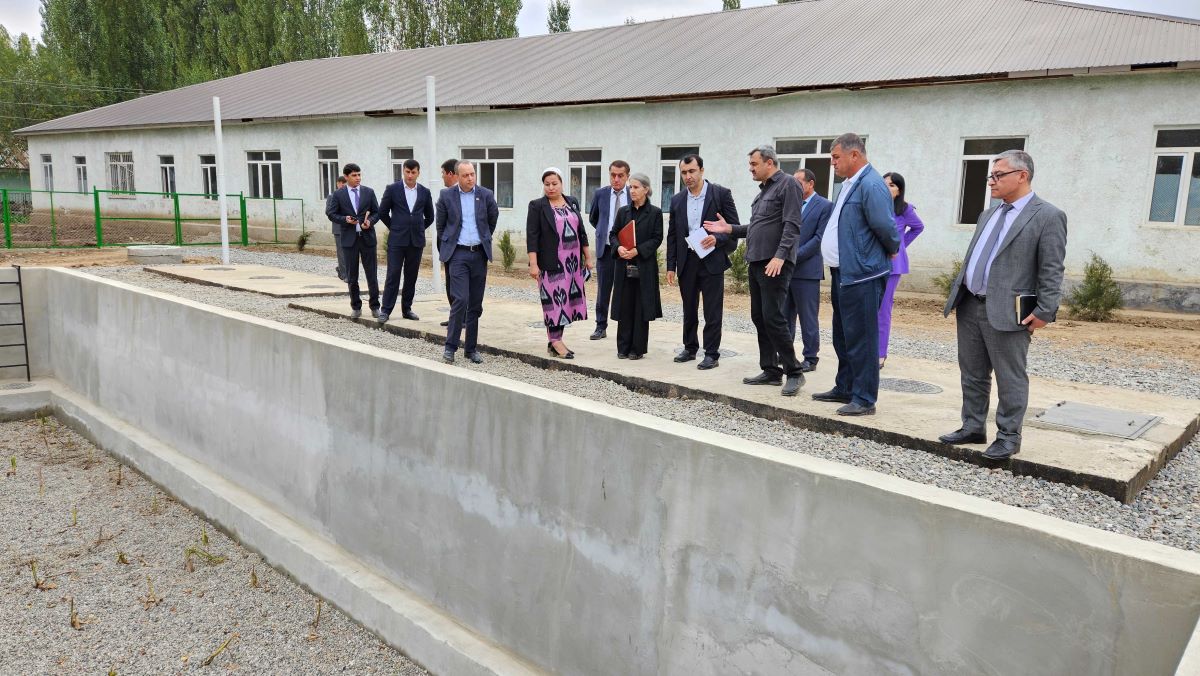
Currently, seven pilot LTF facilities are operating in schools, medical institutions, and small settlements in Sogdiana region and districts of republican subordination.
These facilities employ, among other things, phyto-engineering systems (constructed wetlands) — structures where water treatment occurs through natural processes involving plants, soil, and microorganisms.
Representatives of the International Secretariat Office on Water in Tajikistan (ISW), as well as BORDA and EQUIDEV organizations, shared their experience in operating such systems.
Among the advantages of such technologies, participants noted low maintenance costs, low energy consumption, no need for complex infrastructure, and the ability to adapt to local conditions.
What problems exist in current standards?
One obstacle to the spread of such systems, according to participants, is the absence of special requirements in national building codes and regulations (SNiP) for the design of local treatment facilities.
Additionally, there is currently no clear procedure for their acceptance and commissioning.
Experts noted that current sanitary requirements do not fully account for the characteristics of modern decentralized treatment systems.
In particular, standards for ammonia content in treated water may be difficult to achieve for some natural treatment technologies. At the same time, such systems can effectively remove organic pollutants and have other environmental benefits.
What changes do specialists propose?
Seminar participants proposed developing more flexible requirements that would account for the type of treatment technology used, the size of the facility, the intended use of treated water, and operating conditions.
In particular, it is proposed to develop separate rules for local treatment facilities: establish requirements for their design, determine the procedure for acceptance and commissioning, and account for different treatment technologies.
Specialists also propose reviewing requirements for treated water quality so that they account not only for pollution indicators but also for the characteristics of specific treatment technologies.
Special attention was given to the reuse of treated water in agriculture. Participants believe it is necessary to establish water categories depending on the degree of treatment and set rules for its application.
It is necessary to determine which crops can be irrigated with such water, which irrigation methods are permissible, what quality indicators need to be monitored, how often inspections should be conducted, and what intervals should be observed between irrigation and harvest.
Proposing unified rules and a monitoring system
Participants proposed developing a national guideline on decentralized sanitation. Such a document should establish rules for the application of local treatment systems, water safety requirements, and procedures for the use of water and organic residues after treatment.
It is also proposed to create a monitoring system for LTF. It should include not only laboratory analyses but also simple on-site inspections — for example, assessment of water turbidity, odor, and sludge levels in septic tanks.
Additionally, participants believe it is necessary to create a national database for monitoring local treatment facilities, which would receive information from all pilot projects.
Experts propose changing the approach to sanitation
Deputy Head of the Water Resources Department of the Ministry of Energy and Water Resources of Tajikistan Gul Sharifzoda noted that it is necessary to update not only regulatory documents but also the approach to understanding sanitation.
“It is necessary not only to update the regulatory framework but also to work on a modern understanding of sanitation and water resources. We have developed a Soviet school of thought, whereas in Western practice the concept of sanitation is interpreted more broadly. Therefore, it is important to train specialists, develop a unified understanding of terms and approaches, and improve existing regulatory documents taking into account modern requirements,” he said.
Following the seminar, proposals were prepared for a national roadmap for the development of local treatment facilities, reuse of treated water and composted sludge with defined safety criteria.
Participants believe it is necessary to establish an inter-agency working group to develop appropriate building and sanitary standards.
The “Blue Peace Central Asia” project (2025–2029) is aimed at supporting sustainable water resources management and developing water diplomacy in the region. It is implemented by a consortium of the International Water Management Institute (IWMI) and the International Union for Conservation of Nature (IUCN) with the strategic partnership of CAREC.