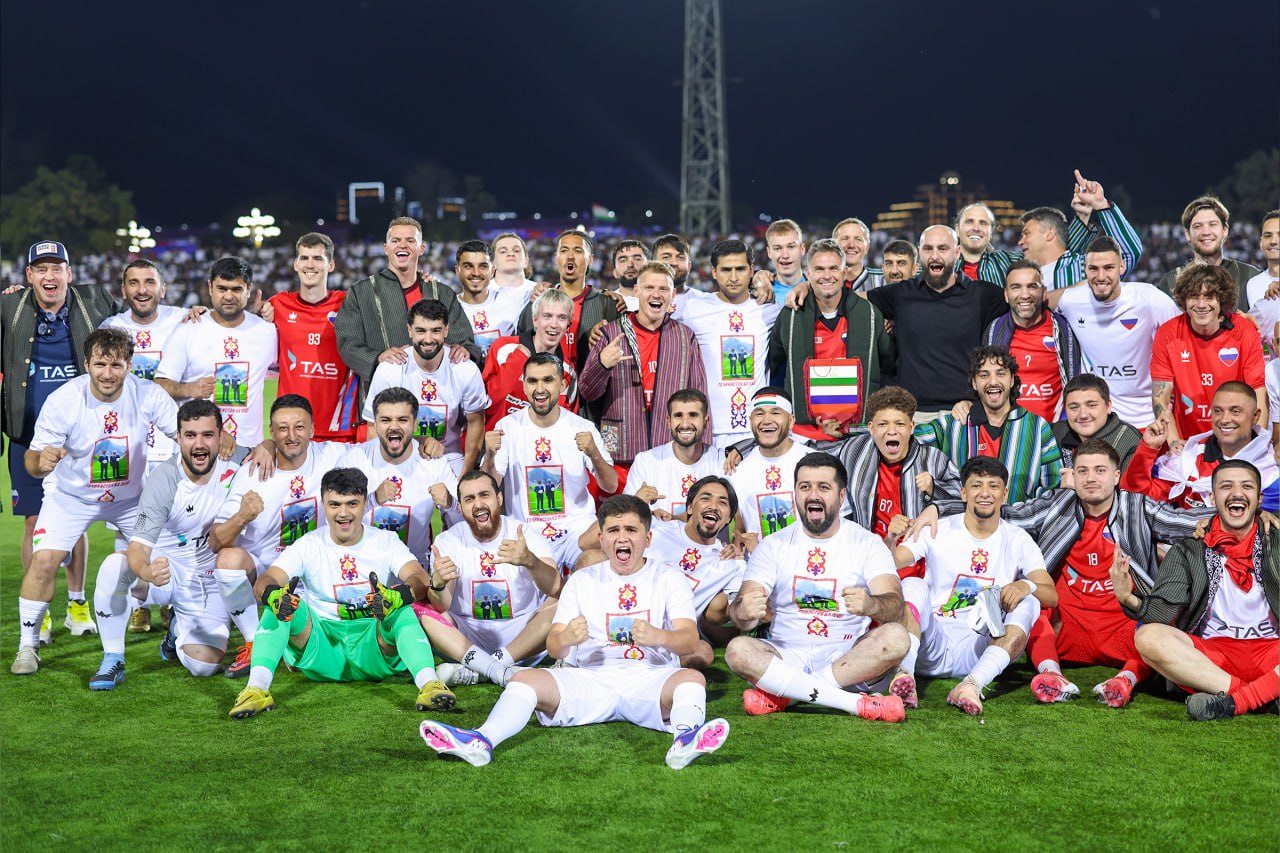
The Central Republican Stadium hadn’t seen such an unusual football evening in a long time. On the field were Khurshed Makhmudov and Dilshod Vosiev, Roman Pavlyuchenko and Alan Dzagoev, Dmitry Tarasov and Fatkhulo Fatkhulloev. On the sidelines were Petr Segrt and Leonid Slutsky, with Andrey Arshavin nearby in the Russian coaching staff. And on the scoreboard in the end was a decidedly unfriendly 3:4.
Tajikistan was leading 3:1, Russia was down to ten men, but one of the main unusual rules of media football changed everything – the “red ball” and Pavlyuchenko’s goal, which counted for two.
In Dushanbe, they had prepared not just a football match. The meeting of media national teams from Tajikistan and Russia, timed to the 35th anniversary of the country’s state independence, was turned into a show. And even before the opening whistle, it became clear: there would be no ordinary friendly football today.
The crowd began filling the Central Stadium long before the teams took the field. While the footballers warmed up, famous Tajik performers performed for the spectators – Farrukh Hasanov, Noziya Karomatullo, Farahnooz and Zulaykho Makhmadshoyeva. Hasanov performed “Gori!” – a song he performed at “Intervision” in Moscow in 2025.
The Russian guests were welcomed in Tajik fashion. Delegation members were given traditional chapans as gifts. The atmosphere actually resembled a festival more than an ordinary football evening. But gradually the music gave way to football. By the start of the match, the stands were nearly full. According to the organizers, the match was attended by 16,850 spectators – that is, almost 17,000.
And the crowd came not just to watch bloggers. The hosts could once again see footballers who had relatively recently defined the face of Tajik football: Khurshed Makhmudov, Dilshod Vosiev, Fatkhulo Fatkhulloev, Ibrahim Rabimov.
They were managed by a man well remembered in Dushanbe – Petr Segrt. It was this Croatian specialist who led the Tajikistan national team to its first-ever Asian Cup, where the team reached the quarterfinals in 2024.
Russia had no shortage of stars. Pavlyuchenko, Dzagoev, Tarasov, Georgy Shchennikov, Vitaly Dyakov – alongside them were representatives of 2Drots, “Amkala,” Broke Boys, Lit Energy, bloggers, streamers, and rapper Lil Kavkaz. And at the last moment, Andrey Arshavin also joined the delegation, becoming part of Leonid Slutsky’s coaching staff.
The day before, this entire group appeared before journalists at a press conference. Slutsky and Segrt, Arshavin and Pavlyuchenko, Edams Skylar, Anar Abdullaev and others answered questions. And in the evening it became clear why such an unusual lineup was needed at all.
Media football thrives at the intersection of two worlds: people who grew up watching national team matches and European cups come to see Pavlyuchenko and Dzagoev, while the young internet audience comes to see media league heroes and bloggers. In Dushanbe, these two audiences met at one stadium.
50 minutes instead of 90 – and almost without breaks
Here it’s necessary to immediately explain the rules, because without them it’s practically impossible to understand what happened next. The match consisted not of the usual two 45-minute halves, but two 25-minute halves. Additionally, the teams had special challenges – opportunities at certain moments to change the standard course of play.
You could see a bullseye instead of the usual penalty. And toward the end, a “red ball” appeared: after activating such a challenge, a goal scored within an established three-minute window with the special ball counted as two goals instead of one. This rule ultimately completely turned the result around.
But the first minutes required no exotic elements. The teams simply started playing football – and unexpectedly seriously. Already in the first minute, Anar Abdullaev created danger. He found himself in a promising position after a cross, but failed to properly control the ball.
Tajikistan responded with their own attacks. The team moved through midfield very quickly. Neither Segrt nor Slutsky intended to turn the meeting into a veterans’ stroll: there was pressing, there were attempts to play combinatively, there was a desire to immediately win the ball back.
What was lacking was coordination. Sometimes a good attack fell apart on the final pass – which is completely natural for teams assembled specifically for a single match. Gradually the hosts began to look sharper, but Russia scored.
Pavlyuchenko came up with it, Mavrin finished it
In the 7th minute, Roman Pavlyuchenko received the ball in midfield and drove it forward. Then came a pass to Vasily Mavrin and continued movement toward the penalty area. Mavrin played a one-two with the former Russian national team forward, burst in from the right and precisely directed the ball into the far corner – 0:1. The guests’ first truly complete sequence of play ended immediately with a goal.
The Russians barely had time to celebrate. About a minute passed – Tajikistan earned a free kick near the guests’ goal. Fatkhulo Fatkhulloev stepped up to the ball. The shot was nearly perfect: the ball hit the post and bounced into the net – 1:1.
And here the stadium truly exploded for the first time. The match, which before the start could be perceived primarily as a show with stars of the past and bloggers, instantly acquired a competitive edge. Slutsky began reacting with substitutions. But Tajikistan continued to press. The class of former Tajik national team players hadn’t gone anywhere.
Vosiev reminded everyone of his former self
In the 16th minute, the hosts executed one of the best combinations of the first half. A quick flank attack, several timely passes – and Dilshod Vosiev finishes the attack into an almost empty goal – 2:1. The stadium roared again. And there was something very recognizable in this goal for those who remember Vosiev from his best years. The right positioning choice, timely movement into space, and calm finishing of the play.
Slutsky had to strengthen the game. Alan Dzagoev took the field – a footballer with whom the coach is connected by a huge stretch of his professional career. They worked together for many years at CSKA and the Russian national team, and now they met again on the same team in a completely different football reality. The first half ended 2:1 in favor of Tajikistan.
In the second half, Russia came out as a different team. Slutsky made a new wave of substitutions, including changing the goalkeeper, and added players better able to handle the ball. Gradually the guests began to seize the initiative. Dzagoev started receiving the ball more often and looking to continue attacks. After his free kick delivery, Dyakov failed to properly adjust to the ball. Then after a corner, Dmitry Tarasov got a good chance but shot straight at the goalkeeper.
Tajikistan now acted differently: spent less time with the ball and more readily used the space behind the advancing Russians. And just when it seemed a Russian goal was brewing, the hosts scored. In the 32nd minute, the Tajiks carried another attack through to a shot. The Russian goalkeeper powerfully punched the ball out of the penalty area with his fists.
It seemed the danger was averted. But Firuz Bobiev was first to the rebound. Without controlling the ball, he sent it with the outside of his foot into the top corner – 3:1. At first there was a pause: the referee went to check the play for a possible offside. But the violation wasn’t confirmed – the goal stood. The stands celebrated, and Russia found itself in a position from which under normal rules and with the remaining time it would have been extremely difficult to escape. But this was media football. And the next episode began to turn the match around.
Penalty turned into a bullseye
Not even a minute passed before the referee had to sort out another disputed situation in Tajikistan’s penalty area. At first there was talk of a possible handball. After review, it turned out that there was indeed a violation, but a different one – a trip against Anar Abdullaev. The referee pointed to the punishment.
However, instead of a regular penalty, a challenge provided for in the format was used – a bullseye. For a viewer accustomed to classical football, this looked unusual. The taker starts moving toward the goal with the ball and gets the opportunity to beat the goalkeeper in an almost one-on-one situation – here it’s not enough to simply pick a corner and shoot from a spot.
The injured player himself took the shot. Anar Abdullaev ran up, approached the goalkeeper, waited for the moment and coolly rolled the ball between his legs – 3:2. Now the real madness began.
Red card – it seemed this was the end for Russia
Russia went forward, but soon put itself in a very difficult position. In the 42nd minute, Tajikistan broke away on another counterattack. Vanya Mlechny couldn’t keep up with his opponent and grabbed him by the shirt. The referee showed a straight red card. The fact of the ejection was confirmed in post-match reports.
Moreover, the episode was unpleasant also because the Tajik footballer suffered an injury and could only leave the field with help from his teammates. On the scoreboard – 3:2. Almost no time left, Russia down to ten men, it seemed all was lost. But it was precisely here that the rules of media football finally intervened in the narrative.
Slutsky used the provided opportunity to put an additional footballer on the field and restore numerical equality, and then went all-in – Russia activated the “red ball.”
One goal that turned into two
The meaning of the challenge is extremely simple and simultaneously merciless for the opponent. A three-minute timer starts. If the team manages to score with the special red ball, the goal counts as two. That is, at 3:2, Russia no longer needed to score twice. One goal was enough.
Tajikistan later also used its “red ball,” but it was the Russian challenge that proved decisive. It was the 44th minute, a corner kick, a delivery into the penalty area. And there, above everyone else, was Roman Pavlyuchenko. The former Russian national team forward literally hammers the ball with a header under the crossbar.
For a second a new question arises – wasn’t there an offside? Check – no, it’s a goal. And on the scoreboard not one but two are added. The score changes from 3:2 to 3:4. One Pavlyuchenko strike erased the advantage that Tajikistan had built for almost the entire match. It was this bonus goal that official post-match reports called the winning goal.
Here, perhaps, is the episode that better than any explanation shows the difference between classical and media football. In a regular match, Pavlyuchenko would have equalized – 3:3.
The evening was a success
And the hosts were not yet doomed. Segrt’s team still had their own challenge with the “red ball.” Now Tajikistan could with one accurate shot not just equalize the score, but completely turn the game around again. The stadium understood this perfectly. The final minutes turned into not so much tactical football as a chase for one episode.
Tajikistan needed a goal, and Russia was defending the result. But the hosts failed to repeat Pavlyuchenko’s trick. The final whistle recorded 3:4. The Russian media national team won the match, having come back from 1:3.
Media football is sometimes accused of having too much show and too little actual football. In Dushanbe it turned out the opposite: the show brought people to the stadium, and the football made them forget that before them was just a friendly match. And perhaps that’s precisely why the evening was a success despite Tajikistan’s loss – 3:4.