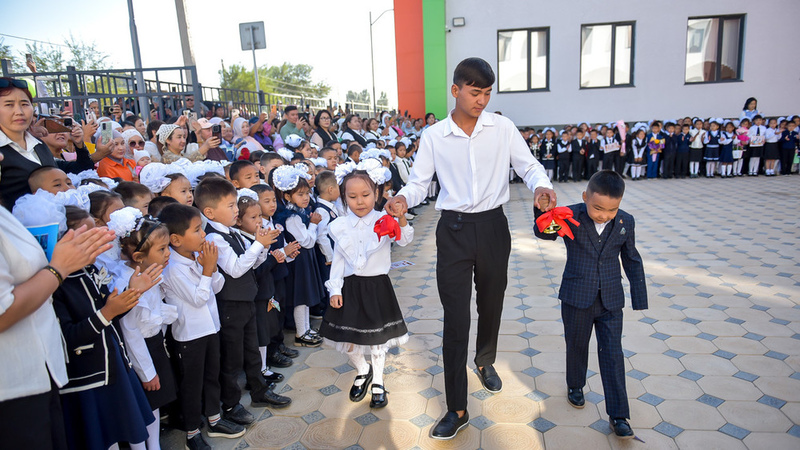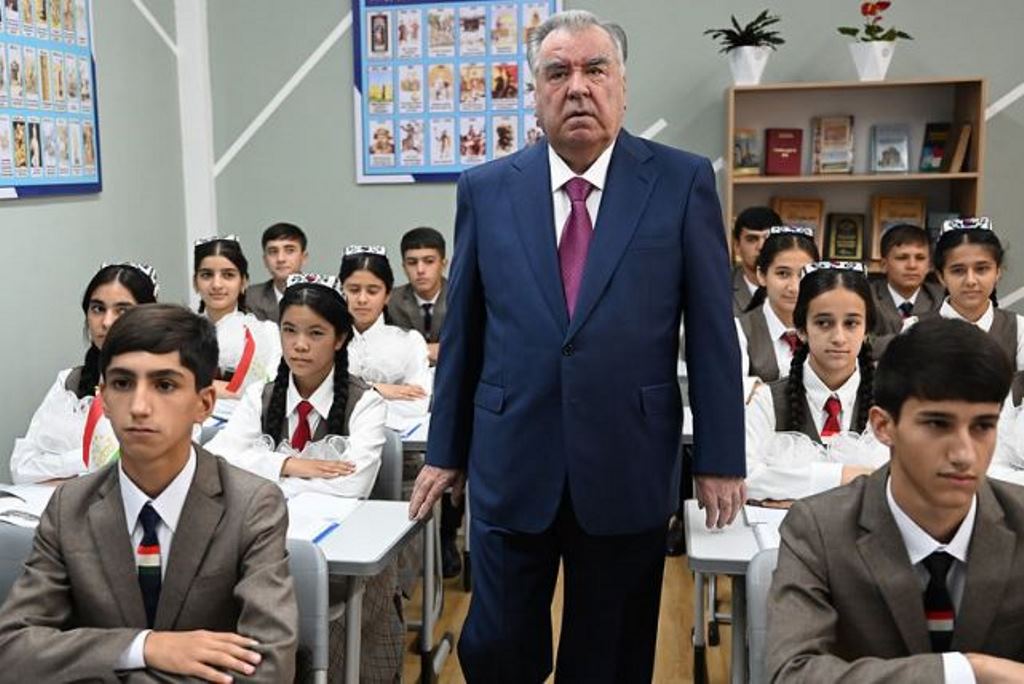
President of Tajikistan Emomali Rahmon on August 31 spoke at capital school No. 105 on the occasion of the start of the new academic year and Knowledge Day. In his speech, he addressed issues of education quality, preschool and vocational training, digitalization, children’s use of social media, and career choice.
One of the main themes of the speech was the impact of smartphones and social media on schoolchildren.
According to the president, uncontrolled use of smartphones and social media among students in recent years is causing concern.
He stated that excessive time spent by children on the internet can negatively affect their sleep, speech, memory, ability to acquire knowledge, and physical development.
The president noted that a number of developed countries have already introduced various restrictions on the use of mobile phones by schoolchildren under 16 years of age.
The president instructed the Ministry of Education and Science, the Agency for Innovation and Digital Technologies, and the Committee for Primary and Secondary Vocational Education to comprehensively study this issue within three months and present proposals for its solution to the government.
At the same time, he emphasized the need to develop among young people a culture of using the internet, social media, and artificial intelligence.
Over 80 billion somoni directed to education
Emomali Rahmon stated that over the years of independence, more than 70 billion somoni from the state budget has been directed to the education sector, with another 10 billion somoni allocated through state investment projects.
During this period, the country has constructed and put into operation 4,135 buildings of educational institutions with 1.8 million student places. Their construction cost 8.4 billion somoni.
Rahmon: the problem of textbook shortage has been solved
According to the president, since the beginning of 2025, 9.215 million copies of textbooks and educational materials have been distributed to educational institutions in the country.
To provide schools with textbooks for the 2026–2027 academic year, 40 textbook titles underwent competitive selection. Their publication is ongoing.
“
“Today, there are no problems with textbook shortages in educational institutions,” stated Emomali Rahmon.
At the same time, he urged the Ministry of Education to focus now on the quality of textbooks and their compliance with international standards.
The president also instructed more careful verification of international educational methodologies before their implementation in Tajikistan. According to him, such approaches should first undergo testing and adaptation to the country’s conditions and national values.
Kindergartens should cover up to 50% of children
The president separately addressed preschool education.
He instructed regions, the Ministry of Education, and other responsible bodies to more actively engage in kindergarten construction and use available opportunities to implement the National Strategy for Education Development until 2030.
Coverage of children by preschool education should be increased to 50%.
The president also instructed measures to be taken to prepare qualified personnel for preschool institutions.
Vocational education: number of specialties increased to 730
The head of state stated that the number of professions and specialties in the system of primary and secondary vocational education has increased from 230 to 730 in recent years.
Today, training in the primary vocational education system is conducted in 330 professions and specialties, while in secondary vocational education it is conducted in 400 specialties.
The country has 66 primary vocational education institutions where more than 28,000 people are studying, including almost 8,000 young women.
The number of students in secondary vocational education institutions has reached 106,500 people.
In 2026, the Program for the Development of Primary and Secondary Vocational Education for 2026–2029 was approved. The program provides for the repair and restoration of 61 educational institutions.
At the same time, the president acknowledged the need to improve practical training, equip workshops and laboratories, provide institutions with specialized textbooks, and strengthen ties with enterprises so that graduates can find employment.
Rahmon urged young people to study AI and modern technologies
The president urged young people to pay more attention to studying modern professions, foreign languages, digital technologies, and artificial intelligence.
He noted that today specialists in the fields of cybersecurity, information technology, artificial intelligence, and programming are particularly in demand.
Rahmon also stated the need to change the approach to career choice. According to him, many young people choose a specialty not based on their abilities and interests, but under the influence of fashion and others’ choices.
The Ministry of Education and Science, the Committee for Primary and Secondary Vocational Education, the National Academy of Sciences, and the Academy of Education are instructed to develop proposals within three months on forming a culture of career choice and identifying the abilities of children and adolescents.
Universities want more specialized subjects from the first years
The president also criticized the situation where students in their first two years of university study predominantly non-specialized disciplines, with major subjects in their specialty beginning only from the third year.
According to him, this reduces students’ interest in their chosen profession.
The Ministry of Education and Science and universities are instructed to study this issue within three months and present proposals to the government.
“
“We primarily need a specialist, not a young person who is simply a diploma holder,” emphasized Rahmon.
President reminded about the presidential quota
Emomali Rahmon also noted that the presidential quota for university admission has been in effect since 1997.
During this time, 29,000 school graduates from 61 cities and districts were admitted to 20 universities in the country under the quota. The main goal of the program is to support young people from remote areas and provide regions with qualified personnel.
In conclusion, the president urged parents and teachers to pay more attention to children’s upbringing, and young people to acquire knowledge, profession, and practical skills.
He also emphasized the need to maintain peace and national unity against the backdrop of a complex international situation and stated that educated, professionally trained, and patriotic youth should become the foundation for the country’s further development.
School for three mahallas
Emomali Rahmon today, together with Dushanbe Mayor Rustam Emomali, commissioned the new building of school No. 105, designed for 2,400 students in two shifts in the Shakhmansurov district.
The school consists of five sections and includes 130 educational and auxiliary classrooms. In ten specialized classrooms, students will be able to study physics, chemistry, biology, computer science, foreign languages, music, military and labor training.
The institution also provides an assembly hall with 400 seats, a cafeteria with 290 seats, a gym, traditional and electronic libraries.
On the school grounds, a sports field and a parade ground for military training classes are equipped. The courtyard is landscaped and illuminated.
The new educational institution should provide modern conditions for education of children and youth from three mahallas of the Shakhmansurov district.
In labor training classes, schoolchildren will be able to master professions and crafts simultaneously with general education disciplines.
Authorities note that the creation of such conditions corresponds to state policy on the development of natural, exact, and mathematical sciences, as well as the preparation of in-demand specialists.
The school was constructed by LLC “Somontaaminot” with the involvement of local specialists and the use of domestic building materials.
How many schools were built in Dushanbe
According to authorities, in 2017–2023, modern schools for 72,000 students were constructed and put into operation in Dushanbe.
Over the past nine years, 55 new educational institutions with more than 95,000 student places have appeared in the capital, as well as 42 kindergartens with 8,000 children.
As part of preparations for the 35th anniversary of state independence, as of July 1, 2026, 57 general education and preschool institutions have been put into operation in Dushanbe.
By the end of the current year, the capital plans to open seven more educational institutions with 10,000 student places and eight modern kindergartens for approximately 1,000 children.