In 2002, a correspondent for “Asia-Plus” traveled to northeastern Afghanistan – to the provinces of Takhar and Kunduz. Just one year had passed since the assassination of Ahmad Shah Massoud and the events of September 11, which changed the region and the entire world. In small towns and districts of the country, traces of the recent war still remained, and people were only beginning to adapt to peaceful life and a new government.
A Year After Massoud’s Assassination
The idea to visit Khoja Bahovuddin, a small provincial town in Takhar Province in northern Afghanistan, did not arise by chance. It was here on September 9, 2001, that Ahmad Shah Massoud was killed by terrorists – a man who had previously been invulnerable to his enemies, having survived numerous assassination attempts by Soviet and Afghan special services.
Now in Khoja Bahovuddin, last year’s terrorist attack is rarely recalled – life is too difficult, and there are many problems. Besides, portraits of Massoud are now a rarity here.
A year ago, during the height of the counterterrorism operation by international coalition forces against Al-Qaeda and Taliban fighters, which began after the tragedy of September 11 in the United States, the previously unknown Khoja Bahovuddin briefly transformed into the military and political center of Afghanistan.
The entire military and political elite of anti-Taliban forces were based here, thousands upon thousands of refugees from practically all over northern Afghanistan, dozens of international humanitarian organizations, hundreds of ubiquitous journalists. In general, life here was literally boiling, bazaars were full of people and goods.
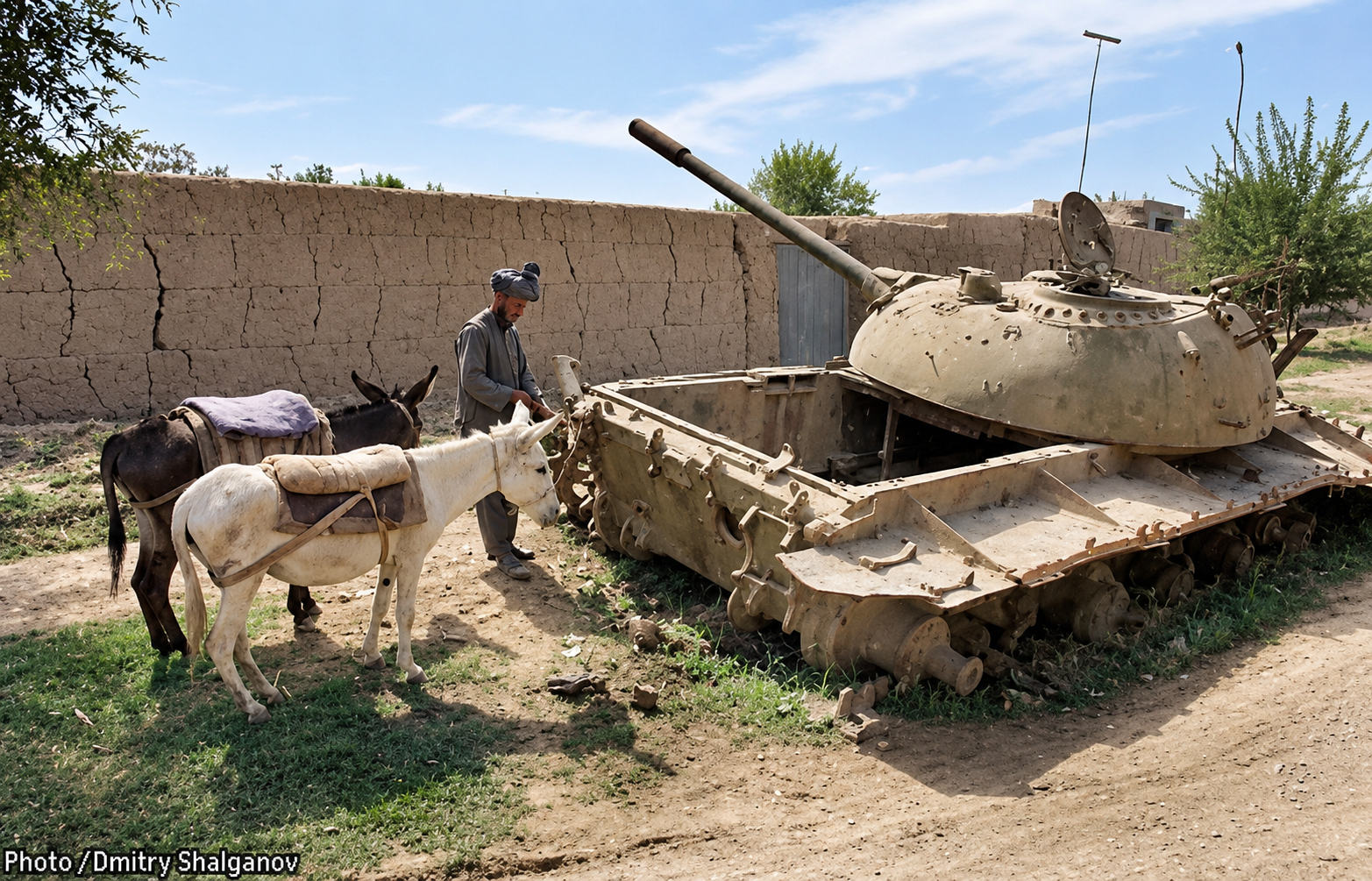
Today the dusty streets of the town are deserted, refugees have returned to their villages, districts, and provinces, and only a few shops are open in the market.
Of the international humanitarian organizations, only the French ACTED remains here, under whose patronage the only clinic in the district operates.
There are no political or military leaders here now. They all received high positions in Kabul. The former administrative head of the district, Kozi Kabir, for example, was appointed as an advisor to Hamid Karzai, the head of the transitional government of the Islamic State of Afghanistan, and now he and his entourage have moved to the capital.
Otherwise, everything here has remained the same: dust, poverty, unemployment, and epidemics. Currently, malaria and diarrhea are rampant here. The local military leader Karimulo (former deputy to Kozi Kabir) kindly provided us with accommodation, and in the morning, when we unsuccessfully tried to hire a car, he gave us his brand new “Gypsy Russi” – a Russian UAZ vehicle for a trip to the neighboring district of Dashti Kalya.
Karimulo has at his disposal a dozen armed men who are supposed to become part of the government armed forces or border troops. For now, while the high command in the capital has not made a decision on the structure and financing of the troops, these guys maintain public order in the district.
Before setting out, we pay a courtesy visit to Khoja Rauf – the local elder and delegate to the Loya Jirga (the Council of Elders of Afghanistan held in June in Kabul). Khoja Rauf is pleased with the changes that have occurred over the year. He thanks Allah for ending the war, for the people being engaged in peaceful work, and for the establishment of a government. He cautiously assesses the activities of Karzai’s government: “we will see if it can solve socio-economic problems.”
The War Has Ended, Weapons Remain
In Dashti Kalya, an hour’s drive along a dusty dirt road west of Khoja Bahovuddin, we are met by the local leader Mamur Hasan. After eastern inquiries about family and children over a cup of fragrant tea, we head out to the former front line toward the Kokcha River.
In front of destroyed buildings that once served as barracks, a dozen fighters line up, dressed in whatever they could find. Mamur Hasan is dissatisfied with the condition of his fighters’ weapons. He complains that before, when there was fighting, fighters did not forget to clean their rifles. But now discipline has fallen. He believes weapons will still be needed and must be preserved. Afghanistan is a poor country and cannot afford to buy new ones.
Mamur Hasan has begun construction of new barracks on the right bank of the Kokcha. In the future, he intends to place units of the armed forces and border troops there. He hopes that soon the transitional government will begin to actively form the armed forces, border troops, and police, and will resolve issues of their financing and equipment. Therefore, he continues to keep a dozen or so young fighters on standby.
Below us is the Kokcha River and a brand new, recently completed bridge. As it turned out, the bridge was built by Tajik specialists with financial support from a German non-governmental organization.
While I listen to Mamur Hasan’s words of gratitude to our bridge builders and German grant providers, four American Humvees drive up to the bridge. The soldier on the armor sat impassively in the spirit of Rambo and Schwarzenegger. The American military crossed to the right bank and slowly moved east along the Tajik-Afghan border line.
Mamur Hasan is frankly displeased. He is the head of the district and was not warned about the Americans’ visit. Without hiding his irritation, he says: people have a lot of weapons in their hands, a provocation is possible, who will be responsible for the consequences?
In general, Hasan is dissatisfied with much of what is happening now in his country. In June, he represented his district at the Loya Jirga in Kabul. He says he wanted to bring the pain and aspirations of his countrymen to the Council of Elders, but unsuccessfully. According to him, everything at the Council proceeded according to a scenario planned in advance by someone.
He harbors no illusions about the current transitional government. Corruption, bribery, and nepotism existed before and still exist. He is convinced that if Karzai’s administration fails to eliminate the absolute power of field commanders locally, and fails to solve socio-economic and inter-clan problems, the country could once again plunge into chaos and civil strife.
He personally intends to finally engage in agriculture. An agronomist by training, he was forced to become a military leader. From his father, an influential landowner, he inherited melon and cotton plantations, which he gladly demonstrates to us.
He dreams of creating a modern agricultural system in his region, because, according to him, Afghanistan is an agrarian country and only proper use of land can guarantee a prosperous life for his countrymen.
The Road, “Hallelujah,” and the Border
We leave Hasan with his dreams and continue west along the border line. Our route lies through Khojighar, a former Taliban stronghold, to the district center of Imam Sahib.
Along the way, we see hundreds of people with pickaxes and stretchers restoring the road. The sight is stunning. It reminds us of our recent history – something like the construction of the great Fergana Canal or the development of the Vakhsh Valley. In some places, we encounter bearded men in camouflage uniforms from the MDS organization, who are demining roads.
In Imam Sahib, at the local security office, we were recommended to spend the night at the “Tajik clinic.” As it turned out, four residents of Dushanbe have been living in a two-story mansion in the center of the town for the past six months. We meet them: Rustam, Ibrahim, Rano, and Manzura. They are all parishioners of one of the Christian churches. They provide medical assistance to local residents and conduct discussions on religious topics.
In the evening, before dinner, the missionaries pray, asking God for peace and tranquility for their Afghan brothers and sisters. Local residents apparently enjoy visiting the “Tajik clinic.” And each has their own interest. Some have health problems, some are interested in when the next humanitarian aid will arrive, and there are those who enjoy theological discussions.
After dinner with Afghan guests, the missionaries sing psalms to the accompaniment of a guitar, praising the Creator in the Tajik language. The Afghans, apparently initially shy of us, behave restrainedly. But gradually they succumb to the magical influence of the melody and begin to sway to the rhythm.
In the morning, accompanied by our fellow countrymen-guides, we examine local attractions. People apparently treat the Tajik missionaries with respect. Many approach and ask if an eye doctor from Dushanbe has arrived, or if there will be humanitarian aid. Children accompany us with greetings of “Hallelujah,” and it seems they do this without malice.
From Imam Sahib to the Afghan port of Sherhan on the Tajik-Afghan border is just over an hour’s drive. However, Tajik goods are practically not visible in the town’s markets. Unlike Uzbek goods! Practically all types of soft drinks, food products, down to toilet paper are brought here by enterprising Uzbek merchants.
In the port itself, there is peace and quiet. Reports that a pontoon bridge had been built between Tajikistan and Afghanistan, and that humanitarian cargo from all over the world flows through our republic in an endless stream, turned out to be greatly exaggerated.
A pontoon was indeed once deployed when Russia’s Ministry of Emergency Situations was delivering humanitarian aid to Afghanistan. But then, apparently due to lack of cargo or for some other reason, it was dismantled. Now a boat operates here, which delivers people and cargo to both sides as needed.