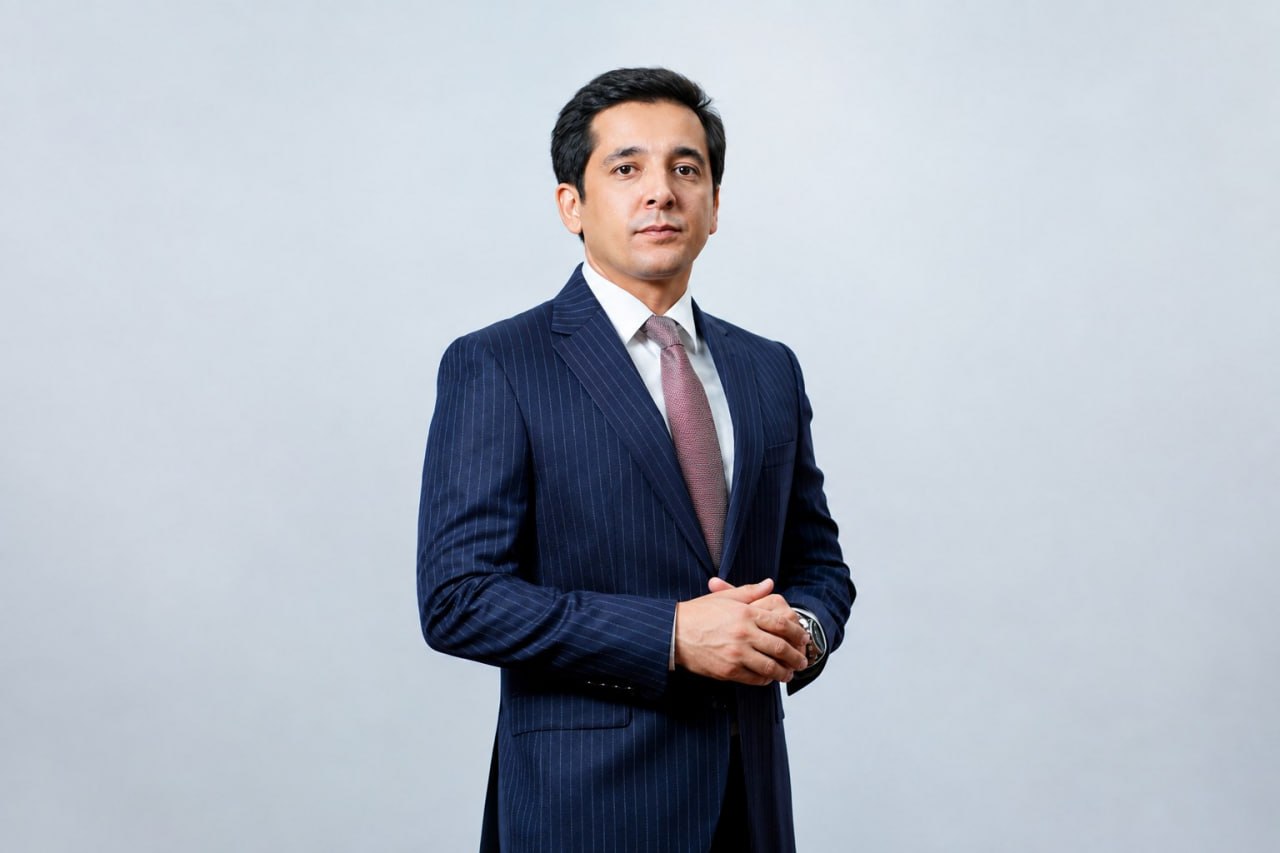
Over three years, the assets of Eskhata Bank grew from 5.3 to 9.3 billion somoni -a 76% increase. An impressive pace. So what lies behind this figure? We spoke with the Chairman of the Management Board, Akmaljon Sayfidinov, about what is driving the bank’s growth, how its management is structured, what role technology and international partners play in it, and about the risks that are rarely discussed publicly.
The bank’s assets have nearly doubled in three years. Why should this interest a reader who, in essence, simply keeps their money at Eskhata?
Akmaljon Sayfidinov: Because behind this dynamic lies a very simple question that every depositor asks: “What if I need my money -will the bank definitely be able to give it back to me?” Asset growth is, quite literally, the answer to that question. The more resources a bank has, the more confidently it weathers market fluctuations, and the more reliably it meets its obligations to clients -on deposits, transfers, and loans. This isn’t an abstraction for an annual report that interests only analysts -it’s the safety cushion the client doesn’t see, but counts on.
If we translate this into concrete figures -what does the bank actually pay out?
Akmaljon Sayfidinov: According to our data, in the first half of 2026 alone, Eskhata depositors received more than 182 million somoni in interest payments -some from term deposits, some from savings accounts. For the client, this is the most tangible effect of the bank’s work: the money isn’t just sitting in an account, it’s earning a return. The principle remains straightforward: the longer a client is willing to keep funds with the bank, the higher the rate can be.
And for those who don’t hold a deposit but simply use transfers or a loan -is there any effect from this growth?
Akmaljon Sayfidinov: For clients who use transfers, the bank’s growth means a faster, more accessible network for sending and receiving money from more than 200 countries. For entrepreneurs, it means more resources for lending to businesses that are already operating and need capital to grow. The bank’s reliability is felt not only in the deposit account, but in the speed and accessibility of every operation a client relies on.
The economics of growth: four pillars instead of one
What drove this growth?
Akmaljon Sayfidinov: The 4-billion-somoni increase is the result of several processes running in parallel, not a single successful product. In more detail:
The bank’s main source of income is interest income from lending, not transfers, as is sometimes assumed from the outside. The income structure is diversified, and it is the loan portfolio that drives the bank’s main financial result.
Transfers remain an important product: the number of transfer recipients grew 28.5% over the year -a story about reach and trust more than about the bank’s profit.
Digitalization. Since 2018, the bank has been systematically investing unprecedented sums in IT infrastructure and its own digital channels, with the aim of raising the level of security. The mobile app has been downloaded 3 million times -a million more than a year earlier -and more than 600,000 clients handle all their banking needs every month through Eskhata Online, without visiting a branch. This lowers servicing costs and frees up more funds for process development, while keeping the service channel secure.
Regional network. The number of ATMs has grown across the country, including in the hard-to-reach areas of Khatlon and GBAO. Growth in the regions is directly reflected in the client base: the bank now has more than 1.7 million clients -almost 19% more than a year earlier.
Competition as an engine, not a threat
Eskhata is one of the country’s three systemically important banks. How do you hold your position as competition in the banking sector grows so fast?
Akmaljon Sayfidinov: Competition is normal, and the fact that several banks are growing at the same time is a good sign for the economy as a whole, not just for us: it means trust in the banking system is growing faster than the fears left over from any previous crisis. We’re not competing on who has more branches. We’re competing on who solves a client’s specific problem faster -a transfer, a loan, opening an account. Our answer to competition is speed, quality of service, and closeness to the client, not scale for its own sake.
How management works inside the bank?
How is decision-making structured within the bank -how much do you delegate, and where is the line beyond which a decision must be escalated to you personally?
Akmaljon Sayfidinov: The rule is simple: processes shouldn’t depend on whether the Chairman happens to be available at a given moment. Product teams and department heads make decisions independently within their own limits and metrics. That is their area of responsibility, and the Management Board doesn’t interfere in operational matters as long as the indicators are within normal range.
But anything that changes the bank’s overall risk profile -large credit limits, decisions affecting capital adequacy, or strategic pivots that can’t be reversed within a single quarter, such as entering a new market, launching a new product, or changing the business model -as well as key personnel decisions within the top-management team, because the quality of every other decision at the bank for years to come depends on these people, is brought before the Management Board for discussion.
Risk management
Rapid asset growth almost always means faster growth of the loan portfolio. How do you maintain asset quality at this pace?
Akmaljon Sayfidinov: The bank doesn’t disclose the exact structure of its reserves or the share of overdue debt in external materials -that’s standard banking practice, not a desire to hide anything. But it’s fair to say this much: the loan portfolio is growing while the bank maintains the capital-adequacy ratios required by the regulator, and reserves are built up in proportion to portfolio growth, not after the fact, once a problem has already occurred. The bank is conservative in how it selects borrowers in the first place: it finances businesses with a track record and turnover, not ideas starting from zero -which reduces risk at the entry point, before it ever shows up in overdue-debt statistics. The fact that the international rating agency Moody’s upgraded Eskhata Bank’s rating from B3 to B2 with a stable outlook is external confirmation that the market views this growth model as managed, rather than as a risky bet.
ESG: Social Responsibility and Green Financing
You also run dedicated programs -for example, on developing women’s entrepreneurship?
Akmaljon Sayfidinov: Yes, that’s a separate priority for the bank, and in fact one of the three components of our ESG strategy. Over the past year and a half, the bank has supported more than 7,500 women entrepreneurs across Tajikistan -from small retail outlets to manufacturing projects. At Eskhata, women receive business-development loans on more favorable terms, with lower interest rates, and the bank also places strong emphasis on financial literacy.
We’ve been working with the European Bank for Reconstruction and Development on the Women in Business program since 2017, and over that time more than 100 million somoni in loans have been issued under it to nearly two thousand women clients. In July 2026, the EBRD expanded this line and added $15 million to support youth and women’s entrepreneurship across Central Asia.
The environmental question remains as relevant as ever, and it’s one of the key areas of ESG. How are banks supporting it?
Akmaljon Sayfidinov: Eskhata Bank was the first in Tajikistan to issue green bonds; we have a separate credit product for environmental projects, and in February 2025 we formalized this into our own Green Bond Framework -a document used to assess which projects genuinely qualify as green. In December 2025, we received a loan from the Asian Development Bank (ADB) specifically for green financing of small and medium-sized businesses. This was the ADB’s first local-currency financing to a commercial bank in Tajikistan, and for us it’s an external validation that the green-lending model works. I’d also note that in August, Eskhata Bank’s annual sustainability report was published. It sets out in detail all of our work in this area and the results achieved. It’s available on our website, eskhata.com.
Beyond the border: international partnerships
International cooperation rarely comes up in conversations about the Tajik banking market. Does Eskhata have partnerships outside the country?
Akmaljon Sayfidinov: Absolutely. We value and cherish our cooperation with each of our partners. The bank has worked with the European Bank for Reconstruction and Development for more than twenty years. In 2005, the EBRD became one of Eskhata’s shareholders. Over that time, the partnership has passed through several stages -from an initial loan for small-business financing to trade-finance programs. It’s worth understanding that an organization of that caliber doesn’t remain a shareholder simply out of courtesy. The bank’s annual review -of its capital, risk management, and reporting -has gone through, every one of these years, transparently and without critical findings.
That same year, 2005, marked the start of the partnership with IFC, the International Finance Corporation, which has provided the bank with more than $34 million in loans and trade-finance lines, including $10 million for small-business recovery after the pandemic. Cooperation with the Asian Development Bank has been ongoing since 2023. Eskhata Bank was the first in Tajikistan to receive confirming-bank status under its trade-finance program, and in 2025 became the first commercial bank in the country to receive an ADB loan in local currency -the same financing I mentioned earlier in the context of green finance.
The team
How is the management and technical team built -do you hire from the labor market, or grow people inside the bank? How many of today’s top managers followed a path similar to yours?
Akmaljon Sayfidinov: Since 2018, when we moved away from external vendors and began building technology in-house, we’ve grown a large engineering and IT team of our own. That was a deliberate choice: only an in-house team can change the product at the speed we need, rather than the speed an external vendor dictates. Within management, a significant share of our top-management team is made up of people who started their careers at Eskhata as specialists. That means they know all the ins and outs of the bank’s internal workings, and share its values and vision. We’ve also strengthened the team with expatriate hires -bringing in some of the best professionals from international finance to carry out our digital-transformation goals as effectively as possible.
Ecosystem
What goal have you set for the bank for 2028?
Akmaljon Sayfidinov: The bank’s next stage isn’t simply about acquiring more new clients, but about deepening relationships with those already with us -from the transfer that parents send, to their children’s first wallet of their own through the Eskhata Junior product, and building a whole ecosystem around the bank. It matters to accompany the client at every stage of their life, not just show up the moment a loan or a transfer is needed.
What was the hardest decision of your time leading the bank?
Akmaljon Sayfidinov: At that point I had only been leading the Management Board for a year. Looking at the market then, we saw it was changing very quickly, digitalization was moving fast, and Eskhata was increasingly seen as reliable, but corporate and a bit dated -meaning the very qualities that had once been an advantage were starting to turn into obstacles to our ambitious business goals.
Having weighed everything, we concluded that the bank needed a rebrand, and we carried it out in 2024. We reworked the visual identity and positioning. “Bank for Close Ones” isn’t just a slogan -it’s a direct appeal to the way family ties, values, and mutual support are woven into life in Tajikistan. I’ll admit that, as someone used to calculating and forecasting everything, it was psychologically harder for me to make a call on such fundamental changes, given that the old approach had “worked” for 30 years. Here, I simply had to trust something that couldn’t be measured in advance.
Looking ten years ahead, where do you expect the more serious challenges to come from -traditional competitors, or new players like neobanks and fintech startups?
Akmaljon Sayfidinov: More likely the third option, and that’s exactly why the bank itself is investing in digital products. Unregulated fintechs don’t need to maintain capital and reserves under regulatory requirements, or carry the regulatory burden a bank carries -and in the short term, that gives them a speed advantage. But a bank has something that’s earned only over time: the trust of a client who has seen, year after year, that their money comes back, and the standing of a partner trusted by international financial institutions. Our task is to combine that trust with fintech-level speed, rather than choose one over the other.
Coming back to what stands behind the figure of 4 billion: it’s not just a source of pride, but an enormous volume of decisions, team resources, and risks that the bank takes on every single day. It’s the transfers that keep reaching families on time. It’s the loans that help businesses grow, rather than merely survive. It’s the deposits that stay reliable, whatever happens in the market. This year, as Tajikistan marks 35 years of independence, it means a great deal to us that the bank’s path, all these years, has moved forward alongside the development of the country itself and its economy. I want to congratulate all Tajikistanis on this occasion and thank them for their trust. Eskhata Bank is growing together with the country, and remains close to the people who matter -its clients -for years to come.