The direct military confrontation between Israel and the United States on one side, and Iran on the other in early 2026, has produced unexpected shifts in the regional balance of power. The “maximum pressure” strategy deployed during the campaign against Iran ultimately failed to achieve its intended outcome. The Iranian regime proved far more resilient than US-Israeli planners anticipated, undermining expectations of a rapid collapse or swift structural transformation.
As regional security calculations were reassessed in the early days of the war, the urgent need for alternative land routes to the Mediterranean through Syria became clear. With the Strait of Hormuz weaponized and oil transit disrupted, a new geopolitical reality emerged. It has since become evident that Turkey’s role has grown increasingly critical for Washington as it seeks to counter Iran’s renewed influence—so long as the regime in Tehran remains intact and does not undergo an internal shift that would align it with American interests.
Washington’s failure forced a recalibration of its regional priorities, prompting a reassessment of Turkey’s value as both a NATO ally and a geographic buffer, alongside Syria’s function as a transitional state anchoring the emerging land corridor. These developments have opened narrow strategic windows, though their durability remains uncertain. Classified as a middle-tier military power, Turkey possesses advantages unmatched in the region: foundational NATO membership, a strategic position linking Europe, Asia, and the Middle East, shared borders with Iran, Iraq, and Syria, a disciplined military, deep historical ties, and an extensive network of multilateral relationships.
This geopolitical positioning grants Ankara automatic gains from the fallout of the war in Iran, reinforced by the strong working relationship between President Donald Trump and Turkish leadership. Despite long-standing friction with Washington, the US-Turkey relationship remains a functional, conditional partnership subject to continuous negotiation. Current American reliance on Turkey to contain residual Iranian influence and stabilize Syria is likely to drive significant cooperation, reshaping traditional US policy toward Ankara—a shift with inevitable regional consequences.
Amid rising tension between the US administration and the Israeli government following the failed offensive against Iran and diverging regional priorities, Turkey’s prospects for filling the power vacuum or serving as a containment barrier have grown. This trajectory directly conflicts with Israeli interests, presenting Prime Minister Benjamin Netanyahu with a strategic dilemma: eliminating Iran expands Turkish influence, while failing to eliminate Iran preserves Iranian power. Either scenario challenges Israel’s post-October 7 security doctrine, which has relied on projecting defensive capabilities beyond its borders.
Yet Turkey cannot fully assume this regional posture without Syria. To play this role—one that aligns with its core national security imperatives—Turkey requires a stable, capable Syrian partner with which it can maintain strong relations and long-term strategic coordination. Once again, regional interests converge on Damascus.
As Washington’s view of Turkey as a buffer evolved, a parallel role emerged for Syria. Beyond its established importance in maintaining internal stability, countering Iranian influence, containing cross-border terrorist organizations, and dismantling drug-trafficking networks, Syria has acquired new strategic weight as an alternative overland energy corridor bypassing the Strait of Hormuz. Moreover, fully containing Iranian influence in the region requires Syrian involvement in Lebanon to support the Lebanese government in neutralizing Hezbollah, disarming the group, or restricting its ability to deploy weapons outside state control.
This framework explains Trump’s continued discussion of a Syrian role in Lebanon as an alternative to Israeli operational friction and buffer-zone policies. In return, Washington offers incentives, including pressure on Israel to withdraw from territories occupied in southern Lebanon and along the Syrian border strip in Quneitra, as well as facilitating security arrangements.
Syria holds historical and geopolitical leverage in Lebanese affairs. However, transitional Syria faces a strategic choice between two paths. The first involves direct military engagement combined with diplomatic mediation; while this option would maximize regional influence, it risks internal exhaustion, sectarian tension, and economic strain during a fragile transitional phase. The second path entails a strategy blending diplomatic mediation with limited military operations to secure borders and northern Lebanon, aimed at strengthening the central Lebanese government and restoring its monopoly over force and decisions of war and peace.
Prioritizing internal stability while providing quiet diplomatic and logistical support allows Syria to consolidate early gains without triggering domestic backlash, especially given its current security fragility at the outset of its political transition.
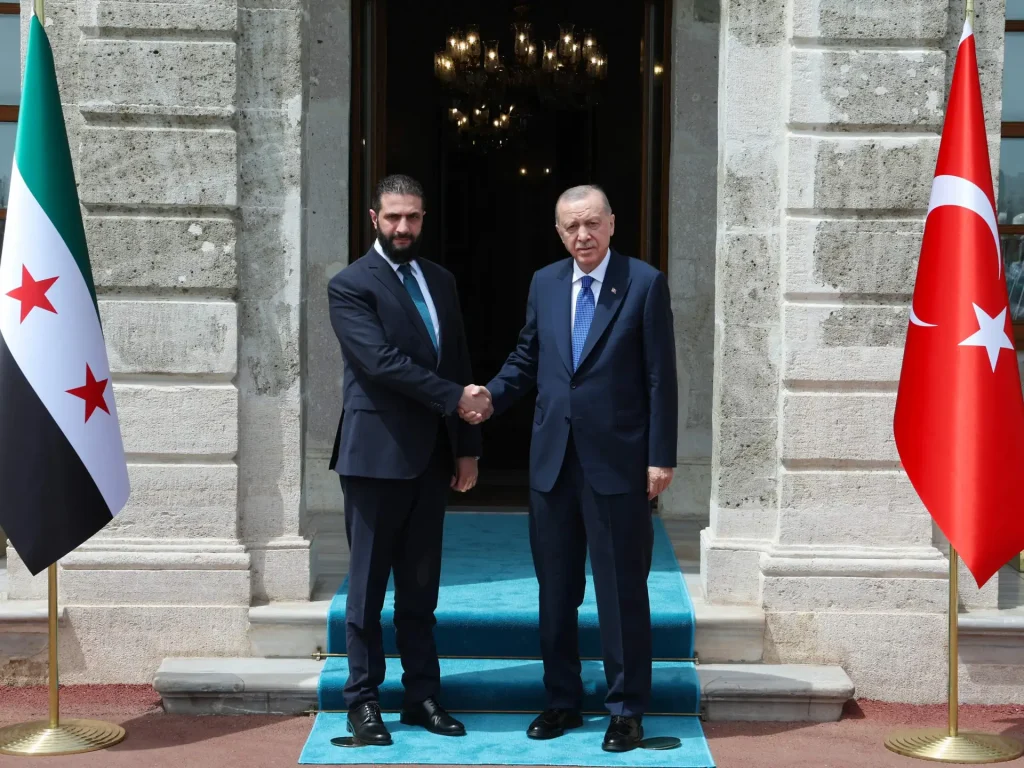
Although direct military involvement in Lebanon remains a red line Damascus seeks to avoid, a calibrated hybrid diplomatic-military approach requires firm American guarantees. Given the positive rapport between Farouk al-Sharaa and Trump, such guarantees could be extended, provided any intervention remains gradual and tied to stability benchmarks. As reflected in his diplomatic posture, al-Sharaa approaches negotiations through a win-win framework designed to ensure all parties retain a stake in the outcome, reducing incentives to undermine agreements.
As Damascus seeks to buy time and capitalize on the shift toward alternative energy supply chains, Lebanese stability remains essential. Regulating relations with Lebanon through a strong central state benefits both countries, particularly economically.
The emerging roles for Turkey and Syria represent high-risk political undertakings, yet they offer a rare alignment of strategic opportunities. The contiguous geography of Syria and Turkey lies at the heart of these regional realignments. These developments face strong opposition from Netanyahu, as they threaten to enhance Syria’s regional influence and state capacity. In Israeli calculations, a capable Syrian state represents not only a long-term security challenge but an economic one as well, especially after conflict undermined prospects for transit routes through Palestinian territories.
Major geopolitical shifts open narrow windows of opportunity that demand clear vision, concrete resources, active risk management, and rapid institution-building. Syria and Turkey now occupy positions that allow for significant strategic gains previously out of reach—provided they avoid ungrounded optimism and address internal vulnerabilities. History shows that strategic windows remain open only briefly before closing as new regional balances take shape.
This article was translated and edited by The Syrian Observer. The Syrian Observer has not verified the content of this story. Responsibility for the information and views set out in this article lies entirely with the author.