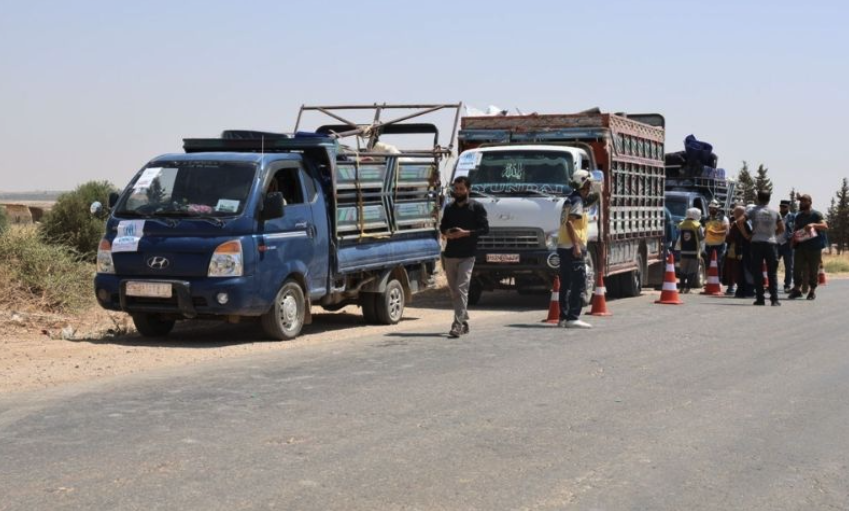
A new convoy set out, as part of the “Syria Without Camps” vision, carrying 182 families returning from displacement camps in the Idlib countryside to their places of origin in the western Hama countryside.
These convoys are being facilitated and supervised by the Hama governorate, in a scene reflecting the continuation of the return movement despite the challenges awaiting returnees.
These convoys, which aim to support residents’ stability and strengthen returnees’ integration into their local communities after years of displacement, collide with realities on the ground, as activists and returnees describe suffering that starts with the absence of water and electricity and does not end with skin diseases, destroyed roads, and reconstruction promises that have yet to materialize.
The convoy set out as part of a joint initiative between the Directorate of Social Affairs and Labor in Hama and the Al-Ghab Region Administration, under the direct supervision and follow-up of Hama Governor AbdulRahman al-Sahyan, alongside the Syrian Civil Defense and a number of charitable associations.
The convoy included the return of residents to the towns and villages of Jabal Shahshabo, Qalaat al-Madiq, al-Tuwaina, and al-Sharia, in a step aimed at supporting returnees’ stability, facilitating their return to their areas, and strengthening their integration into their local communities after years of displacement.
Water for $15 and Missing Electricity
Civil activist Bassel Qassem told Enab Baladi that residents returning to the northern Hama countryside or the Al-Ghab plain face hardship from the moment they arrive, due to the total absence of basic services, as most villages and towns lack the minimum requirements of life, including water, electricity, and sewage systems, which poses an obstacle to stability.
Qassem explained that the water problem represents the most prominent challenge, as villages and towns are completely without drinking water, forcing residents to buy water tanker deliveries at a cost ranging between $10 and $15 per tanker to secure their daily needs.
As for electricity, the activist noted a complete absence of poles and electricity networks in some villages and towns, pushing residents to rely on solar panels and batteries as a costly alternative.
Qassem warned of the health risks resulting from this situation, especially in the summer, as contaminated sewage water spreads through main and side roads, leading to the spread of skin diseases, especially among children, such as leishmaniasis, psoriasis, and eczema.
He pointed out that roads in the Hama countryside and the Al-Ghab plain are unpaved and unrehabilitated, and are strewn with traces of shelling, shrapnel, and rockets resulting from past targeting with various types of weapons, making them unfit for travel.
Regarding medical services, Qassem said medical points and hospitals are few and lack basic services, and in case of an injury or sudden illness, residents must travel to Qalaat al-Madiq Hospital, Hama National Hospital, or the city of Mahardah, which are far from the area.
Repairs Limited to Doors and Windows Only.. Destroyed Homes Left Out of Coverage
Regarding the role of humanitarian organizations, Qassem explained that despite talk of some organizations entering the area for repair purposes, their numbers are few, and their projects require long start-up times that can extend to several months after contracts are signed.
He criticized the repair mechanism being followed, saying it is limited to homes with intact roofs that need simple work such as doors and windows, while fully destroyed homes receive no repairs at all, leaving a large segment of returnees without real shelter.
Qassem warned of a parallel deterioration in conditions in the camps along the Syrian-Turkish border, where residents held protests in the recent period over the lack of drinking water, poor services, accumulating waste, and neglected sewage networks.
He added that most organizations have halted their services in the camps and moved to other areas, increasing the burden on families who cannot return to villages in the Hama countryside because their homes were destroyed and they lost their land and sources of livelihood.
Camps in the North and Obstacles to Return
The case of AbdulBaset Youssef Kinsawi, a resident originally from the town of Kafr Nabuda in the Hama countryside who currently lives in camps in northern Syria, embodies the shock displaced people face over the reality of return, and their collision with a gap between official promises and a deteriorating living reality.
Kinsawi said, in his testimony to Enab Baladi, that the total destruction of his home and its being razed to the ground represent the biggest obstacle to any thought of return, since there is no infrastructure or minimal shelter to house him and his family.
His family bears a heavy legacy of human loss, as his son was killed in the fighting, and his wife lives with the family and children, which doubles the social and economic burdens tied to any decision to move or return.
Kinsawi criticized the partial solutions being proposed, limited to providing transportation allowances or travel fares, describing them as superficial solutions that do not guarantee a dignified return or provide alternative housing commensurate with the scale of the losses, but instead leave the displaced person out on the street.
The Reality of the Camps and the Hardship of Living There
On the other side of the equation, continued residence in the camps of northern Syria is not a comfortable option, but rather a continuation of a journey marked by humiliation and a sense of neglect, according to Kinsawi’s description.
He revealed that paid services follow displaced people even inside the camps, with conditions reaching the point of imposing fees and installing water meters for tent residents, placing additional financial burdens on families lacking economic safety nets.
He criticized the absence of assessment and compensation mechanisms that would guarantee affected people the recovery of their rights or access to alternative shelter, amid what he described as an outright abandonment of the obligations presumed owed to the families of victims and the wounded.
Parallel Efforts and Ongoing Projects
Alongside the return convoys, the area is witnessing parallel service projects. In the western Hama countryside, the Water Resources Directorate in Hama governorate began the first phase of rehabilitating the main “Afamia” pumping station after a 14-year halt, in cooperation with the World Food Program.
In the northern Hama countryside, the General Establishment for Drinking Water, in cooperation with the organization “Orange,” announced a project to rehabilitate the water station of Latmin village by installing a solar power system.
Rehabilitation and repair work has also begun on the Kafr Nabuda and Maan health centers in the Hama countryside, carried out by UNICEF in cooperation with the Hama Health Directorate. The project aims to equip 10 clinic rooms in Kafr Nabuda to serve about 50,000 people, and the Maan center to serve more than 10,000 people, and a health center has been opened to strengthen medical services in the Hama countryside.
The Syrian Civil Defense also carried out service work covering 96 schools in the Hama countryside, including washing and cleaning 60 schools, and clearing rubble and opening roads for 32 other schools, to create a safe environment for students.
In addition, infrastructure such as roads was rehabilitated, and rubble and mines were cleared to pave the way for a safe return, alongside the construction and rehabilitation of more than twenty schools in the governorate. The area also saw the construction of a new road serving about 5,000 people.
On a broader level, a meeting bringing together the Hama governorate, representatives of government bodies, and civil society organizations discussed launching service projects in three cities under the vision, including infrastructure rehabilitation, school repairs, and health facility maintenance.
Syria Without Camps
These convoys fall under the “Syria Without Camps” vision, launched by Syrian Finance Minister Mohammad Yasser Barnieh in early January 2026, which aims to support residents’ return to their areas, strengthen stability in local communities, and work toward closing the internal displacement file.
The vision received Saudi support worth $1.5 billion, and Decree No. 59 of 2026 was issued, providing for the formation of a committee headed by the Minister of Emergency and Disaster Management, including the ministers of finance, public works, housing, social affairs and labor, local administration, and environment, in addition to the governorates of Aleppo, Hama, and Idlib.
The committee is working to prepare basic infrastructure in destroyed areas and raise the level of services for residents in displacement areas.
The committee announced a project to repair 60,000 homes as an initial phase, with a budget of $1.8 billion approved for its implementation, and the Minister of Public Works explained that the work mechanism focuses on addressing infrastructure and services first, then providing financial grants for repairs.
This article was translated and edited by The Syrian Observer. The Syrian Observer has not verified the content of this story. Responsibility for the information and views set out in this article lies entirely with the author.