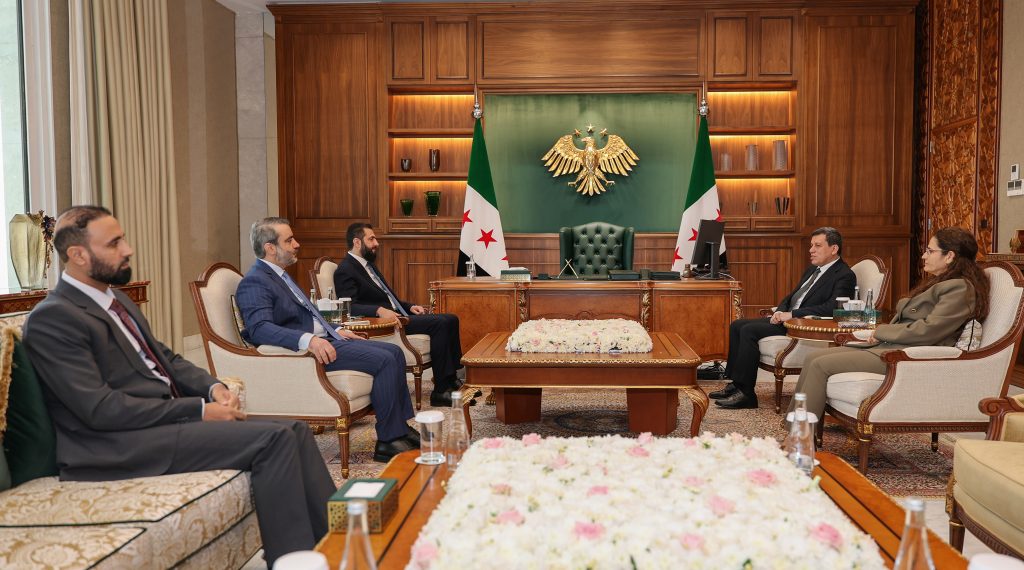
President Ahmad al-Sharaa met in Damascus with Mazloum Abdi and Ilham Ahmed to review progress on the January 29 agreement and address the obstacles slowing institutional integration in Syria’s northeast. The talks focused on resolving outstanding issues across the military, security, and administrative sectors, where most provisions have already been implemented.
Dr. Samir al-Abdullah of the Arab Center for Contemporary Syrian Studies told Al-Thawra al-Suriya that the remaining friction points now require decisions issued at the highest political level. Technical committees, he argued, have reached the limits of what they can resolve without executive authority.
Meanwhile, the presidential team charged with executing the accord conducted a field visit to Ras al-Ayn, meeting residents and displaced families from Al-Hasakah governorate. The delegation reviewed local needs, outlined security guarantees, and discussed mechanisms for organized returns.
Integration Measures and Curriculum Alignment
Ahmad al-Hilali, spokesperson for the presidential team and deputy governor of Al-Hasakah, affirmed that integration efforts remain active and uninterrupted. Although President al-Sharaa recently described the pace as slow in an interview with Al Jazeera, al-Hilali stressed that the process continues to move forward without reversal.
On education, al-Hilali confirmed that schools will reopen under the national curriculum issued by the Ministry of Education in Damascus. A transitional program—introduced last year for students previously taught under the Autonomous Administration’s system—will remain in effect for the coming academic year through designated schools. Full standardization will be implemented across all institutions the following year.
Arabic will serve as the primary language of instruction, while Kurdish language courses will be formally incorporated into the national curriculum. Joint committees are developing a unified national syllabus that reflects Syria’s cultural diversity, with an expected rollout in 2028.
Dr. al-Abdullah emphasized the need for a decisive and well-structured transition plan, arguing that a unified curriculum must reinforce national cohesion while respecting regional identities. Governor Nour al-Din Ahmad highlighted significant progress in institutional mergers, noting the integration of roughly 20,000 employees into the Education Ministry, 2,000 into Health, and 700 into Electricity. Discussions with the Ministry of Higher Education regarding the future of universities in the region are described as highly positive.
Al-Hasakah Education Director Adnan Barri previously reported that the governorate serves more than 700,000 students across over 2,000 schools. Nearly 70 percent of these facilities require urgent rehabilitation due to structural deterioration and damage caused by years of displacement. The directorate has appealed for international support to secure basic classroom furnishings and complete essential repairs ahead of the new school year.
Return of Displaced Families
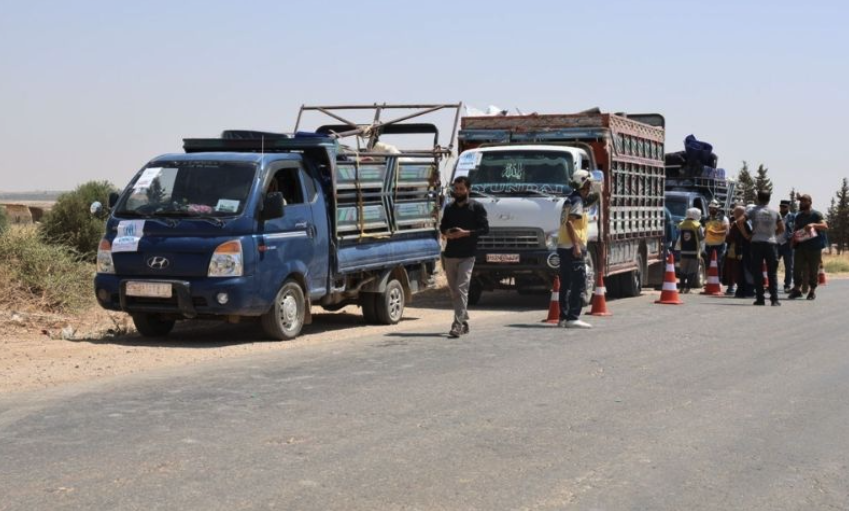
Preparations are underway for the return of hundreds of families to Ras al-Ayn and surrounding rural areas. Representatives Raed al-Ali and Khalil al-Sheikh Salim described recent meetings with the presidential team and Internal Security officials as constructive, noting that technical and security concerns are being addressed systematically.
Dr. Mustafa Abdi, a member of the presidential team, clarified that the timing of returns is determined primarily by demining operations rather than political considerations. Engineering units from the Syrian Arab Army, UN teams, and local forces have been clearing between 100 and 150 landmines per day along former contact lines. These efforts aim to secure safe passage for an estimated 12,500 displaced families from the region.
This article was translated and edited by The Syrian Observer. The Syrian Observer has not verified the content of this story. Responsibility for the information and views set out in this article lies entirely with the author.