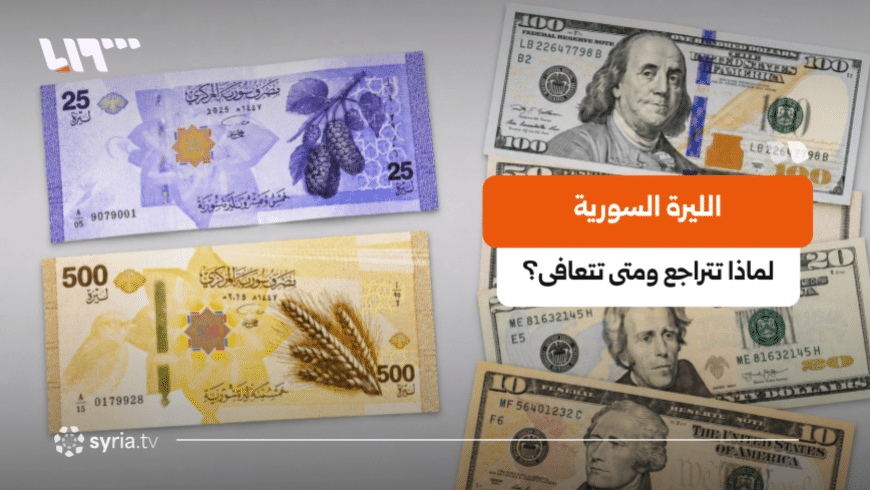
The Syrian pound has come under sustained pressure in recent months, weighed down by rising demand for foreign currency, a widening trade deficit and a growing fiscal shortfall, while domestic production continues to grapple with deep structural weaknesses.
Economists interviewed by Syria TV argue that the pound’s depreciation cannot be attributed to short-term monetary factors alone. Rather, they contend, it reflects entrenched economic imbalances and the absence of a coherent policy framework capable of strengthening productive sectors and narrowing the country’s external deficit. Unless these underlying problems are addressed, they warn, the continued slide of the currency is likely to further erode household purchasing power.
Economist Dr Ali Mohammed attributed pressure on the parallel-market exchange rate to a combination of interlocking factors, including a chronic trade deficit, a weakened productive base, ineffective fiscal and monetary policies, and persistent external shocks. Together, he said, these factors have reduced the economy’s ability to generate foreign currency while demand for dollars continues to grow.
Fellow economist Firas Haddad argued that the most immediate pressure on the pound stems from surging demand for foreign exchange in recent months, particularly as imports have risen sharply. Additional strain has come from the state budget deficit and uncertainty surrounding the government’s plans to finance it, including reports that sovereign bonds could be issued to cover funding gaps.
According to Haddad, however, the roots of the crisis run deeper than current market dynamics. He argued that the exchange rate’s decline, with the dollar reaching roughly 150 pounds, reflects broader shortcomings in the economic policies adopted to address Syria’s accumulated challenges.
Trade and Fiscal Deficits Intensify Pressure
Mohammed described the trade deficit as one of the principal sources of pressure on the currency. Available estimates indicate that Syrian exports did not exceed $1 billion last year, compared with imports valued at between $7.5 billion and $8 billion.
On that basis, Syria’s trade deficit is estimated at between $5.7 billion and $6.7 billion, equivalent to roughly 19 to 23 per cent of gross domestic product, which the government estimates at about $30 billion.
The growing disparity between exports and imports, Mohammed said, highlights the economy’s limited capacity to generate foreign currency through productive activity and trade, even as demand for dollars continues to rise in order to finance imports.
He also pointed to the public finances, noting that the budget deficit during the first half of the year reached approximately $1 billion, with projections suggesting it could rise to $1.8 billion by year-end. The critical question, he argued, is not the existence of the deficit itself but the means by which it is financed.
Although authorities may rely on instruments such as sovereign bonds or Islamic sukuk, Mohammed warned that deficit financing can generate additional inflationary pressures, placing further strain on both prices and the exchange rate.
Haddad similarly linked the fiscal deficit to currency weakness, arguing that the gap between government revenue and expenditure, together with the methods used to finance it, has a direct effect on demand for dollars and investor confidence in the Syrian pound.
Lack of Policy Coordination
Haddad argued that addressing Syria’s accumulated economic difficulties requires a unified government strategy rather than fragmented approaches developed independently by individual ministries.
The ministries of economy, industry and energy, he said, cannot tackle these challenges in isolation. In his view, the government has yet to present a comprehensive economic vision that reflects Syria’s unique circumstances and the structural problems inherited from years of conflict and economic disruption.
He noted that the economy continues to face formidable obstacles, including poverty levels approaching 90 per cent according to international estimates, entrenched corruption across multiple sectors and the lingering effects of sanctions despite the easing of some restrictions.
The partial lifting of sanctions, Haddad explained, has not automatically translated into renewed investment. Many international banks remain reluctant to re-engage with Syria, while the country’s continued inclusion on financial monitoring lists and anti-money-laundering compliance concerns continue to impede both banking activity and foreign investment.
He also cautioned against a rapid transition towards a fully liberalised market economy without adequately assessing the social and economic consequences. Trade liberalisation and market reforms, he argued, must take account of their impact on domestic producers and living standards.
Production Shortfalls and Rising Imports
According to Haddad, strengthening domestic production is essential to stabilising the currency. No currency can maintain its strength, he argued, without a productive economic base capable of satisfying local demand and competing in export markets.
Opening the economy to imports while domestic industry remains fragile and agriculture continues to struggle, particularly as a result of energy shortages, has weakened local competitiveness. Syrian products, he said, still require substantial improvements in quality and standards to compete internationally, while lower-priced imports continue to gain ground in the domestic market.
As imports increase, demand for dollars inevitably rises, further pressuring the exchange rate at a time when export earnings remain insufficient to meet foreign-currency requirements.
Mohammed echoed that assessment, arguing that Syria’s weak productive structure has created excessive dependence on imported goods. Improving the trade balance, he said, will require reviving domestic manufacturing, promoting import substitution and expanding exports.
He added that higher oil production and the continued operation of the Baniyas refinery could help reduce Syria’s energy import bill. During the first half of the year, the country reportedly produced around one billion cubic metres of gas and approximately 1.5 million tonnes of oil.
Haddad likewise pointed to energy imports as a significant contributor to foreign-currency demand, arguing that the refinery’s shutdown over the previous two months had placed additional pressure on the pound.
The Limits of Monetary Policy
Mohammed said the Central Bank of Syria has primarily focused on managing liquidity and controlling the money supply, while seeking to align financial regulations with international standards and anti-money-laundering requirements.
However, he noted that there has been little clarity regarding the use of other policy instruments, including interest rates and certificates of deposit, or concerning the extent of coordination between the central bank and the Ministry of Finance.
The central bank alone, he argued, cannot resolve the country’s exchange-rate challenges. Sustained currency stability requires coordinated fiscal, monetary and economic policies across multiple institutions.
Mohammed also warned that a widening gap between the official exchange rate and the parallel-market rate risks diverting economic activity into informal channels and reinforcing black-market trading.
Maintaining monetary stability, he said, will require careful monitoring of inflation, prudent liquidity management, stronger confidence in the banking sector and measures to bring cash circulating outside formal financial institutions back into the banking system.
Depreciation’s Impact on Households
The weakening pound is already taking a measurable toll on living standards.
Mohammed noted that currency depreciation directly reduces purchasing power by increasing the cost of goods and services, particularly products whose prices are linked to the dollar, including vehicles, real estate and durable consumer goods.
As the exchange rate deteriorates, the real value of wages continues to decline. He cited the minimum wage, which he said had previously been worth about $130 but is now equivalent to roughly $95 at current exchange rates.
The real measure of income, he stressed, is not its nominal value but its purchasing power. Currency depreciation and rising prices steadily reduce what households can afford, even if salary levels remain unchanged.
Haddad argued that the pound’s future trajectory will depend largely on the government’s ability to expand economic output and support productive sectors. Strengthening industry and agriculture, he said, remains the most effective means of preventing further depreciation.
Without sufficient support for production and without tangible progress in attracting investment, he warned, the pound could remain exposed to further declines, raising the risk of a demand shock in an economy already burdened by weak consumer purchasing power.
Domestic Production as the Path to Stability
Both economists agreed that stabilising the Syrian pound will require far more than monetary interventions.
Mohammed argued that the fundamental drivers of dollar demand, particularly the trade deficit, weak production and sluggish export growth, must be addressed directly. Improving the trade balance through stronger domestic manufacturing, import substitution and export expansion is essential, he said, alongside prudent liquidity management, inflation control and renewed confidence in the banking system.
Haddad reached a similar conclusion, maintaining that support for industry, agriculture and productive investment offers the most reliable route to currency stability. Unless domestic production is strengthened and investment translates into tangible economic activity, he warned, the pound is likely to remain under persistent downward pressure.
Ultimately, both economists contend that the Syrian pound’s depreciation is not the result of a single factor but of a combination of immediate market pressures and deep-rooted structural weaknesses. Rising demand for dollars, budget and trade deficits, weak productive capacity and policy shortcomings have all contributed to the currency’s decline, with the consequences increasingly felt in the daily lives of ordinary Syrians.
This article was translated and edited by The Syrian Observer. The Syrian Observer has not verified the content of this story. Responsibility for the information and views set out in this article lies entirely with the author.