NEW YORK — As the sun sets on a Friday evening, preparations for Shabbat are in full swing in South Brooklyn. Local businesses—a modest kosher restaurant, a Levantine pastry shop, a Judaica store—shutter their storefronts, and pairs of fathers and sons wearing kippas and perfectly pressed suits trickle into several synagogues dotting the Gravesend neighborhood.
Inside one of the few grocery stores still open, a man who left Damascus in the 1990s greets one of his regular customers in Syrian Arabic as a Hebrew song plays in the background. The pair part ways with a “Shabbat Shalom.”
These Brooklyn streets—home to the largest Syrian Jewish community outside of Israel, with an estimated 75,000 members—echo the spirit of the once-bustling centers of Jewish life in Damascus and Aleppo.
Today, Syria’s historic Jewish quarters are a dimmer scene. Only six Jews reportedly remain in the country, too few for the quorum required for communal worship under Jewish law. Ancient synagogues sit largely shuttered or in ruins: some abandoned in the wake of anti-Jewish violence in the years surrounding the 1948 establishment of the state of Israel, others damaged and destroyed during more than a decade of civil war.
But the toppling of the Assad regime in December 2024 opened space for a new chapter to be written in Syria, one that Syrian Jews in the diaspora, and their allies, aim to be a part of. In the end of the war and the new government’s stated commitment to welcoming all Syrians and building international friendships, they see an opportunity to right historic wrongs and bring Jewish life in Syria back from the brink.
The revival of Jewish heritage in Syria has a political dimension, too, as questions over the treatment of ethnic and religious minorities dominate foreign perceptions as a measure of whether the country’s transitional leadership—much of which has roots in a faction once tied to Al Qaeda—will fulfill its promises to build a Syria for all.
Within the Jewish community engaging with Syria, one particularly thorny question—whether and how Israel fits into the picture—has opened a fault line.
The divide
The first Jewish delegation to Damascus in February 2025, coordinated with the Syrian Emergency Task Force (SETF), a US-based advocacy and humanitarian group, grabbed headlines—then quietly split.
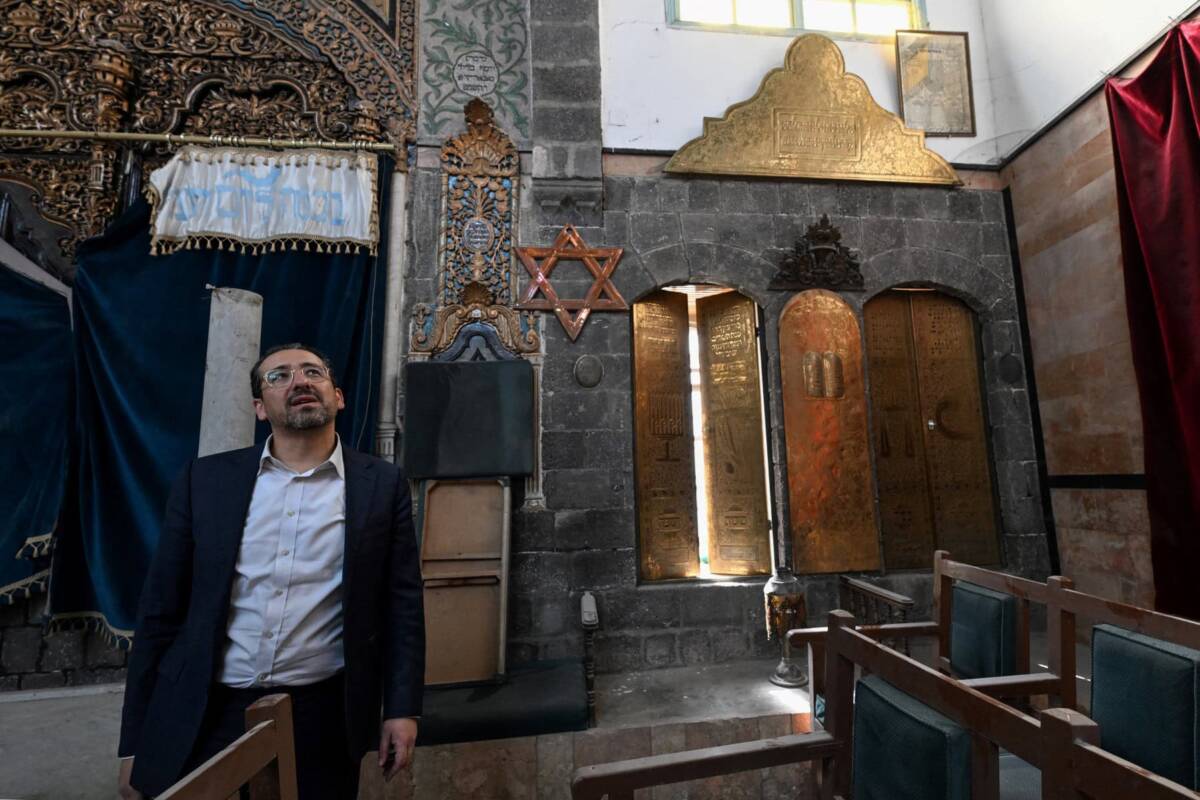
The visit, during which a group of Syrian and non-Syrian American Jews visited a Jewish cemetery and two Damascus synagogues, was seen as historic—marking nascent signs of promise for Jewish return after decades of hostilities and state repression reduced the once 30,000-strong Syrian Jewish community to a mere handful.
The majority of the community clandestinely fled in response to episodes of anti-Jewish violence ignited by the 1947 United Nations vote to partition Palestine. Of the 5,000 who remained until the late 20th century, most left after Hafez al-Assad lifted a longstanding ban on Jewish emigration in 1992.
The fault line within the February 2025 delegation opened when one of the participants, Michigan-based Rabbi Asher Lopatin—who is not Syrian—felt that the SETF’s positioning of Jewish identity as a bridge for Syria-US relations, without taking a pro-Israel stance, was both a missed opportunity and at odds with his own values.
For Mouaz Moustafa, the Syrian American director of the SETF who organized the visit, Lopatin’s staunchly pro-Israel disposition and desired approach stood at odds with the geopolitical sensitivities.
Splitting from the SETF, Lopatin is now leading his own visits to Damascus. Most who participated in his two trips so far—in September and December 2025—were American Jews without Syrian roots.
As an unwavering pro-Israel advocate and liaison for interfaith dialogue in Michigan, Lopatin says that his goal as an “outsider” is foremost a political one: to sustain momentum on Syria’s newfound pro-West sensibility and eventually build relations with Israel. “I’m really excited about this new government. They have talked about making peace with the US and even with Israel,” Lopatin told Syria Direct.
Michigan-based Rabbi Asher Lopatin puts on a prayer shawl during a visit to the al-Faranj Synagogue in the Jewish quarter of Old Damascus, 18/2/2025 (Louai Beshara/AFP)
Lopatin and two other participants in his delegations Syria Direct spoke to characterize the visits as “goodwill missions.” Through them, Lopatin aims to create space for pro-Israel American Jews and Syrians to come together for cultural and intellectual exchanges.
On the diplomatic stage, Syrian-Israeli talks for a security agreement have stalled, while Israeli forces continue to occupy territory in southern Syria. Lopatin hopes that people-to-people connections forged through his citizen diplomacy initiatives could encourage diplomacy and cooperation between the two governments.
While most of Lopatin’s colleagues in this venture are Ashkenazi—Jews with recent ancestry in eastern and central Europe—he has found a strong supporter in Joseph Jajati, a 32-year-old Syrian American businessman based in Brooklyn. Jajati was also part of the initial SETF delegation, but has since joined forces with Lopatin. The pair sport matching “Make Syrian Great Again” caps on their trips to Syria.
In general, “Syrian Jews are happy because they believe [Syria] is going to make peace with Israel,” said Jajati, who speaks English in a thick Brooklyn accent and Arabic in the signature Syrian one. Born in Damascus, he grew up tethered to his Syrian heritage, watching Arabic TV shows and listening to the stories of his family’s life in Syria before they left in the early ‘90s. “I’m happy too, but as a Syrian first. We don’t want war anymore,” he continued.
Since joining Lopatin’s faction, Jajati has founded the Syrian Mosaic Foundation, the umbrella organization that hosts Lopatin’s delegations, providing logistical and on the ground support. The organization, whose name evokes Syria’s diverse ethnoreligious social fabric, defines its mission as “leading heritage preservation, driving community development, and forging cross-cultural partnerships that create lasting change.”
Strategic silence
Henry Hamra, a Brooklyn-based cantor from Damascus who joined the first February 2025 delegation, has remained a steady and focused partner for Moustafa at the SETF. Returning from Damascus, the pair helped successfully lobby Washington for sanctions relief, framing recent Jewish engagement with Syria as proof of the new government making good on its stated commitment to pluralism.
Hamra’s diplomatic maneuvering engages with the US but refrains from directly touching on the topic of Israel.“My dream is reviving the Jewish identity in Syria,” Hamra told Syria Direct, adding that he is not a politically minded person. His “dream” is instead born of personal connection to Damascus, which he left with his family and thousands of other community members as a teenager in the early 1990s.
Hamra’s father, Yousef Hamra, was the last rabbi to leave Damascus and joined his son on the February 2025 visit. Stepping into the al-Faranj Synagogue where he once led prayers brought back a flood of memories, Hamra said.
“It’s a perfectly appropriate strategy for Jews interested in visiting Syria to not permit their visits to become entangled in the very difficult diplomatic issues that are still unresolved between Israel and Syria,” said Steven Heydemann, an expert on Syrian politics and chair of Middle East Studies at Smith College. “What we’ve seen, as Israel has moved to solidify its position in southern Syria, is a hardening of the position of the interim [Syrian] government.”
Israeli violations of Syrian sovereignty since Ahmad al-Sharaa took power in December 2024 have renewed longstanding hostilities between the two nations. Stating that the interim government poses an “elevated threat,” Israel has advanced troops into a once-demilitarized buffer zone inside Syria’s southern border, bombed the Ministry of Defense in Damascus and armed Druze factions in Suwayda that clashed with government forces last July.
While this context makes Lopatin’s approach an uphill battle, Hamra’s cultural focus has made inroads in both Damascus and Washington. In Washington, leveraging a Syrian Jewish identity separated from Israel served as a potent counterweight to Israeli messaging pushing for the US government to keep the Caesar Act sanctions intact.
“There was a huge effort, particularly by Bibi Netanyahu and [his advisor] Ron Dermer, on the Caesar Act for it to remain,” recounted Moustafa, who spearheaded the lobbying efforts. “Hearing directly from the Syrian Jewish community saying that we cannot rebuild the oldest synagogue in the world as long as Caesar sanctions remain was a huge part of the decision-making process for some of the [congress]members who flipped sides.”
Last October, Hamra ran for a seat in Syria’s first post-Assad parliament, promising to promote national unity and lobby the US for economic cooperation. He did not succeed in the initial indirect election, but his bid remains open as one third of the seats have yet to be appointed by President Ahmad al-Sharaa.
Election posters of Henry Hamra, a Syrian American parliamentary candidate and son of the last rabbi to leave Damascus in the 1990s, hang on a wall in Damascus ahead of indirect elections, 3/10/2025 (Louai Beshara/AFP)
Hamra has also officially registered his Jewish Heritage in Syria (JHS) foundation in Damascus—the first Jewish NGO in the country. Through the foundation, he is working to clean up old Jewish cemeteries, restore synagogues and navigate a complex bureaucracy, liaising between Syrian officials in Damascus and his diasporic neighbors in Brooklyn to return seized Jewish properties to their owners.
“I want to educate the Jewish Syrian community that there’s nothing to be scared of, to go back and see what we have in Syria,” he said.
In Damascus and in Washington, Israel is “completely outside the conversation and has nothing to do with what’s being done in Syria,” Moustafa explained in a joint phone call with Hamra. “It’s about an ancient homeland that is holy to the Syrian Jewish community. The implication that may or may not have for Syrian-Israeli relations is there, but it is never a focus, nor did it ever come up in any meeting with [Syrian officials],” he said.
A bold approach
Meanwhile, Lopatin is not shy from venturing into the fraught territory of Syria-Israel relations. His two delegations so far have featured conversations with ministers including Qutaiba Idlibi at the Ministry of Foreign Affairs and Hind Kabawat, who leads the Ministry of Social Affairs and Labor.
Two participants—Professor Lawrence Schiffman of New York University’s Hebrew and Judaic Studies department and Professor Susannah Heschel of Dartmouth University’s Jewish Studies department—characterized the Syrian officials’ stances in these talks as cautiously optimistic and pragmatic towards Israel. The discussions they described echoed public statements that Syria stands open to normalizing relations with Israel, but that this hinges on Israel withdrawing its occupying forces.
“There were initially overtures on the part of the interim government, and they were largely ignored in Israel. Now, there are voices in Israel [that] view that as a missed opportunity,” Heydemann said. Through his delegations, Lopatin is trying in part to salvage that missed opportunity.
Lopatin’s latest trip, in December 2025, made headway on creating forums for cultural exchanges between American Jews and Syrians. A handful of academics viewed the Dura Europos paintings, which depict scenes from the Hebrew Bible, and artifacts from the now bombed-out Jobar Synagogue, which are stored at the Damascus National Museum.
The group hopes to create partnerships between the museum, which contains important Jewish artifacts, and US universities that host scholars interested in studying them, in the form of academic conferences where individuals from each institution can come together for intellectual exchange.
According to an official at the museum, a contract is underway for a partnership. NYU, where Professor Lawrence Schiffman teaches, has shown interest in such an idea: The university provided financial and regulatory approvals for Schiffman to travel to Damascus for the first trip Lopatin organized last September.
Lopatin hopes that these exchanges, by fostering individual and institutional connections, can act as a backchannel to diplomacy at a time where official negotiations are stalling. But increasingly, these efforts are intended for Israeli, not Syrian, eyes.
“One of the goals is influencing Israel, to say: Hey guys, there’s a lot of potential here for friendship,” Lopatin said. In his experience liaising with Israeli officials, from members of the foreign ministry to Ron Dermer, he has been frustrated by Israel’s cold stance. “Israel is the one that needs to be pushed,” he added. “I would love for Israel to be warmer to this new government.”
He hopes that efforts to “spread goodwill” in Syria will act as a buffer for Israel’s hostilities, that “Syrians feel the love from American Jews and in a way mitigate the bad stuff coming from Israel, because whatever they are doing isn’t making Syrians happy.”
Lopatin plans for his next trip to bring Jewish business leaders to Syria, hoping that economic incentives can push the dial further.
A Syrian Jewish man looks at the ruins of the Eliyahu Hanavi Synagogue (Jobar Synagogue) in the northeastern outskirts of Damascus during a visit from the United States, 18/2/2025 (Louai Beshara/AFP)
While Syrian officials are aware that Lopatin’s group bears an interest in seeing relations with Israel, they have still extended invites to the group, hosting them as official guests of the state, he and other participants said.
“The Syrian government is keenly aware that how they treat the diaspora Syrian Jewish population is being watched closely and is being seen as an indicator of whether they are willing, not just to talk of pluralism and inclusion, but do something about it,” Heydemann added.
This month, Syria’s interior ministry announced it arrested five individuals tied to a plot to kill Rabbi Michael Houry, who is among those who have visited Syria since the fall of the Assad regime and participated in reopening the al-Faranj Synagogue in Damascus. The Syrian government accuses Hezbollah of involvement, which the Lebanese armed group denies.
While the Syrian government has welcomed Jewish delegations, broader trends in the treatment of minorities have been mixed, with serious incidents of identity-based violence against members of the country’s Alawite and Druze minorities. While the Damascus government has taken steps towards accountability for what it characterizes as “individual violations,” its critics at home and abroad remain deeply skeptical of its commitments.
Still, as Heydemann points out, when Israel points to this record as evidence of the new government’s enduring extremist tendencies and a justification to continue its own hostilities, it plays by a glaring double standard given its treatment of Palestinians, from settler attacks in the West Bank to what UN and human rights experts have identified as a genocide in Gaza.
The skeptic
For Rabbi Elie Abadie, Senior Rabbi Emeritus of the United Arab Emirates (UAE), both camps’ enthusiasm for the new government is premature. While cautiously optimistic, Abadie—born in Lebanon to parents who fled Aleppo—has held off on opportunities to travel to Syria, believing that the community must “wait and see” whether the Syrian government is truly committed to respecting all minority groups.
Without that demonstrated commitment, Abadie suggests that the Syrian government’s warmth to Jewish delegations derives from strategic interests. “Many countries around the world think that to get to the US government, you have to go through the Jews, which I don’t think is really true, but that’s what they think,” Abadie told Syria Direct. “Even the UAE had that idea.”
Over the decade leading up to the UAE’s signing of the 2020 Abraham Accords, which normalized its relations with Israel, Abadie regularly hosted Emirati dignitaries at the Edmond J. Safra Synagogue in Manhattan. Those conversations, which centered on religious commingling during the era of Andalusian Spain and the UAE’s interest in creating such a spirit inside its borders, were “catalysts to speeding that normalization,” Abadie said. Such informal, people-to-people connections can “clarify things that can not be clarified on the official level,” he added.
But Abadie warns that the history between Syria and Israel—formally in a state of war since 1948—makes any path to normalization much less straightforward. “There are some similarities, but historically, there are completely different scenarios,” he said.
One of Abadie’s missions is centering the perspectives of Middle Eastern perspectives in Jewish dialogue, which he says is usually dominated by Ashkenazi voices. He hopes to work with Sephardic institutions in Brooklyn and meet with President al-Sharaa on an eventual trip to Damascus.
He suggests that, because of a shared language and customs, he would cut through complex diplomatic issues and push for progress more effectively than Lopatin’s delegations.
“When I speak to Arab leaders, I bring Arabic culture, sayings and songs. Immediately, any wall breaks down,” Abadie said. “If you have a Jew who is not Middle Eastern, who doesn’t know the culture, the barrier will always exist.”
Back in Brooklyn
As families sit for Shabbat dinner in Brooklyn, Jajati recalls his hopes for Syria. On the second visit Lopatin led last December, he arranged for kosher meat to be shipped to a Damascus restaurant so that the delegation could sit for a full meal on the last evening of Hanukkah.
“This is the only place you can have kosher meat in Syria,” Jajati said with pride in a video he posted on social media.
Jajati, Hamra and Abadie may find themselves settled into three distinct approaches, but they share a dream of seeing Jewish life return to Syria, and are grounded by a common connection to home.
Pieces of this connection can be found in the archives of the Sephardic Heritage Museum in Brooklyn, which holds a collection of photographs documenting prominent Jewish families’ lives in Syria and journeys to the US over the course of the 20th century.
In one, Jajati’s father sits at a dinner table in Damascus. In another, Hamra’s uncle stands inside the al-Faranj Synagogue. A third shows Abadie’s family when he was a child, living in their first refuge in Lebanon. The photos speak to enduring memories and ties preserved in Syrian Jewish families over decades of exile.
The diplomatic underpinnings of visits to Damascus may take time to realize, but for now, a simple homecoming suffices. “I’ll go back to Syria every chance I get,” Hamra said.