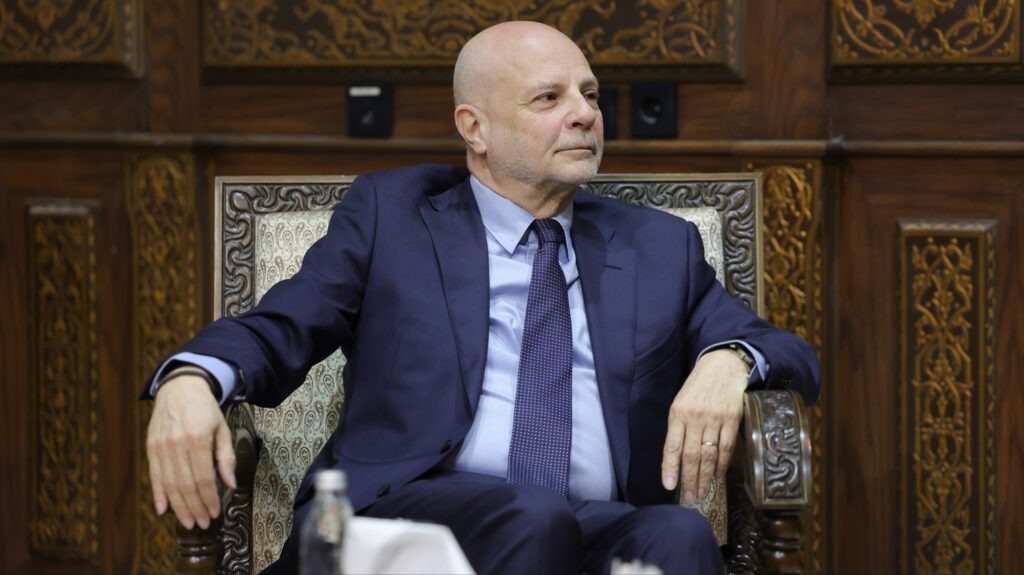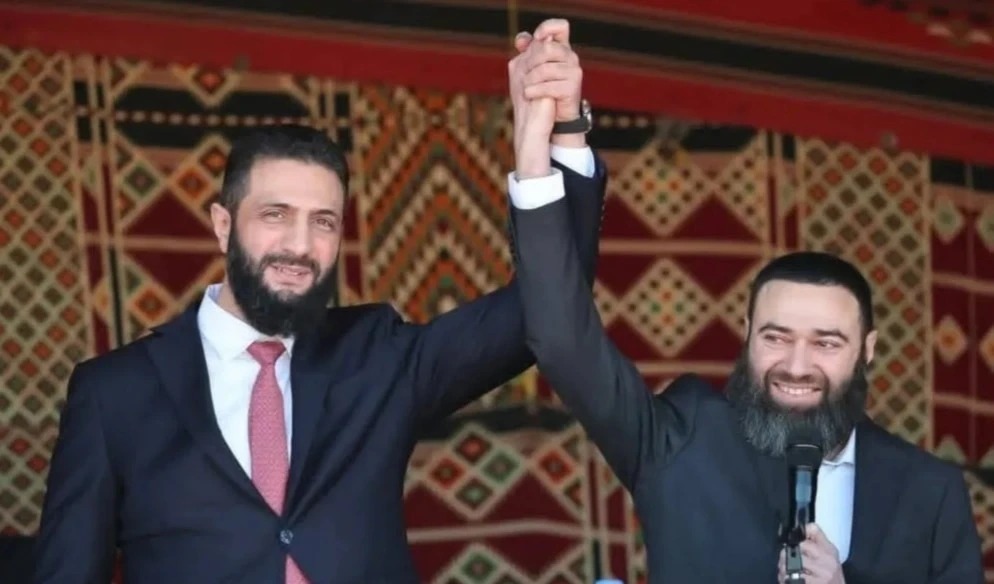
Syrian transitional president Ahmad al-Sharaa has received Issam Boweidani — the former commander of Jaysh al-Islam, known as Abu Hammam — in Damascus following his release from detention in the United Arab Emirates, where he had been held for nearly a year. His return came shortly after Al-Sharaa’s visit to the UAE as part of a broader Gulf tour that included Saudi Arabia, Qatar, and Abu Dhabi.
Senior officials from the transitional government attended the reception, among them Defence Minister Marhaf Abu Qasra, Interior Minister Anas Khattab, and Foreign Minister Asaad al-Shibani. Boweidani later travelled to Douma in Eastern Ghouta, his onetime stronghold, where Jaysh al-Islam erected a reception tent to welcome supporters and local residents who gathered to greet him.
Boweidani had been arrested at Dubai International Airport in April 2025 while attempting to leave the UAE after a short personal visit, reportedly using his Turkish passport. According to family members, his case remained legally ambiguous for months before he was accused of belonging to Jabhat al-Nusra — an allegation the family rejected, insisting that his relationship with the group had been defined by hostility, not affiliation.
Multiple sources say Boweidani stood trial in the UAE, with the Syrian state appointing a lawyer to represent him. A verdict had been scheduled for April 29, but the judicial process shifted following Al-Sharaa’s visit to Abu Dhabi. His family later received assurances from Syrian officials that his release was imminent, and his arrival in Damascus was subsequently confirmed.
The family denied reports that Boweidani returned aboard the presidential aircraft carrying Al-Sharaa, saying instead that his return was arranged through separate procedures. A family delegation also travelled to the People’s Palace in Damascus in preparation for meeting him upon his arrival.
A New Military Reality
Boweidani’s release carries clear political weight. Earlier attempts by the transitional authorities to secure his freedom had failed, but Al-Sharaa’s mediation during his Gulf tour ultimately succeeded. The public reception in Damascus — followed by the journey to Douma — gave the episode a celebratory tone and sent a message to Jaysh al-Islam’s base in the Damascus countryside, as well as to factions that have been absorbed into the new military structure since the fall of the Assad regime.
Boweidani assumed leadership of Jaysh al-Islam in 2015, succeeding its founder Zahran Alloush, who was killed in an airstrike on his headquarters in Eastern Ghouta. The faction was one of the most prominent armed opposition groups in the area before its evacuation to northwestern Syria in 2018. After the collapse of the former regime, Boweidani and his faction were integrated into the Syrian Ministry of Defence as part of the restructuring of armed formations, and he took up a senior post in the new army.
Yet his return also reopens a sensitive file that extends beyond the circumstances of his detention. Jaysh al-Islam has long faced accusations of abuses during its control of Douma and Eastern Ghouta — including the abduction of activists Razan Zaitouneh, her husband Wael Hamada, and their colleagues Samira Khalil and Nazem Hammadi. The faction has also been accused of shelling Damascus with mortars and rockets, placing abductees in cages in the streets of Douma, and recruiting children.
These allegations raise difficult questions for the transitional authorities as they navigate how to handle commanders of armed factions who now occupy positions within the institutions of the new state — particularly as legal proceedings continue in Europe against figures linked to Jaysh al-Islam. Since 2020, France has detained the faction’s former spokesman, Majdi Nehmeh (Islam Alloush), who is being tried on charges of complicity in war crimes.
Although Boweidani’s supporters have framed his case as one of arbitrary detention in the UAE, the official and public celebration of his release places the transitional government before a dual challenge: reassuring factions that have joined the new army, while addressing the legacy of abuses and the demands of accountability. At this intersection of factional reconciliation and transitional justice, Boweidani’s return to Douma is more than a personal or military milestone. It reflects the delicate balance the new authorities are attempting to construct in post-Assad Syria.
This article was translated and edited by The Syrian Observer. The Syrian Observer has not verified the content of this story. Responsibility for the information and views set out in this article lies entirely with the author.