The Committee to Investigate the Fate of the Sons and Daughters of Detainees and Forcibly Disappeared Persons, formed by Syria’s Ministry of Social Affairs and Labor, said 194 children have returned to their families.
The committee had documented 314 cases of missing children who were placed in ministry-affiliated care homes during the rule of the former Syrian regime.
According to the committee’s head, Raghda Zidan, the search is continuing for the remaining children whose entry into these homes was documented.
Zidan said in an interview with the official al-Ikhbariya channel, published Thursday, April 30, that the figure of 314 is not final and may rise as new files are found.
She said the file is not merely a matter of numbers, but rather the result of the former regime’s policies and “the chaos of its administrations and lack of oversight,” which explains the difficulty of reaching the children and information.
She explained that the former regime was directly responsible for the disorder in the files and weak data, including incomplete addresses, phone numbers, and names, along with tampering with or the disappearance of some files after liberation.
Zidan confirmed that the committee began reviewing 612 “placement” files completed during the years of the revolution. So far, it has confirmed that children placed in the years from 2011 to 2015 are not children of detainees, while the review of the remaining years continues.
She stressed that genetic analysis is used only after all other means have been exhausted, in order to protect the child’s privacy.
What Is the Committee’s Goal?
The committee was formed to search for children of detainees within associations affiliated with the Ministry of Social Affairs and Labor, with the aim of returning them to their families.
Associations that were supported by Asma al-Assad, wife of the deposed Syrian regime’s president, Bashar al-Assad, most notably “Lahn al-Hayat,” face allegations of placing children of detained women and men, changing their names and surnames, and then handing them over to other families.
Zidan said the committee’s jurisdiction is limited to children who were placed in ministry-affiliated care homes during the time of the former regime. She confirmed that most cases are concentrated between 2012 and 2015, the period that witnessed the peak of disappearances and violations.
Zidan added that the committee worked to change the boards of directors of care homes that existed during the former regime’s rule, such as “SOS” and “Lahn al-Hayat.”
She noted that the new administrations have assumed their duties, adding that legal accountability for implicated officials takes place through lawsuits filed by families, after which they are investigated by the Ministry of Interior or the Ministry of Justice.
According to Zidan, the powers of the Ministry of Social Affairs and Labor are limited to removing the administration only.
In this context, the committee’s head called on anyone who has any information about the missing children to contact them through the hotlines open around the clock.
The Committee’s Work Mechanism
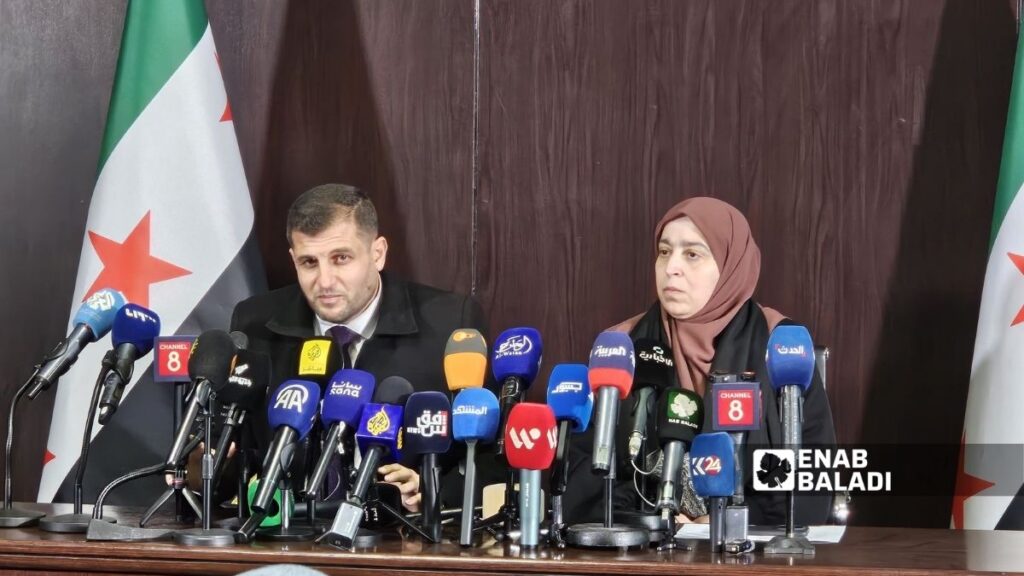
Zidan had revealed during a press conference at the Ministry of Social Affairs and Labor, attended by Enab Baladi on January 6, that 150 of the children had returned to their families.
Speaking to Enab Baladi at the time, she explained the committee’s mechanism for identifying previous cases, saying the committee works along specific tracks, foremost among them searching the files available in care homes, a process she described as difficult and complex because of the large number of documents.
The committee also reached an agreement with experts from the International Center for Transitional Justice, who provide support in archiving and data analysis, noting that this work requires time and cannot be completed quickly.
Regarding the committee’s contact with the children’s families, Zidan confirmed that there is permanent and continuous communication through specialists from the committee’s members, via social media and periodic meetings. She pointed to the formation of a volunteer committee, half of whose members are families, to participate in the committee’s work, and said there is direct and continuous follow-up by several committee members with the families of the missing children.
Investigation committee on detainees’ children presents its findings