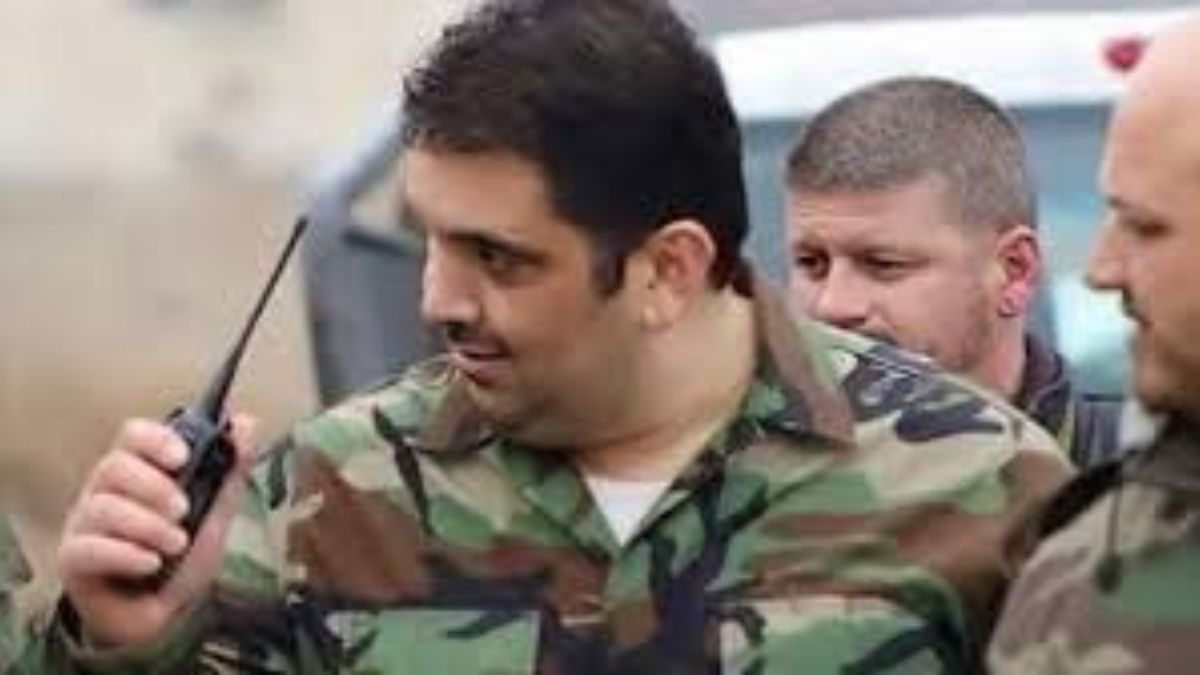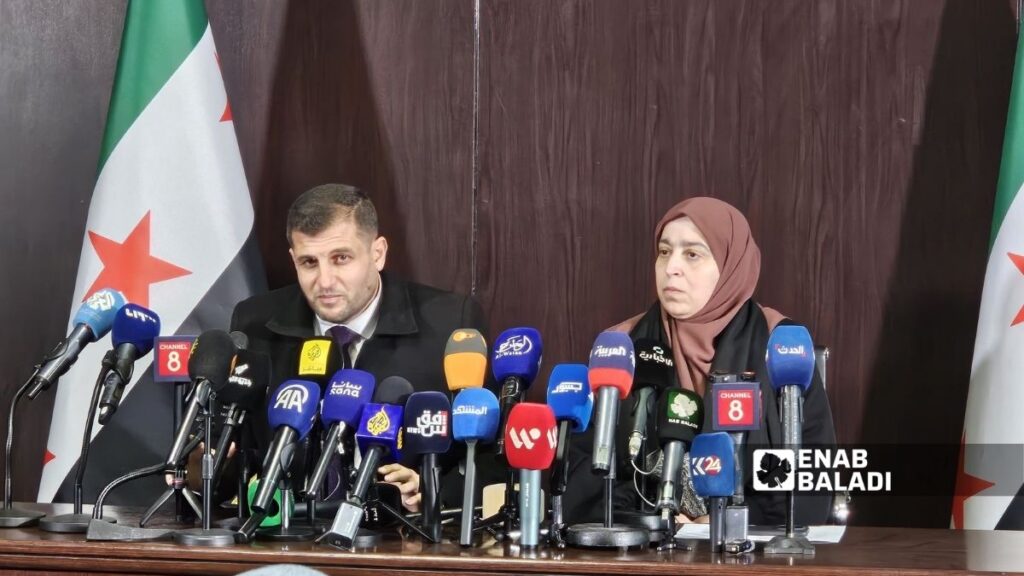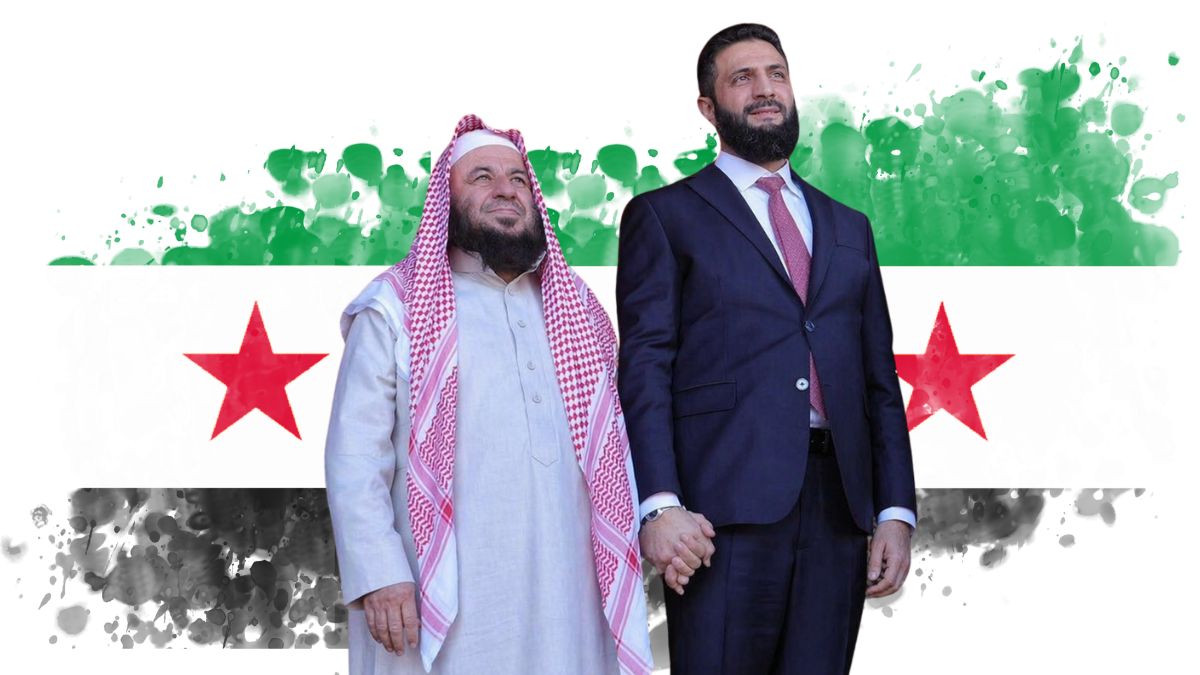
One day before the arrest of Amjad Youssef—the perpetrator of the Tadamon massacre of April 2013—Syrian state media aired footage of transitional President Ahmed al-Sharaa in Douma, standing hand in hand with Samir Kaakeh. Kaakeh, the sharia official of Jaish al-Islam, is the man implicated in the abduction, enforced disappearance, and likely murder of Samira al-Khalil, Razan Zeitouneh, Wael Hamadeh, and Nazem Hammadi, along with other crimes. Their abduction took place in the final month of that same year, 2013.
Information about this crime is public and readily accessible. It has been published repeatedly on this platform, which was also the first Syrian outlet to run a detailed Arabic report on the Tadamon massacre and its perpetrators—written by the two researchers who uncovered it, Ansar Shahoud and Uğur Ümit Üngör—on the same day The Guardian published a shorter English version. Today, the killer Amjad Youssef stands before the machinery of accountability; the killer Samir Kaakeh stands on the stage of power.
What blocks the path to truth and justice in the case of the four abducted activists is not a lack of information or credible evidence. It is the political and institutional environment now taking shape. That same environment strengthens the demand for justice for the victims of Tadamon while simultaneously reinforcing the neglect of justice for the victims of Jaish al-Islam. This contrast forces a fundamental question about the relationship between justice and politics in Syria today. It may be the central question of legitimacy in its deepest sense: to what extent can justice be independent of the ruling group’s political preferences? Or, put differently, to what extent can legitimacy be separated from power—so that power itself may be questioned by those affected by its actions?
We already know the answer from the Assad era. Justice, like everything else, was subordinated to the regime’s overriding priority: the perpetual monopolization of power. Samira al-Khalil, imprisoned for more than four years under Hafez al-Assad without charge or trial, knew this well. So did Razan Zeitouneh, the lawyer who defended political detainees—including Salafists—before the Supreme State Security Court under Bashar al-Assad. In truth, all Syrians knew it. Syria was a legal desert as much as it was a political one. The right to justice, like the right to politics, was denied to everyone. For that reason, it is indefensible to demand justice and political rights for some but not for others. A right is not a right unless it is universal. For the same reason, judicial independence was a constant demand of democratic opposition forces throughout the Assad decades, alongside political freedoms and party pluralism.
Today, the question concerns the right of democratic opposition figures to justice and political participation. The first test case is that of Samira al-Khalil, Razan Zeitouneh, Wael Hamadeh, and Nazem Hammadi. Why this case? Not because their lives are more valuable than the lives of any other four among Syria’s roughly 200,000 disappeared. Rather, because their story brings together elements unmatched in any other case. They had a documented history of opposition to the Assad regime long before the revolution and the forces that emerged afterward. There is ample evidence pointing directly to Jaish al-Islam—enough to initiate a judicial process. The suspects are known by name, foremost among them Kaakeh. And crucially, the abductors share the ideology of today’s rulers. Pursuing justice in this case is therefore the decisive test of whether justice in Syria can be independent of ideology and power. The arrest of Atef Najib does not test the independence of justice today, nor does it prove it. Opening a judicial process into the crimes of Kaakeh and his followers is what tests that independence—and proves it. This is the case that defines the fate of justice in Syria today.
Figures like Razan, Samira, Wael, and Nazem—and like Ansar Shahoud, Uğur Ümit Üngör, and countless Syrians and their partners worldwide—built the moral and rights-based foundation of the Syrian revolution. Razan Zeitouneh authored the two most reliable reports on the chemical massacre in the Ghoutas in August 2013, based on direct fieldwork that placed her life at risk. She worked to build an independent justice body in Eastern Ghouta so that force would not replace law. For that very reason, Kaakeh and his aides abducted her and her companions. Ansar Shahoud devoted two years of her young life, risking her health, to uncover the truth about the Tadamon massacre—now exploited for political gain by people who do not even mention her name or that of her research partner. Young Alawite men, especially Hazem al-Abdullah, risked their lives to smuggle the videos to Europe and place them in the hands of researchers—facts that sectarians eager to criminalize an entire community prefer to hide. Syrian lawyers and human rights activists, and no one else, are the ones pursuing Assad’s criminals and shabiha in Europe, seeking a measure of justice for their fellow citizens. What unites all these people is their commitment to democracy, justice, and citizenship in Syria. Today, they are politically and publicly disappeared—just as Razan, Samira, Wael, and Nazem were disappeared—while the mufti of killing, Kaakeh, is embraced, and while those who never cared for truth, freedom, or equal rights preen themselves, claiming exclusive credit for the Tadamon case.
The contrast between the cases of Kaakeh and Youssef goes beyond the double standards of those in power today. It amounts to deciding who owns the revolution and the country. These actors arrived late to a revolution to which they contributed nothing. For years, they were violently hostile to it. Today, they lay claim to what millions of Syrians struggled and sacrificed for, thanking no one but themselves and excluding everyone else from power, decision-making, and public voice—as though Syria were their private property, just as it was under Assad.
The case of Samira, Razan, Wael, and Nazem is a national, political, and public case—just like the case of the Tadamon victims. Just as the Tadamon case did not wait for personal lawsuits before being pursued—leading to the arrest of the first perpetrator thanks to information provided by independent researchers and journalists—the same should apply to the crimes of Kaakeh and those like him. This platform, which published the most extensive report on the first crime, is the same one that has provided the most extensive information on the second. The file exists. The legal claim exists. What does not exist is independent justice.
This case will not die, nor will it expire with time. We will not surrender it to the forces of hatred and forgetting. It is a story known in Syria and around the world—detailed, documented, and tied to specific names. A crime committed in public, with known perpetrators. Their exemption from justice defines the absence of justice in post-Assad Syria—or else marks the measure of justice still missing.
We address these words to Syrians out of a duty to speak truth to power in all circumstances, and in the hope that the case may finally move forward—twelve years, four months, and eighteen days after Samira, Razan, Wael, and Nazem were disappeared. For us, this is a matter of right and truth: the life and freedom of our loved ones, or at minimum full knowledge of their fate, and the recovery of their bodies if Kaakeh and his men killed them. We want known graves for our loved ones, mourning for ourselves, and memory for our public cause.
We also address Syrians to say this: what protects your lives, your freedom, and your rights is neither power nor sect, but independent justice and the equal right of all to it. The lesson of Bashar al-Assad and his regime is not far behind us.
This article was translated and edited by The Syrian Observer. The Syrian Observer has not verified the content of this story. Responsibility for the information and views set out in this article lies entirely with the author.