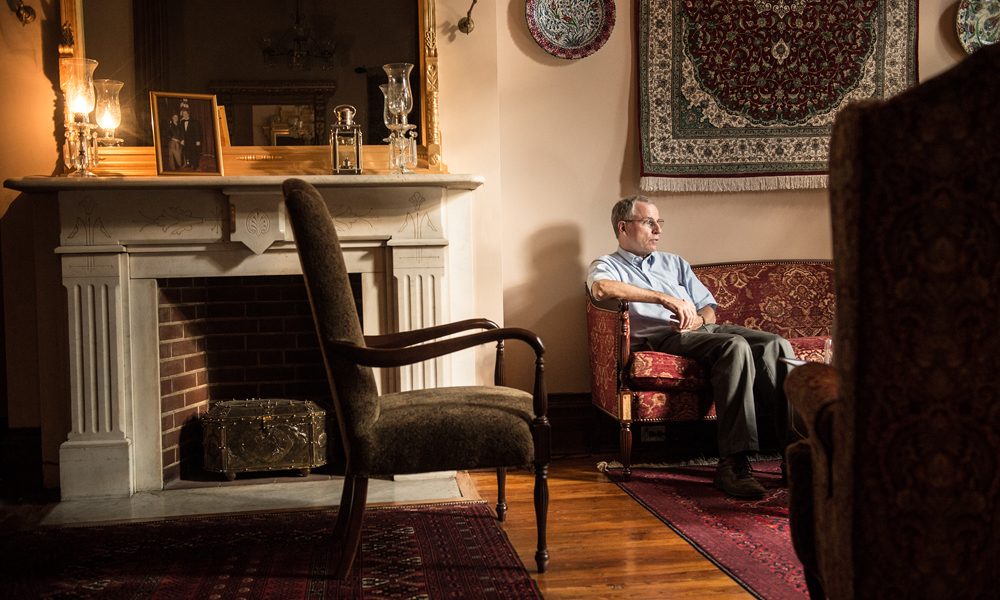
Former U.S. ambassador to Damascus Robert Ford places direct communication, a clear grasp of interests, and respect for red lines at the center of any stable relationship between Washington and post-liberation Syria.
In an extensive interview with Syria TV, the veteran diplomat revisits the first months of the Syrian revolution and discloses details of an early, little-known attempt to open a channel between the Assad government and opposition figures—an initiative ultimately crushed by regime security services. He reflects on the limits of the Obama administration’s Syria policy, the missed opportunity that may have followed the 2013 chemical attack on Eastern Ghouta, and the internal and external factors that weakened the Syrian opposition.
Ford also examines the rapid shift in U.S.–Syrian relations under Donald Trump and outlines what Syria must do to attract investment, rebuild its economy, and establish a more predictable relationship with Washington.
The following text presents Ford’s answers in full, accompanied by brief editorial notes that clarify the events and context he references.
A Dialogue Attempt Blocked by Assad’s Security Services
Ford recounts an unexpected overture from Damascus in the spring of 2011:
“Some senior Syrian officials told us privately that Bashar al-Assad’s government wanted to begin reaching out to opposition leaders about a reform process… This happened in Muallem’s office at the Foreign Ministry in May 2011.”
At the time, Ford was the U.S. ambassador to Syria, joined by French ambassador Éric Chevallier and British ambassador Simon Collis. Ford does not name the officials involved beyond Foreign Minister Walid al-Muallem, and no independent documentation of the meeting exists.
His account aligns with reporting from The Guardian, which noted preliminary contacts between government envoys and opposition figures such as Michel Kilo and Aref Dalila in May 2011. Those figures later halted discussions as killings escalated.
Ford describes how the regime abruptly shut down a planned meeting:
“We persuaded some opposition figures, including Michel Kilo, that the process might be useful. But on the night before the planned meeting… regime security officers raided the intended venue and arrested people.”
No public record identifies the location or the detainees. The well-known Semiramis Hotel meeting on 27 June 2011 was separate and public, and cannot be treated as the same event.
At the time, Washington still advocated dialogue conditioned on halting violence, releasing detainees, and ending mass arrests. On 18 May, the U.S. imposed sanctions on Assad and senior officials; the next day, President Barack Obama warned Assad to lead a transition or “get out of the way.”
Ford’s support for dialogue, he notes, stemmed from witnessing the cost of war in Algeria and Iraq:
“After that, I became sceptical that the government would enter into a genuine dialogue… After my experience in Algeria… and in Iraq, we urged all parties to stop the violence.”
Washington and the Syrian Opposition
After the U.S. embassy closed in February 2012, Ford remained ambassador and became a key channel to the political and armed opposition.
By autumn 2012, Washington concluded that the Syrian National Council lacked broad representation and sufficient ties to forces inside Syria. Secretary of State Hillary Clinton publicly called for a broader body, and Ford helped shape the Doha meetings that produced the National Coalition of Syrian Revolutionary and Opposition Forces on 11 November 2012.
He worked on a proposed 50-member structure—20 from the internal opposition, alongside SNC representatives and others—under what became known as the Riad Seif Initiative. One month later, the U.S. recognized the coalition as “the legitimate representative of the Syrian people,” though not as a government-in-exile.
Ford continued pressing the coalition to broaden its base, strengthen political-military coordination, and articulate a clear post-Assad vision. His assessment of the opposition is blunt:
“The opposition made two major mistakes… it failed to develop and explain a vision of what the new government would look like… The second problem… was the absence of a unified opposition leadership bringing together political and military figures.”
Foreign governments, he adds, contributed to fragmentation by cultivating preferred Syrian partners.
A Political Transition Without an American War
From August 2011 onward, Washington formally supported a political transition ending Assad’s rule—but separated that goal from the use of U.S. military force. Ford attributes this to the bitter legacy of Iraq and Afghanistan:
“The experience of Iraq and Afghanistan had been extremely bitter, so the reason for the American decision is easy to understand.”
The U.S. provided non-lethal aid and, in 2013, covert CIA support to vetted opposition factions. Ford argued that military pressure was necessary to force concessions, and that delays strengthened extremist groups such as Jabhat al-Nusra. But strict vetting and limits on weapons—especially the refusal to supply anti-aircraft missiles—meant the program never aimed to help the opposition win the war.
Ghouta 2013 and Obama’s Aborted Strike: A Lost Opportunity
The limits of Obama’s Syria policy were tested after the 21 August 2013 chemical attack on Eastern Ghouta. Obama had previously declared chemical weapons a “red line.” A UN investigation confirmed large-scale sarin use; the U.S. assessed with “high confidence” that regime forces were responsible.
On 31 August, Obama announced he would seek congressional authorization for limited strikes. U.S. forces were already positioned.
Congressional resistance and public opposition stalled the vote. A remark by Secretary of State John Kerry—suggesting Assad could avoid strikes by surrendering his chemical arsenal—opened the door to a Russian diplomatic initiative. The U.S. ultimately accepted a deal to dismantle Syria’s declared chemical stockpile.
Ford believes the abandoned strike might have shifted Assad’s calculations:
“Perhaps—and only perhaps—if Obama had launched air and missile strikes… the government might have decided to negotiate a political transition.”
He stresses, however, that an American invasion was never contemplated and that neither regime hardliners nor jihadist factions would necessarily have accepted a negotiated transition.
After Russia’s 2015 intervention, the opposition-arming program’s impact diminished. Trump ended the CIA program in 2017. Under Biden, U.S. policy focused on containing the crisis rather than altering its balance.
After Liberation: Equal Citizens and Syrian Decisions
Ford argues that the lessons of the opposition’s fragmentation must guide the new Syrian state. He calls for consultation, equality, and rejection of foreign sponsorship in domestic disputes:
“It is also important for Syrians to regard other Syrians as equal citizens, and not to seek foreign assistance for one Syrian side against another.”
Trump and al-Sharaa: When Personal Relationships Drive Policy
Ford attributes the rapid post-liberation shift in U.S.–Syrian relations largely to Donald Trump’s personal style—and to the influence of Turkish President Recep Tayyip Erdoğan and Saudi Crown Prince Mohammed bin Salman.
“President Trump moved very quickly to develop relations with the new Syrian government… He ignored even his closest advisers… and later invited [Ahmed al-Sharaa] to the Oval Office.”
For Trump, Ford says, foreign policy is shaped as much by personal relationships as by strategic interests.
Reconstruction: Expertise, Investment, and the Conditions for Growth
Ford argues that future U.S.–Syrian relations should extend beyond security to economic and educational reconstruction. He distinguishes between American expertise—which Syria can request—and private investment, which requires a predictable business environment.
“Major private American companies will not invest in Syria unless the business environment is attractive… including bureaucratic procedures and fair courts.”
He recalls Turkey’s reforms under Turgut Özal, which streamlined bureaucracy and strengthened dispute-resolution mechanisms, helping attract foreign capital. While Syria’s circumstances differ sharply from Turkey’s in the 1980s, Ford emphasizes a core principle: investment follows confidence in institutions.
Between Damascus and Washington: Candor Over Public Statements
Ford underscores the importance of direct, honest communication—especially with a president like Trump, who is impatient and unconventional:
“Frank discussion and the explanation of interests, calculations and red lines will help each capital understand the other.”
He concludes by stressing that Syria’s answers must come from Syrians:
“The solution to Syria’s challenges is not in the United States. It is in Syria and among Syrians… As the Arabic proverb says: patience is the key to relief.”
This article was translated and edited by The Syrian Observer. The Syrian Observer has not verified the content of this story. Responsibility for the information and views set out in this article lies entirely with the author.