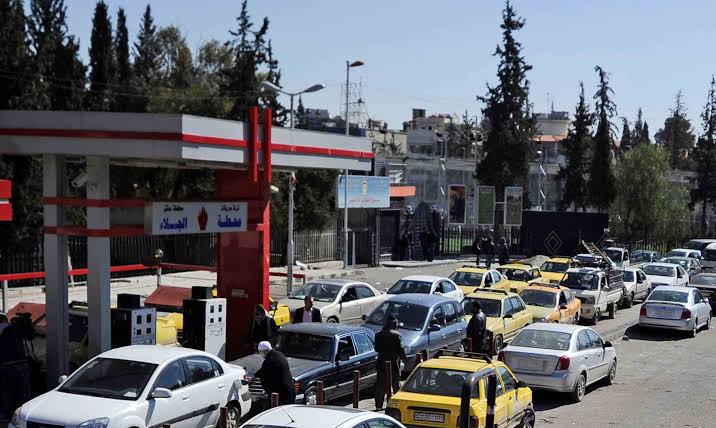
The return of long fuel lines in Damascus, Aleppo, Homs and Latakia has stunned Syrians, emerging just days after the transitional government slashed gasoline, diesel and domestic gas prices by 14 to 20 percent. The cuts were intended to ease pressure on households. Instead, they froze the market overnight. The crisis reveals a central truth about Syria’s transitional economy: the shortage is not rooted in supply, but in a breakdown of market governance, price predictability and regulatory management.
The Ministry of Energy insists production remains stable. Officials say the Baniyas and Homs refineries continue to supply more than 7.3 million liters of gasoline daily. The disruption, they argue, stems from the new permanent pricing committee, created to adjust domestic fuel prices in line with international oil markets and currency fluctuations.
On June 28, the committee cut the price of premium Octane 95 gasoline by more than 20 percent, dropping it to 130 New Syrian Liras — roughly 13,000 old pounds. Instead of stabilizing the market, the sharp reduction caused fuel to disappear from stations nationwide within hours.
A Crisis Born of Uncertainty, Not Supply
Economists say treating the shortage as a logistical failure misses the point. The transitional government has attempted full deregulation of fuel prices in an economy still financially fragile and exposed to extreme exchange‑rate volatility. By tying domestic prices to near‑daily global fluctuations, the government created an environment of acute uncertainty for private importers and station owners.
Fearing that additional price cuts could arrive after they purchase bulk supplies — forcing them to sell at a loss — station owners began withholding capital and delaying orders. This hesitation, not a lack of fuel, triggered the paralysis.
Syria’s daily demand ranges between 3.8 and 4.5 million liters of gasoline and up to 7.8 million liters of diesel. The recent shortage began not because tankers failed to reach ports, but because station owners paused orders for two to three days to see how far the pricing committee would push reductions. That delay choked pump supplies, sparked consumer panic and unleashed a wave of hoarding that overwhelmed the few stations still operating.
Black Market Surge
The regulatory vacuum revived Syria’s entrenched black market. Speculators quickly exploited public anxiety, buying fuel at the reduced official rate and reselling it at steep markups. In Latakia, parallel‑market prices surged above 20,000 old Syrian pounds per liter — more than 7,000 pounds above the official price.
This premium is driven by the widening gap between the central bank’s official exchange rate and the informal street rate. Because fuel imports are denominated in U.S. dollars while domestic sales occur in local currency, the exchange‑rate disparity guarantees lucrative margins for illicit traders.
Deregulation Without Infrastructure
The crisis underscores that full deregulation was introduced prematurely. A liberalized energy market requires deep financial liquidity, stable currency reserves and hedging tools that allow businesses to absorb price swings. None of these conditions exist in post‑regime Syria.
Economists argue that a partial deregulation model — freezing prices for fixed 30‑day intervals — would provide the predictability needed to curb speculative hoarding and restore confidence among station owners and consumers.
A Governance Failure, Not a Resource Failure
Field inspections confirm that refinery output remains stable. The problem is not production, but management. Restoring order will require more than increasing crude imports. Without a transparent, predictable pricing framework and strong anti‑monopoly enforcement, any future price adjustment risks triggering another wave of panic and long lines across the country.
This article was translated and edited by The Syrian Observer. The Syrian Observer has not verified the content of this story. Responsibility for the information and views set out in this article lies entirely with the author.