Labor unrest is widening across Syria’s private industrial sector as workers at two major factories in the Rural Damascus governorate press ahead with coordinated strikes over wages, benefits, and workplace conditions.
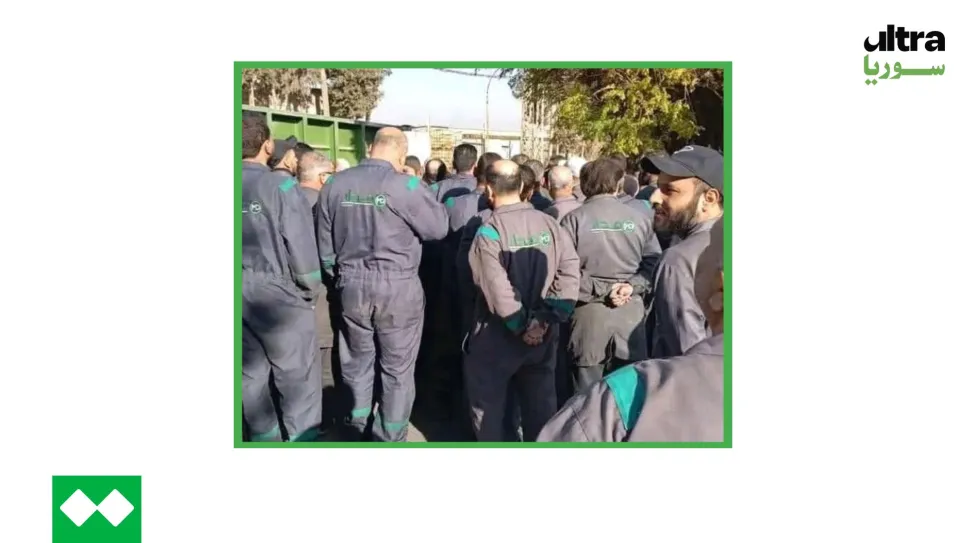
Employees at the Zenobia Ceramic and Sanitary Ware Company in the Al-Kiswah district have launched an open-ended walkout over low pay and what they describe as abusive management practices. At the same time, workers at the nearby Madar Detergent Factory have staged parallel protests, signaling what economists say is a deepening rupture in labor-employer relations within Syria’s struggling private sector.
Madar Factory Accused of Stalling Tactics
A worker inside the Madar plant told Ultra Syria that employees are demanding immediate salary increases to offset soaring living costs.
In what workers described as an attempt to disrupt the strike, management abruptly declared Thursday an official holiday. Company leaders also rejected demands to grant permanent status to contract-based employees. It remains unclear whether they agreed to any wage adjustments.
A statement posted by the “Madar Strike Committee” on Facebook confirmed the stoppage had entered its second day:
“An initial agreement was reached yesterday for a wage increase of one million legacy Syrian pounds. But workers will continue the strike until the Board of Directors issues a written decision. We want clear, written commitments that guarantee fair treatment and a dignified working environment.”
Harsh Conditions Drive Zenobia Ceramics Walkout
At the Zenobia ceramics plant, workers cited severe grievances, including meager pay, toxic managerial behavior, and the complete absence of workplace healthcare.
“Daily wages do not exceed 50,000 legacy Syrian pounds, and the facility lacks basic medical services or an ambulance despite the hazardous nature of the work,” one striker told reporters.
Workers initially demanded a flat monthly raise of one million legacy Syrian pounds. After management ignored a 24-hour ultimatum, they escalated their demand to a $100 monthly increase — roughly 1.4 million Syrian pounds at parallel-market rates. Employees said management had also ignored a formal list of demands submitted ten days earlier, including workplace injury insurance and wage adjustments in line with recent public-sector pay hikes.
Company Response and Legal Position
In a statement defending its position, Zenobia’s management said it remains fully compliant with Syria’s Labor Law No. 17 of 2010. The company, which employs around 4,000 workers across its Adra and Al-Kiswah facilities, said all employees are registered with social security.
Management added that it has paid salaries without interruption for 15 years, even during periods when operations were halted due to energy shortages, raw-material scarcity, or security crises. The company also said it has implemented recent presidential decrees raising the minimum wage — first to 7,500 new Syrian pounds under Decree No. 102 of 2025, and later to 12,560 new Syrian pounds under Decree No. 67 of 2026.
Analysts: Private Sector Under Severe Strain
Economist Younes Olleibi told Ultra Syria that the strikes reflect deeper structural pressures.
“For years, economic discourse assumed the private sector would absorb shocks, create jobs, and raise incomes,” Olleibi said. “What we’re seeing now shows the private sector is under immense strain. Inflation has wiped out purchasing power, and the crisis has fractured the core relationship between employers and their workforce.”
He added that with trade unions co-opted by the state and independent civic spaces suppressed, workers have been left without institutional channels for negotiation. As a result, he said, direct strikes have become the only mechanism through which labor can force its demands back into the public arena.
This article was translated and edited by The Syrian Observer. The Syrian Observer has not verified the content of this story. Responsibility for the information and views set out in this article lies entirely with the author.