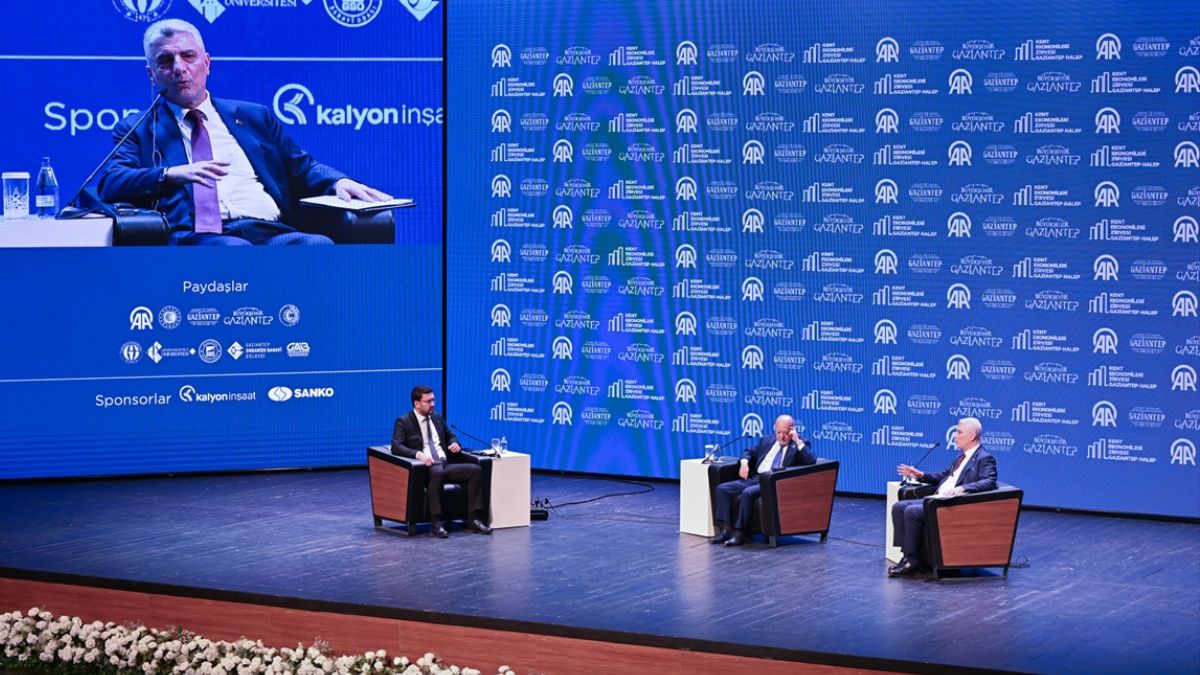
From Syria’s northern neighbor, the Anadolu Cities Economies Summit opened in Turkey’s Gaziantep province on June 9, with official participation from the Syrian and Turkish sides. The summit redefined the economic relationship between Damascus and Ankara and presented practical steps to advance it.
The summit witnessed official attendance by Syrian Minister of Economy and Industry Mohammad Nidal al-Shaar and Turkish Minister of Trade Omer Bolat, in addition to Aleppo Governor Azzam al-Gharib and Gaziantep Metropolitan Municipality Mayor Fatma Sahin.
Syrian Turkish economist Ghazwan al-Masri, vice president of the International Business Forum (IBF) and a member of the Supreme Advisory Council at the MÜSİAD business association, said the Anadolu Summit represents an important milestone in moving Syrian Turkish relations from the stage of renewed communication to the stage of building long-term strategic economic partnerships.
He told Enab Baladi that the importance of the summit lies not only in the attendance of the Syrian and Turkish ministers, but also in the practical messages it carried.
For his part, Rawad Ramadan, head of the Syrian Council for Coordinating Business Councils, believes the importance of the participation lies in the fact that it addressed a “sensitive and direct” economic axis, Aleppo and Gaziantep. He noted that this axis is linked to trade, industry, transport, border crossings, customs, production, and export.
Sustainable Economic Partnerships
For his part, Syrian Minister of Economy and Industry al-Shaar called on Turkish investors to enter sustainable economic partnerships in Syria.
Speaking during his participation in the summit, he said the Syrian government prefers investment models based on sustainable partnership, transfer of expertise, and building productive projects, rather than short-term investments aimed at making quick profits.
He called on investors to adopt a vision based on real partnership and contribution to economic development.
Rawad Ramadan, head of the Syrian Council for Coordinating Business Councils, said the Syrian side went to the summit to discuss practical files that serve the revitalization of the Syrian economy, expand channels of cooperation with the Turkish side, and present the needs of Syria’s private sector in the fields of raw materials, machinery, markets, investment, and trade facilities.
The summit also opened a discussion on specific Syrian products that could be exported to Turkey or through Turkey, while studying specifications, fees, and conformity mechanisms.
He considered this an important file because it links economic cooperation to a clear goal, increasing the Syrian product’s ability to reach markets.
Syria, Turkey Discuss Trade and Investment in Gaziantep
Council Says It Is Ready To Work
The Syrian Council for Coordinating Business Councils said this participation opens an organized space to involve the private sector in following up on economic files and linking Syrian traders and industrialists with their counterparts in Turkey through clear tracks.
The council, which was established by Syria’s Ministry of Economy and Industry, will also focus on collecting the demands of the private sector, organizing communication between companies and chambers, supporting participation in exhibitions, and helping turn the summit’s outcomes into practical opportunities that serve production, trade, and investment opportunities.
A Historic Opportunity For Syria
Minister Mohammad Nidal al-Shaar described Syria as “an emerging country rich in expertise, competencies, and young energies,” stressing that the country has investment opportunities he described as “exceptional” and unavailable in many countries around the world, and that it looks forward to building effective and sustainable economic partnerships.
The Syrian government seeks to upgrade economic cooperation with Turkey to a “strategic level,” according to al-Shaar, who noted that Syria has “major” industrial opportunities that could form an important foundation for future partnerships between the two countries.
Al-Shaar noted that Turkish companies have begun operating inside Syria, especially in Aleppo, while other companies are seeking to complete registration and licensing procedures in preparation for starting operations.
Turkish Minister of Trade Omer Bolat, for his part, pointed to the continued opening of new factories and production workshops in Syria, along with signs of recovery in the agricultural sector.
He said the Turkish ministry supported the participation of Turkish companies in six international exhibitions in Syria last year.
He added that Turkey participated in the Damascus International Fair last year with more than 100 businesspeople, while preparations have begun to participate again in its new edition next August.
Businessman Ghazwan al-Masri told Enab Baladi that Syria today has a historic opportunity to become a regional production and investment hub, benefiting from its geographic location and human resources.
Turkey, in contrast, has advanced industrial, export, and logistics expertise, according to al-Masri, which makes integration between the two economies a “strategic choice” that achieves mutual gains for both sides.
Al-Masri said the success of the next stage requires moving from the concept of traditional trade to the concept of partnership in production, investment, and technology transfer, in a way that contributes to supporting economic stability, creating job opportunities, and achieving sustainable development in Syria and the region.
Crossings, Railways, And Banks
The meeting carried multiple messages related to practical measures to develop the economic relationship between the two countries.
Syrian Turkish businessman Ghazwan al-Masri considered this to reflect a move toward building an integrated economic space between the two countries.
The Turkish side disclosed several measures in this regard, most notably Turkish Minister of Trade Omer Bolat’s announcement that preparations have been completed to open the Islahiye railway crossing between the Turkish city of Gaziantep and Syria. He noted that his country is working to modernize and develop all border crossings with Syria.
He also announced Turkey’s intention to open the Nusaybin border crossing opposite Qamishli (Hasakah, northeastern Syria), saying Ankara had informed the government in Damascus of this, according to Bolat.
He explained that all preparations are in place and complete, and that work at this crossing can be launched as soon as possible to ensure the integration of northeastern Syria and its benefit from trade and investment movement.
He noted that arrangements related to reopening the customs border at the Meydan Ekbis, Islahiye corridor are ready and complete on the Turkish side.
He also pointed to a Syrian-Turkish agreement to open Turkish banks in Syria, with studies currently underway on the legislation needed for that.
Opportunity for the Syrian Economy
Rawad Ramadan, head of the Syrian Council for Coordinating Business Councils, believes the Anadolu Summit opens several important opportunities for the Syrian economy, identifying five main points:
First, improving trade and transport movement between Syria and Turkey. He pointed to the Turkish side’s announcement of its readiness to open the Nusaybin, Qamishli crossing and the Islahiye crossing, and to support completing part of the railway line from the Syrian side.
He considered these files to have a direct impact on transport costs, the speed of materials and goods flow, and Syria’s ability to regain its commercial position.
Second, strengthening Syria’s role as a regional corridor between Turkey, Jordan, Saudi Arabia, the Gulf, and Iraq. This gives the Syrian economy an opportunity in the transport, transit, and logistics sectors, in addition to its impact on local markets and job opportunities.
Third, presenting the idea of organized production and trade zones between Aleppo and Gaziantep. He considered that these zones could support small and medium industries and open space for joint production, especially in food industries, textiles, construction materials, packaging, and logistics services.
Fourth, there was a deeper discussion about increasing Syrian exports to Turkey, or through Turkey to other markets.
This requires identifying Syrian products suitable for export, studying the required specifications, technical mechanisms, customs fees, and conformity standards, to achieve a more balanced trade relationship.
Fifth, the role of business councils, exhibitions, and joint activities stands out in turning these opportunities into relationships between real companies.
He said exhibitions and sectoral meetings can help showcase Syrian products, link producers with importers, and build sustainable commercial and industrial partnerships.
Turkey Targets $10 Billion
Turkey has long had a prominent role in supporting the Syrian government at all levels, including the economic level, as relations between Damascus and Ankara witnessed notable openness after the fall of the former Syrian regime.
Turkish goods flooded Syrian markets under the import openness policy adopted by the Syrian government in the new era, in addition to companies that entered the commercial market in Syria, reflecting openness and cooperation between the two sides.
The volume of trade between Syria and Turkey has now risen to more than $3 billion, according to the Turkish minister, who explained that the next target is $5 billion.
Ankara has also set a goal of reaching $10 billion in trade between Syria and Turkey by the beginning of the fourth decade of this century.
Ramadan said this figure gives an indication of the scale of the proposed economic direction, and of the need for practical steps in transport, customs, financing, and export.
Businessman and MÜSİAD member Ghazwan al-Masri said raising trade exchange to $5 billion in the next stage, then to $10 billion by 2030, is a realistic goal if economic reforms in Syria continue and the logistics infrastructure between the two countries develops.