Since December 8, 2024, Israeli ground incursions into Syrian territory have expanded beyond their immediate military impact and violations of international law. They have become a central point of political contention inside Israel, where disputes over security management and electoral exploitation have intensified. Opposition parties accuse Prime Minister Benjamin Netanyahu of manipulating military decisions and their timing ahead of the Israeli elections scheduled for October 27.
Netanyahu continues to frame Israeli operations inside Syria as essential measures to protect national security. His critics focus instead on the government’s handling of security files, warning against the use of fear and military escalation for electoral gain. Their objections come as Damascus reiterates its readiness to address unresolved issues through dialogue, while insisting on the preservation of Syria’s sovereignty and territorial integrity.
The Buffer Zone Strategy
In recent months, Netanyahu has sought to present Israel’s military presence inside Syria as part of a broader strategy designed to push perceived threats away from the border. He has argued that establishing buffer zones enables Israeli forces to operate beyond their frontiers.
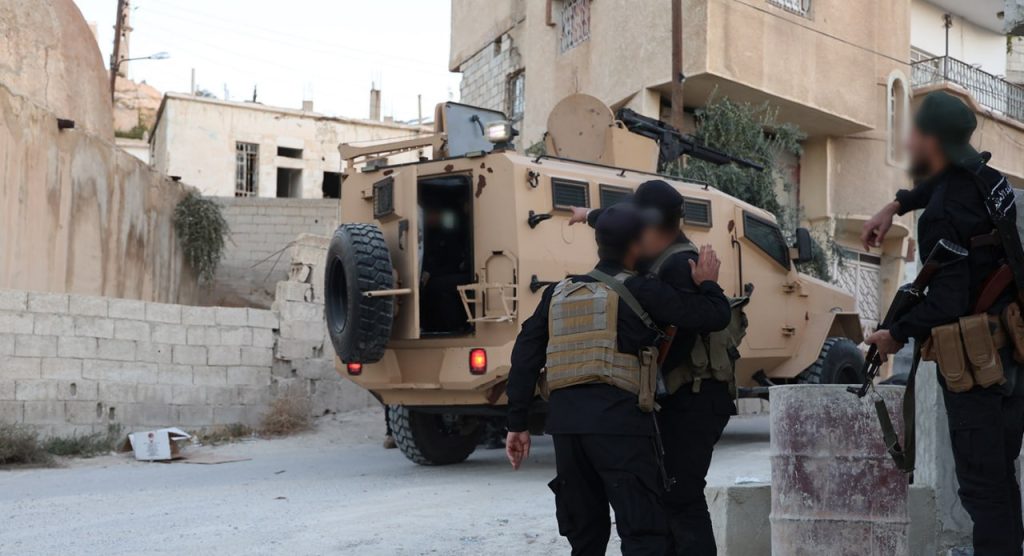
On September 9, Netanyahu visited the Syrian Mount Hermon area, declaring what he called “absolute control” over a strip extending from the summit of Mount Hermon to the Yarmouk River and stretching toward the Mediterranean Sea. He described the prevention of hostile military formations near the border as a major achievement for his government. At the same time, Israeli Defense Minister Israel Katz stated that Israeli forces would not withdraw from the “security zone” they occupy in Syria, according to The Jerusalem Post.
These statements indicate an intention to entrench an Israeli military presence on Syrian soil by linking it to a wider security doctrine that includes holding strategic positions and imposing arrangements across southern Syria, rather than limiting operations to temporary responses dictated by shifting security conditions.
Netanyahu had said in December 2025 that an agreement with Syria was possible, but he conditioned it on the creation of a demilitarized zone extending from Damascus to Mount Hermon. This position raises questions about the scope of Israeli demands, particularly if security arrangements evolve into structural constraints imposed on Syria within its own territory.
Domestic Opposition: Security Debates and Political Exploitation
Inside Israel, the controversy has widened. Opposition figures accuse Netanyahu of using security anxieties and military decisions to serve political interests, warning that such an approach risks exposing Israel to additional dangers.
On October 21, Yair Golan, leader of the Democrats party, urged IDF Chief of Staff Eyal Zamir and senior security officials to prevent Netanyahu from employing the military for political ends. Golan argued that the Prime Minister lacked legitimacy to launch a new military campaign on the eve of elections and warned against jeopardizing national security for political survival, according to the Anadolu Agency.
Golan had earlier criticized the August 19 Israeli strike on the Abu al‑Duhur military airbase in northwestern Syria, calling it a provocative act that strained relations with allies, particularly the United States. He accused Netanyahu of resorting to military force for political motives.
These criticisms extend beyond specific operations to encompass the timing of security decisions and their connection to electoral competition. On September 30, Opposition Leader Yair Lapid accused Netanyahu of stoking security fears ahead of the election, warning against turning security concerns into campaign propaganda. Golan and other opposition figures similarly condemned what they described as exploiting public fears to distract from government failures.
The debate intensified on October 19 when Netanyahu unveiled a new security doctrine that includes preemptive strikes and buffer zones along Israel’s borders. Lapid and Gadi Eisenkot, head of the Yashar party, dismissed the document as a collection of broad slogans rather than a detailed strategy capable of addressing Israel’s security challenges. Eisenkot accused Netanyahu of using fear to divert attention from his government’s record.
Incursions by the Numbers: Human Rights Violations and Civilian Impact
Documented data shows the expanding scope of Israeli operations inside Syria. The Syrian Network for Human Rights (SNHR) reported on October 8 that Israeli forces carried out at least 453 ground incursions between December 8, 2024, and October 6, 2026. The report recorded at least 69 deaths, 162 arbitrary arrests, and 22 incidents affecting vital civilian infrastructure.
Most incursions occurred in the Quneitra and Daraa governorates, with fewer in the Damascus countryside. Operations included entries into populated towns and villages, house raids, gunfire, and shelling. SNHR noted that the figures represent the minimum confirmed baseline.
In a separate metric, UN Human Rights Office spokesperson Shabia Mantoo announced on October 9 that roughly 280 Israeli incursions were documented inside Syria during September alone, the highest monthly count recorded since the beginning of the year.
The UN reported that these incidents included home raids, restrictions on civilian movement, arbitrary detentions, and disruptions to livelihoods. The UN Human Rights Office reiterated calls to halt actions that intimidate civilians or restrict movement, urging thorough investigations into incidents resulting in casualties.
The accumulated data indicates that these operations directly affect civilian life, freedom of movement, and economic stability, while creating risks of altering ground realities. They also raise questions about compliance with the 1974 Disengagement Agreement, which governs the separation of forces between Syria and Israel under UN supervision.
On October 18, the Syrian Ministry of Foreign Affairs condemned the escalating incursions in Quneitra and rural Daraa, as well as intensified helicopter flights, reconnaissance drones, and fighter jet activity over southern Syria. The Ministry warned that continued violations undermine prospects for stability and reconstruction, calling on the international community to intervene and enforce adherence to international law and relevant UN resolutions.
The incursions persist despite Syrian‑Israeli talks held in Amman on August 23 under U.S. mediation, which explored ways to halt strikes, detentions, and ground operations while attempting to revive negotiations over a security framework.
International Criticisms and Warnings
Criticism of Israeli operations in Syria extends beyond Damascus, drawing warnings from regional and international actors concerned about their impact on Syrian sovereignty and regional stability.
On October 19, Turkish President Recep Tayyip Erdogan warned that Israel was attempting to provoke chaos in Syria despite positive developments in the country, stating that Israeli attacks undermine Syrian sovereignty and complicate efforts to achieve regional stability.
Foreign ministers from 12 Arab and Islamic nations jointly condemned Israeli strikes on the Abu al‑Duhur airbase in Idlib, describing them as a dangerous escalation and a breach of Syria’s sovereignty and territorial integrity.
Saudi Arabia, Qatar, Jordan, Kuwait, Egypt, Türkiye, and the United Arab Emirates, along with the Arab League, had previously issued statements condemning Israeli operations around the “Sofa 53” line in Quneitra, asserting that they violate Syrian sovereignty and the 1974 agreement while threatening regional peace.
In the United States, Senator Joe Wilson warned on July 2 that continued Israeli operations inside Syria could prove counterproductive and ultimately harm Israeli interests, urging an end to the incursions.
Damascus Maintains Its Position on Dialogue and Sovereignty
Following the fall of the former regime on December 8, 2024, the Syrian leadership expressed readiness to resolve security concerns with Israel through diplomatic channels. Damascus advocates for arrangements that ensure stability and prevent escalation without compromising Syrian sovereignty or accepting imposed military realities on the ground.
A clear contrast remains between Damascus’s willingness to discuss pending issues and the ongoing expansion of Israeli military presence. The evolving situation demonstrates that these operations carry implications beyond Syrian territory: they constitute violations of sovereignty that draw international condemnation, while simultaneously serving as a contentious issue within Israel’s political debate over security management, timing, and strategic objectives.
As the Israeli elections approach, discussions over Israel’s military presence in Syria remain intertwined with internal disputes over executive security performance. With Damascus committed to dialogue within a framework that preserves territorial integrity, adherence to borders, cessation of incursions, and respect for international agreements remain essential prerequisites for any path toward de‑escalation and stability.
This article was translated and edited by The Syrian Observer. The Syrian Observer has not verified the content of this story. Responsibility for the information and views set out in this article lies entirely with the author.