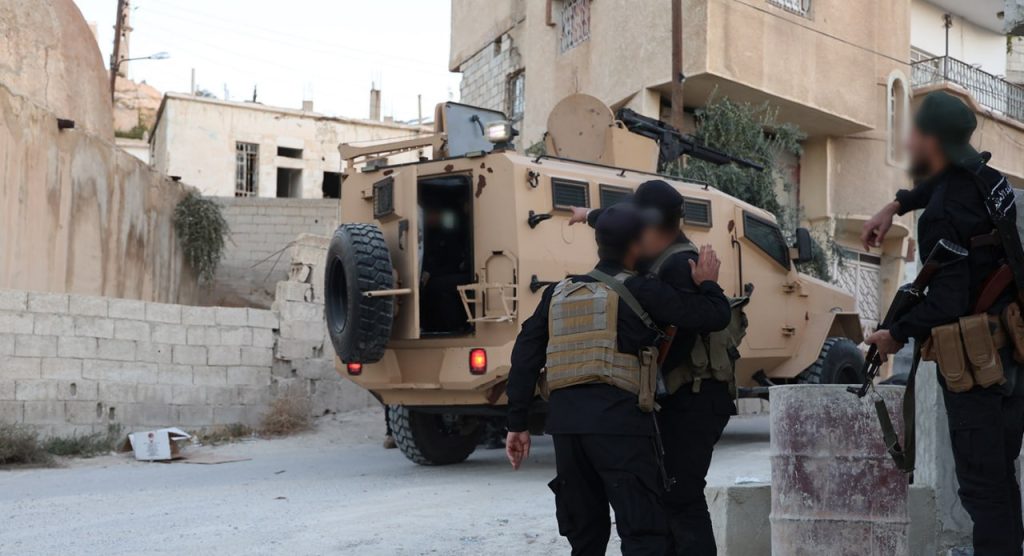
A coordinated security operation on October 22 in the town of Rankous, west of Damascus, marked one of the most significant confrontations this year between Syrian security forces and ISIS, a violent extremist organization responsible for grave human rights violations and widespread civilian harm. Internal Security Forces, working alongside the General Intelligence Service, raided an ISIS cell, killing five militants and arresting six others. Weapons and explosive belts prepared for imminent use were seized.
Two Internal Security members were killed and five wounded, representing the highest single‑day casualty toll among Syrian security forces in 2026. The intensity of the clashes, coupled with the presence of suicide belts, indicates that the cell consisted of trained operatives prepared for sustained resistance rather than a marginal group.
The Rankous raid came less than a week after authorities foiled a plot targeting a police patrol in rural Damascus, underscoring an accelerating tempo of preemptive operations against ISIS cells embedded in urban and semi‑urban environments. Throughout October, Syrian security agencies carried out multiple proactive raids across several governorates.
On October 6, authorities in Hajjira, south of Damascus, arrested Khaled Raed Biruni, known as “Abu Hassan Doushka,” identified as ISIS’s general military commander for what was formerly termed the “Homs Province.” Officials described him as the group’s operational arm in the area, responsible for planning sectarian attacks in Homs and overseeing the preparation of improvised explosive devices.
Three days later, on October 9, a cell was dismantled in the Houla region of northern rural Homs. Two individuals were arrested, and two IEDs intended for attacks on places of worship and security patrols were seized. Investigations revealed that one detainee was responsible for receiving and transporting explosives, while another had attempted to rig a railway track with explosives. On October 16, a joint operation disrupted a plot targeting a police patrol in rural Damascus, securing a ready‑to‑detonate device and arresting the suspects.
These operations formed part of a broader campaign announced by the Ministry of Interior, which reported 61 raids across multiple governorates, resulting in 71 arrests and the confiscation of weapons and explosives. The surge in activity followed a period of relative quiet during the summer months, when ISIS attacks declined sharply due to sustained pressure and logistical constraints.
ISIS, which relies heavily on mobility across the vast Syrian Badia, appears to be facing operational limitations. The summer lull reflected a recalibration to unfavorable field conditions rather than a cessation of intent. With the arrival of autumn, certain cells resumed low‑cost attacks, mostly in open terrain on the outskirts of cities or along transit corridors linking central governorates to the desert and eastern regions.
The most notable attack occurred on October 13 along the Salamiyah–Athriya road in eastern rural Hama, where gunmen suspected of ISIS ties ambushed two road security patrols, killing four personnel and injuring several others. A separate assault targeted the Al‑Hamra checkpoint nearby. The execution style — a swift ambush on motorcycles followed by immediate withdrawal — mirrored tactics ISIS has used in the desert in recent years.
In Deir ez‑Zor, the same period saw sporadic assassinations of security personnel, IED attacks on secondary roads, and incidents near the Iraqi border, including in Al‑Baghouz. Energy infrastructure also came under repeated attack. The Jibsa gas export pipeline suffered multiple strikes since August, while petroleum transport pipelines between Baniyas and Homs were damaged. Additional incidents were reported near Damascus. Some were classified as sabotage, while others remain under investigation.
ISIS has historically targeted oil and gas infrastructure for extortion or to demonstrate its ability to disrupt the economy. However, the rapid frequency and wide geographic spread of recent attacks raise the possibility of involvement by other actors, including smuggling networks or groups seeking to maintain instability.
Repeated attacks in the eastern Badia align with ISIS’s capacity to maneuver across open terrain and conduct low‑overhead operations that yield limited direct military gains but carry significant economic and psychological impact.
Taken together, these developments reveal a clear pattern: ISIS cells are being pushed onto the defensive in residential areas and suburbs, while attempting to maintain symbolic presence through low‑cost strikes in the desert and along highway corridors. Field data indicates that Syrian preemptive operations have penetrated the group’s urban networks, leading to the arrest of field commanders and the interception of explosives before detonation. As a result, planning complex attacks in populated centers has become significantly more difficult and costly for ISIS.
Improved intelligence capabilities have been central to this shift. The precision of the raids in Rankous, Hajjira, Houla, and rural Damascus reflects advancements in information gathering, analysis, timely deployment, and inter‑agency coordination.
The ability to strike ISIS cells before execution narrows the group’s operational space, forcing a pivot from offense to defense. In urban environments, survival has become increasingly precarious, prompting remaining operatives to seek safer havens — a dynamic that underscores the cross‑border dimension of the threat.
According to intelligence assessments, sustained pressure inside Syria is pushing portions of ISIS networks toward Iraq, where rugged terrain, vast spaces, and security gaps persist in certain areas, particularly around Kirkuk and parts of Diyala and Saladin. Increased activity recorded in those regions, especially in Kirkuk where ISIS carried out several notable operations during the same period, aligns with this outward shift.
This article was translated and edited by The Syrian Observer. The Syrian Observer has not verified the content of this story. Responsibility for the information and views set out in this article lies entirely with the author.