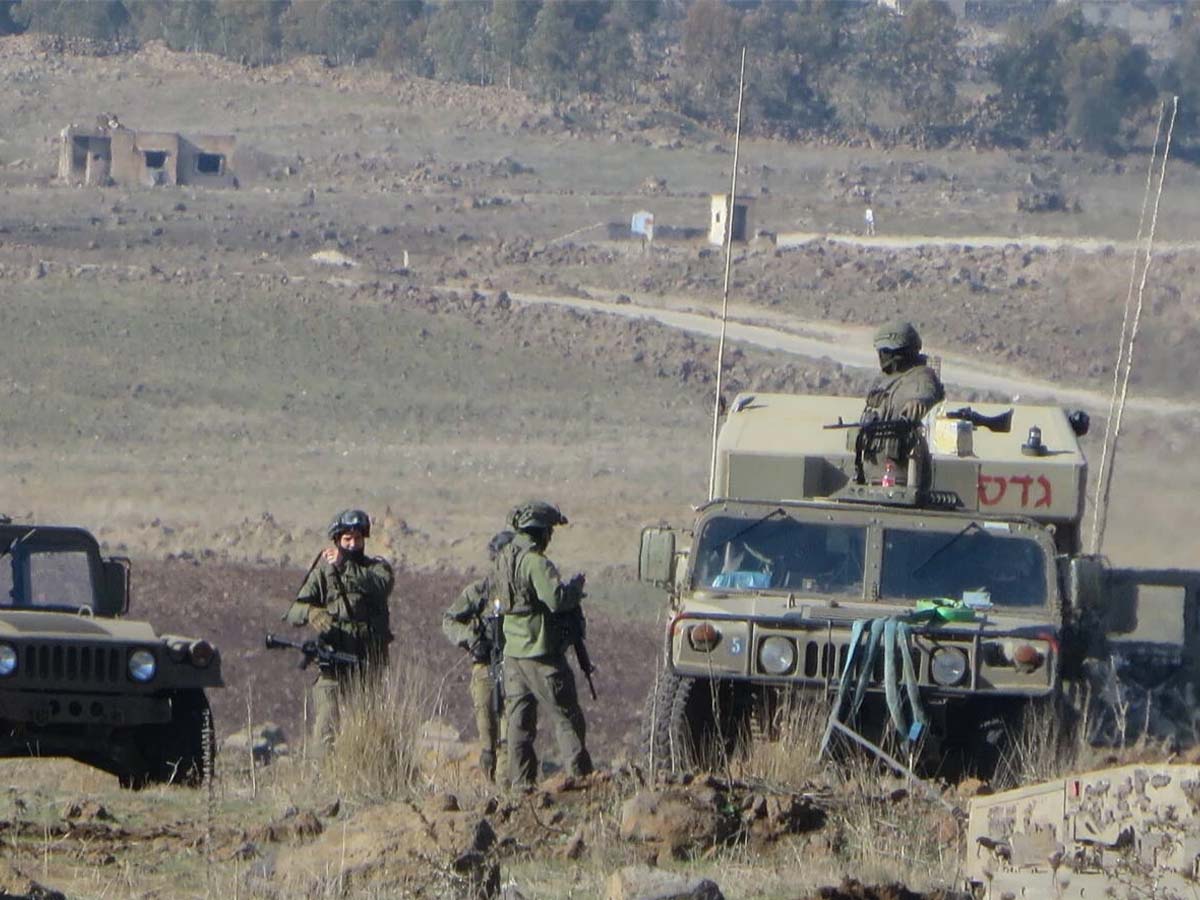
Increased Israeli military movements near dams and water basins in southern Syria have raised fears that their aims go beyond security and military considerations to an attempt to assert influence over the area’s water resources. These concerns center on the Yarmouk Basin and western rural Daraa, and on the Al-Mantara Dam in central rural Quneitra, amid repeated incursions, the setting up of barriers and checkpoints, and the movement of heavy engineering vehicles.
The developments come as water resources grow in importance as one of the most strategic issues in southern Syria. They are tied to the needs of residents and agriculture, and the basins and rivers extend into neighboring countries, opening the door to repercussions beyond Syria’s borders.
Repeated incursions near water sources
According to local sources, Israeli forces have stepped up their movements around a number of water sources since the beginning of November, carrying out repeated incursions that included setting up barriers and checkpoints. These moves have raised questions about the objectives they are meant to achieve, according to the newspaper Al-Nahar.
Amjad Al-Hajji, a journalist who specializes in documenting Israeli occupation violations in southern Syria, said Israeli vehicles had repeatedly and heavily entered the area around the Al-Mantara Dam, accompanied by two large cranes used for construction work. He said the nature of these movements raised fears and possibilities of Israeli projects aimed at transferring water from the dam toward the occupied Syrian Golan.
Mr. Al-Hajji added that the incursions were not limited to the vicinity of Al-Mantara Dam but extended to areas of the Yarmouk Basin, specifically the towns of Maariyah, Abdin and Jumla, reaching as far as Saysoun in western rural Daraa, as well as the village of Sayda Al-Golan in southern rural Quneitra.
Is Israel seeking to tighten its grip on water?
For his part, Mohammad Abu Sharifa, a researcher on Israeli affairs, said the latest Israeli incursions in southern Syria mainly aim to take control of the areas around water sources, in preparation for future projects that would allow Israel to establish direct control over those resources.
Mr. Abu Sharifa said Israel had intensified its incursions in areas where shared water resources between Syria, Jordan, Lebanon and Palestine intersect. He considered that these movements might be linked to efforts to take control of the Yarmouk River and its valley, which could also affect Jordan, since the river is one of its main water tributaries and a primary source of water for irrigating agricultural land.
These concerns are reinforced by the geographical location of Al-Mantara Dam, the largest dam in the Yarmouk Basin. An investigation by the Syrian Archive, in cooperation with the Information and Resilience Center in July 2026, showed that the dam serves around 120 Syrian villages and supports roughly 60 percent of agricultural land in Quneitra and western rural Daraa.
The investigation documented 33 incidents linked to Israeli forces’ movements around the dam between December 2024 and December 2025, including a military presence and restrictions on civilians’ access to water.
Satellite images reveal movements near Yarmouk tributaries
The indicators are not limited to military movements. An investigation by the website Masbar, published in October 2026 and based on analysis of satellite images, revealed Israeli excavation work and the construction of roads and earth berms near the town of Al-Rafid in rural Quneitra. These cut across watercourses and tributaries that flow into Wadi Al-Ruqqad, one of the tributaries of the Yarmouk River. The investigation pointed to fears about the impact of this work on water flow and agricultural land, without establishing the existence of a project to divert water to the occupied territories.
In parallel with the movements near water sources, the Sijil Center documented more than 40 Israeli violations since the beginning of November, spread across incursions, the detention of civilians and the setting up of checkpoints, in addition to intensified overflights.
In the same context, intensive Israeli military movements were observed toward the strategic Tal Al-Zuhour, which overlooks the town of Jbata Al-Khashab in northern rural Quneitra. The incursion force included two tanks and a number of other military vehicles.
41 percent rise in Israeli violations within a month
These developments follow a rise in violations in recent months. The Sijil Center documented 395 violations in October, compared with 280 in September, an increase of 115 violations, or about 41.1 percent. The center also noted that October’s total was the highest of 2026 up to the end of that month.
In a related context, the Syrian Observatory for Human Rights documented 182 Israeli incursions during the same month, reflecting the expansion of military activity in the area, though the two organizations classify incidents on different scales.
While no independent evidence has so far emerged of an Israeli project to transfer water from Al-Mantara Dam to the occupied Golan, the repeated military movements and engineering work near water facilities raise concerns about the future control of natural resources in southern Syria. They also raise the prospect of consequences for water and food security, particularly in Jordan, which also depends on the waters of the Yarmouk River.
Israeli movements in the south are thus no longer read solely as military expansion, but have begun to raise questions about the place of water in calculations of regional influence.
This article was translated and edited by The Syrian Observer. The Syrian Observer has not verified the content of this story. Responsibility for the information and views set out in this article lies entirely with the author.