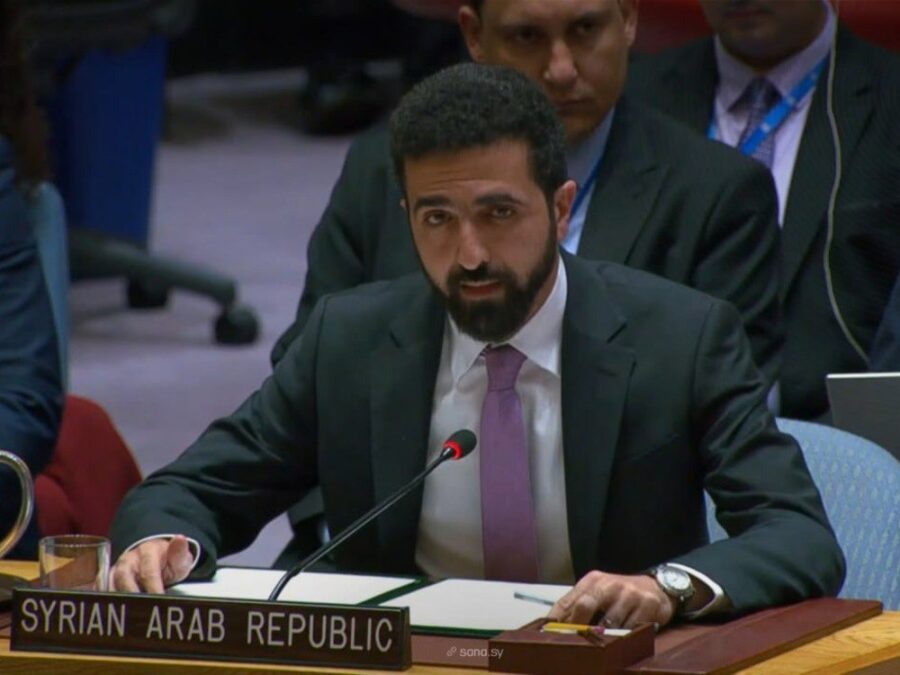
Syria’s Permanent Representative to the United Nations, Ibrahim Olabi, delivered a wide-ranging briefing to the UN Security Council on Tuesday, outlining political, security, and economic developments across the country. He asserted that Syria has entered a new phase focused on rebuilding state institutions, advancing transitional justice, and re-establishing its place within the international community.
Addressing the Council, Olabi said Syria is undergoing a historic, self-directed transformation, emerging from years of conflict to reclaim its regional and global standing. As an example of economic recovery, he highlighted the recent signing of two memorandums of understanding to rehabilitate the Kirkuk–Baniyas oil pipeline, a project he described as central to restoring Syria’s role as a regional hub for energy and economic cooperation.
On domestic governance, Olabi noted that the newly convened People’s Assembly reflects Syria’s diverse social fabric, with representation that includes former regime defectors, survivors of detention centers, tribal leaders, returnees, women, persons with disabilities, and advanced degree holders. He also pointed to the establishment of a seven-member Supreme Constitutional Court, including two women, calling it a foundational institution in the country’s political transition.
Turning to transitional justice, Olabi reaffirmed the government’s commitment to accountability and closure for victims. He said the heads of Syria’s transitional justice and missing persons commissions had participated in meetings at UN headquarters in New York, underscoring Damascus’s pledge to uncover the fate of missing persons and pursue accountability for violations.
Addressing recent events in Suweida province, Olabi offered condolences to the families of victims and confirmed that formal investigations and accountability procedures are under way. He said efforts are being made to ensure the return of displaced residents, safeguard civil rights, and maintain uninterrupted educational services.
On regional security, Olabi emphasized Syria’s determination to strengthen ties with neighboring states. He cited Foreign Minister Asaad Al-Shaibani’s recent visit to Lebanon as a demonstration of support for the Lebanese state and its people. Olabi also revealed that Syrian forces had intercepted an attempt to smuggle a large shipment of advanced weaponry near the Syrian-Iraqi border destined for Lebanon, stressing that Damascus will not allow Syrian territory to serve as a corridor for illicit arms or a battleground for regional conflicts.
He added that, in coordination with the United Nations Development Programme (UNDP), Syrian authorities have launched a national strategy to combat money laundering, terrorist financing, and proliferation financing in line with international standards.
Olabi described a broader diplomatic opening for Syria on the world stage, citing French President Emmanuel Macron’s visit to Damascus, Syrian President Ahmad Al-Sharaa’s meeting with US President Donald Trump, and the initiation of US procedures to remove Syria from its State Sponsors of Terrorism list. Economically, he noted that Syria welcomed approximately 3.5 million visitors during the first half of the year, marking a significant rise in foreign tourism.
Turning to regional tensions, Olabi accused Israel of continuing to violate Syrian sovereignty and destabilize the region. He stressed that Damascus remains committed to diplomatic engagement and de-escalation initiatives, while firmly rejecting any foreign occupation or infringement on its sovereign rights. He concluded by welcoming an upcoming visit to Damascus by UN Secretary-General António Guterres, describing it as evidence of Syria’s transition from a prolonged security crisis to a stabilizing sovereign state.
International officials attending the briefing welcomed the institutional progress. Claudio Cordoni, Deputy Special Envoy of the UN Secretary-General for Syria, described the convening of the People’s Assembly and the formation of the Supreme Constitutional Court as pivotal steps in advancing the transition, and called the process to remove Syria from the terrorism sponsor list a positive development for national recovery.
Edem Wosornu, Director of Operations at the UN Office for the Coordination of Humanitarian Affairs (OCHA), said conditions in Syria are increasingly conducive to shifting from emergency humanitarian relief to long-term recovery. She reported that approximately 1.7 million refugees and 1.9 million internally displaced persons have returned to their home areas since December 2024.
Delegates representing the United States, France, the United Kingdom, Russia, China, and Türkiye, along with other Security Council members, reaffirmed their support for Syria’s sovereignty, territorial integrity, and independence. Council members called for expanded international backing for recovery and reconstruction efforts, while urging Israel to abide by the 1974 Disengagement Agreement and withdraw from occupied areas in southern Syria.
This article was translated and edited by The Syrian Observer. The Syrian Observer has not verified the content of this story. Responsibility for the information and views set out in this article lies entirely with the author.